

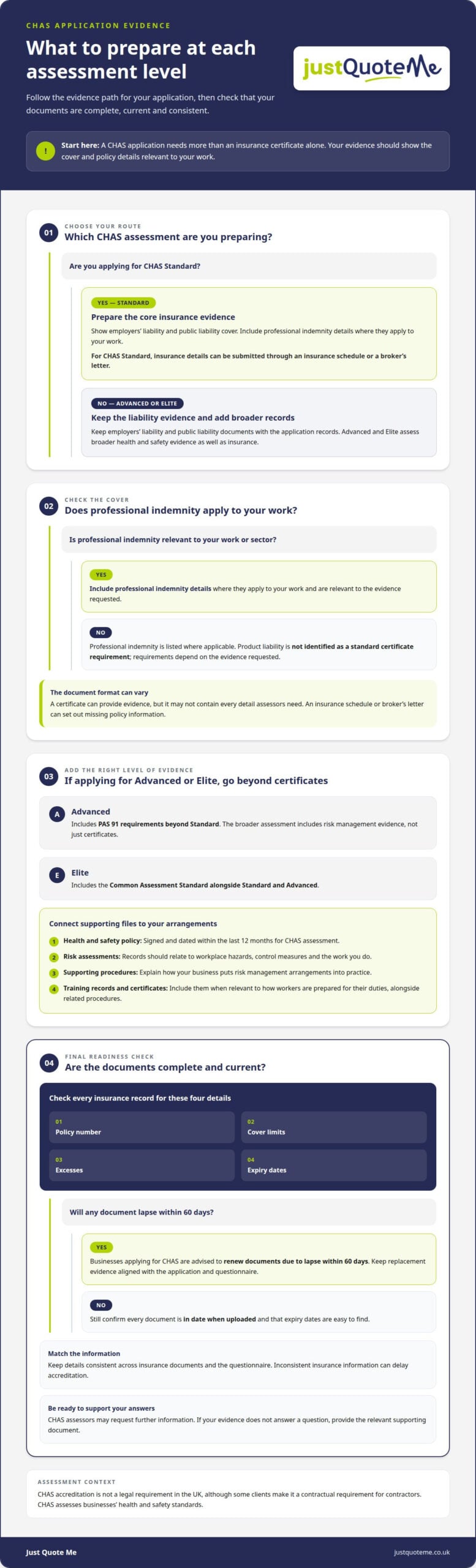
A CHAS application needs more than an insurance certificate alone. An insurance certificate for CHAS accreditation typically needs to show employers’ liability and public liability cover, with professional indemnity evidence where it applies to your work. For CHAS Standard, you can submit insurance details through an insurance schedule or a broker’s letter.
It’s useful to know which documents to prepare before you begin, especially when applying for a higher level. This article explains what insurance evidence to gather, which other business documents may be needed, and how evidence requirements extend for Advanced and Elite. It also explains why current, consistent documents matter to contractor compliance, helping you understand what the assessment looks for and prepare a complete application.
Key Takeaways
- Prepare evidence of employers’ liability and public liability cover, and include professional indemnity details where relevant to your work.
- Understand how evidence needs can extend for Advanced and Elite, so your application reflects the level you’re seeking.
- Review the wider business documents and expiry dates that can affect whether your application is ready for assessment.
- See how CHAS accreditation supports contractor compliance, and where suitable insurance cover fits into that picture.
Insurance certificates required for CHAS applications
CHAS applications typically require evidence of employers’ liability and public liability insurance. Professional indemnity details may also be relevant, depending on your work and sector.
Insurance Information for Applications
CHAS insurance information identifies your business’s cover and key policy details for assessment. For CHAS Standard, evidence should show policy numbers, limits, excesses and expiry dates. These details help demonstrate which cover applies to your work. An insurance certificate for CHAS accreditation should therefore provide clear, current information that matches your application.
Prepare employers’ liability and public liability certificates. Professional indemnity insurance may also be needed where it applies to your work. Whether an application requires professional indemnity or product liability insurance depends on the evidence requested. Professional indemnity is listed where applicable, while product liability is not identified as a standard certificate requirement.
Certificates and Policy Schedules
A certificate can provide insurance evidence, while an insurance schedule or broker’s letter can set out policy details. For CHAS Standard, submit employers’ liability and public liability details through an insurance schedule or a broker’s letter. Since a certificate may not include all the details required, make sure your evidence gives assessors the information they need.
Keep policy numbers, limits, excesses and expiry dates visible in the documents you submit. If a certificate omits a detail, an insurance schedule or broker’s letter can provide it. Inconsistent insurance information can delay accreditation.
CHAS accreditation is not a legal requirement in the UK. However, some clients make it a contractual requirement for contractors, so it can matter when bidding for work. CHAS, the Contractors Health and Safety Assessment Scheme, assesses businesses’ health and safety standards. Advanced and the Common Assessment Standard involve wider assessment requirements.
Additional insurance and business evidence for Advanced and Elite
Advanced and Elite assess more than insurance. Their broader requirements make clear, relevant health and safety evidence important.
Liability Insurance Evidence
For these applications, liability insurance evidence supports the insurance details considered alongside your health and safety arrangements. Keep employers’ liability and public liability documents with the relevant application records. This helps show assessors which policies relate to your business and its work.
CHAS assessors may request further information during an assessment. If your evidence does not answer a question, provide the relevant supporting document. Keep information consistent across your insurance documents and questionnaire.
Advanced includes PAS 91 requirements beyond Standard, while Elite includes the Common Assessment Standard alongside Standard and Advanced. These broader assessments cover risk management evidence, not just certificates. Training records and certificates can help demonstrate how workers are prepared for their duties when relevant to the business’s arrangements. Present them with the related health and safety procedures, rather than as disconnected files.
A health and safety policy for CHAS assessment should be signed and dated within the last twelve months. This shows the assessor that the policy is current. Your documents should also reflect how your business organises its arrangements, as CHAS assesses both policies and how those arrangements operate.
Current Insurance Evidence
Current insurance evidence means your documents are in date when uploaded for assessment. Expired documents can prompt a request for additional evidence, and CHAS accreditation does not establish that your insurance remains current. Make expiry dates easy to find in every uploaded file.
Businesses applying for CHAS are advised to renew documents due to lapse within 60 days. Keep replacement evidence aligned with the details in the application and questionnaire. For help considering suitable business insurance options, use a broker to discuss cover relevant to your work.
Other documents needed for CHAS applications
Insurance is one part of a CHAS application. Supporting business documents help show how your health and safety arrangements work in practice and whether they suit your activities.
A written health and safety policy and workplace risk assessments are important records to organise. According to UK Government, employers with five or more employees must have a written health and safety policy. The Management of Health and Safety at Work Regulations 1999 require UK employers to assess workplace risks. These documents can help explain how a business identifies hazards and manages them.
Supporting evidence should connect to the procedures described in your application. For example, a risk assessment should relate to the work you do, while associated procedures should explain how you manage identified risks. CHAS assessors review health and safety policies and arrangements, including how they are organised. Clear, relevant records help show that your written approach reflects your work.
- Health and safety policy: the written policy and its documented arrangements.
- Risk assessments: records addressing workplace hazards and control measures.
- Supporting procedures: documents that explain how the business puts its risk management arrangements into practice.
Document expiry dates matter beyond insurance. CHAS accreditation is valid for 12 months and must be renewed annually to maintain accredited status. A renewal application therefore benefits from an organised set of current documents, rather than records assembled only when a tender or procurement opportunity arises. Keeping policies, assessments and supporting evidence together can also make it easier to update the application when business activities change.
Before submitting, match each document to the relevant part of your application. Use clear filenames that describe the record, such as “workplace risk assessment” or “health and safety policy”. This distinguishes supporting evidence from unrelated files and helps assessors find the document explaining a particular risk management arrangement. If you apply through different schemes, a consistent set of documents can also simplify repeat procurement assessments.
CHAS certification and contractor compliance
CHAS certification is a health and safety assessment scheme, not simply an insurance document check. CHAS reviews policies and arrangements to assess how your business manages health and safety. Insurance records form one part of the wider compliance picture, alongside documents showing how procedures operate across your work.
CHAS Standard combines a health and safety assessment with SSIP accreditation. CHAS is a founding member of SSIP, the UK umbrella body for health and safety assessment schemes. This can help contractors demonstrate assessed compliance through a recognised scheme, rather than treating each buyer’s pre-qualification request as a separate exercise.
Higher levels add broader procurement evidence. CHAS Advanced includes PAS 91 requirements beyond Standard, while Elite includes the Common Assessment Standard. CHAS Elite assesses contractors across 13 risk management areas. That wider scope means the application needs to show how the business manages risks beyond insurance, with relevant policies and supporting records connected to its actual activities.
Assessment continues after you submit your documents. CHAS assessors may ask questions or request further information, so clear links between application answers and supporting evidence help explain your arrangements. Insurance details that do not match your application can delay accreditation. Buyers may also request current insurance certificates alongside a CHAS certificate, making up-to-date records useful beyond the assessment.
The practical takeaway is to treat CHAS as evidence of organised contractor compliance, not as a substitute for the underlying records. A certificate demonstrates an assessment outcome; it does not keep insurance information current or replace the policies and procedures that support safe work. For cover that fits your contracting activities, explore business insurance options as part of your compliance planning.
Just Quote Me
Just Quote Me can help you consider business insurance that reflects your work and supports the evidence you need for CHAS. If your activities have changed or your policy details need updating, tailored advice can help you understand suitable cover options. These may include Public Liability Insurance, Employers Liability Insurance or Professional Indemnity Insurance, depending on your business and its work. Insurance advice does not replace CHAS’s assessment, but clear, appropriate cover information can help you prepare your application documents. For a practical discussion about your business insurance needs, contact Just Quote Me.
Keep your compliance plans moving
As your work develops, review whether your insurance records still reflect your activities. Treating the insurance certificate for CHAS accreditation as part of your wider business documentation can help keep your preparation aligned with changing project needs.
Get Your Free Business Insurance Quote now, or Request a Call back for free Expert advice. Choose the next step that suits you and keep building your compliance plans with confidence.
Frequently Asked Questions
What Documents Do I Need for CHAS?
Prepare insurance evidence, health and safety documentation, and supporting records relevant to your work. This may include employers’ liability and public liability insurance details, a written health and safety policy, and workplace risk assessments. For Advanced or Elite, the wider assessment may require evidence across additional risk management areas. Organise documents so each application response clearly connects to its supporting record.
What insurance certificates does CHAS require for accreditation?
Evidence of employers’ liability and public liability insurance is typically needed for a CHAS application. For CHAS Standard, submit those details through an insurance schedule or broker’s letter. Professional indemnity evidence may be relevant where it applies to your work. The appropriate evidence depends on your activities and assessment level, so keep relevant policies and supporting documents together.
What minimum public liability insurance cover does CHAS require?
CHAS does not specify one public liability limit for every applicant. The relevant requirement can depend on your work and the buyer’s procurement conditions. Compare the limit shown in your application evidence with the contract or tender requirements. For assessment, the policy limit must be clearly documented and consistent with the information submitted.
Does CHAS require employers’ liability insurance and what is the minimum cover?
Evidence of employers’ liability insurance is typically required for CHAS applications. CHAS does not specify one minimum cover figure that applies to every applicant. Keep the policy evidence with your application, and make sure the stated limit and policy details are clear. Your circumstances and any relevant buyer requirements shape the evidence needed.
What information must an insurance certificate show for a CHAS application?
Make the policy number, cover limit, excess and expiry date easy to find. These details help the assessor identify the policy and understand the cover being evidenced. For example, if a certificate shows the limit but not the excess, include supporting schedule information where available. Consistent details across the certificate, schedule and application help prevent avoidable questions.
How current must insurance documents be when applying for CHAS accreditation?
Submit insurance evidence that remains in date at the time of assessment. Expired documents can lead assessors to request additional evidence, and CHAS accreditation does not confirm that a policy is still current. If a policy is due to lapse within 60 days, renew it and use the updated evidence. This helps keep submitted details aligned with active cover.
