

Could a crack in your commercial property lead to a claim shortfall rather than a straightforward repair? The answer may depend on the cause of the movement and the wording of your policy. Subsidence cover for commercial property isn’t something to assume: exclusions, excesses and how damage is assessed can all affect what happens if you make a claim.
It’s understandable to want clear answers before damage appears or an insurance renewal comes around. Subsidence, heave and landslip describe different types of ground movement, and policy terms may treat them differently. Knowing what to review can help you explain your concerns and property history clearly when discussing cover.
This guide outlines how subsidence cover may work, which policy details and property information deserve attention, and what to have ready for an insurance conversation. You’ll also find practical ways to think about evidence requirements and potential claim shortfalls without assuming that every policy offers the same protection. Just Quote Me is an independent UK insurance broker with over 30 years of industry experience, helping businesses make sense of commercial property insurance and discuss cover tailored to their needs.
Key Takeaways
- Learn how subsidence differs from heave and landslip, and why identifying the type of movement matters when discussing cover.
- Compare the insured property, policy wording, exclusions, excess and claim conditions before deciding whether subsidence cover for commercial property fits your needs.
- Record signs such as cracks or sticking doors as observations, not proof of subsidence, and follow your policy’s notification requirements.
- Gather details of the building’s history, previous movement, repairs, inspections and existing insurance to support a clearer review.
- See how a broker can use your property’s details and insurance priorities to help shape a tailored commercial property insurance conversation.
What does subsidence cover for commercial property mean in the UK?
Cracks or other signs of movement can raise urgent questions about how a commercial building is protected. Subsidence means downward movement of the ground supporting a building, which may cause damage to the structure. The definition of subsidence helps distinguish this from other forms of ground movement, but visible signs alone can’t confirm the cause.
Subsidence cover for commercial property refers to protection for insured damage caused by ground movement, where the policy wording and circumstances allow a claim. The exact terms matter: cover may have specific definitions, exclusions, excesses or conditions. Buildings cover relates to the insured premises. It doesn’t automatically mean that contents, stock, equipment or business interruption losses are included; those protections depend on the policy arrangements.
How does subsidence differ from heave and landslip?
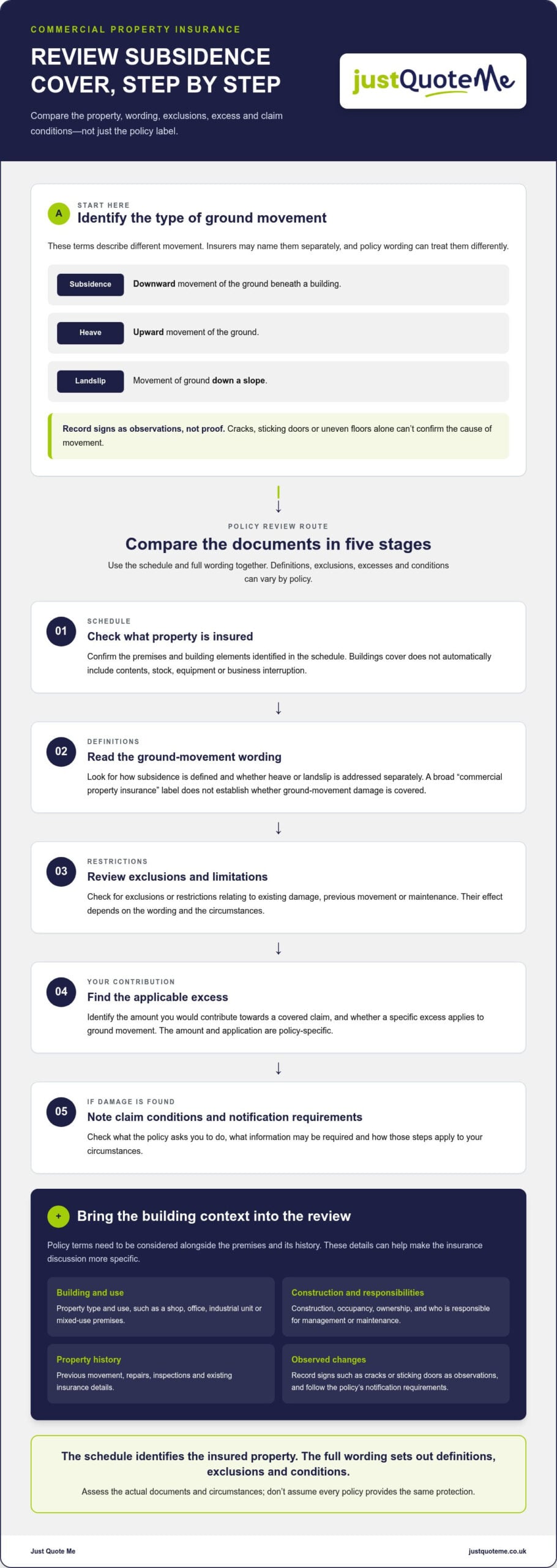
These terms describe different types of movement. Subsidence is downward movement of the ground beneath a building. Heave is upward movement of the ground, while landslip is the movement of ground down a slope. Insurers may name these risks separately because each describes a different movement and policy wording can set out how they’re treated. A crack, sticking door or uneven floor is an observation to record, not proof of any one cause.
Which commercial property details shape the cover discussion?
A useful review starts with the building and how it’s used. A shop, office, industrial unit or premises with mixed uses may present different details for an insurer to consider. Construction, occupancy, ownership and the division of management or maintenance responsibilities can also affect the conversation. For example, an owner who leases a building may need to clarify which parts of the premises they’re responsible for maintaining.
That context helps avoid relying on a generic answer. The policy schedule identifies the insured property and selected cover, while the full wording explains definitions, exclusions and conditions. A broad label such as “commercial property insurance” doesn’t, by itself, establish whether damage linked to subsidence is covered. Review the schedule and wording together, and relate them to the building’s use and history. Just Quote Me arranges commercial property insurance and can help bring those details into a tailored insurance discussion.
Which commercial property policy terms should you compare for subsidence?
A policy’s headline description won’t tell you exactly how a subsidence claim would be treated. Compare the schedule and full wording side by side, paying attention to what is insured, how ground movement is described, and what conditions apply. Definitions and exclusions can differ between insurers, so there’s no single answer that applies to every commercial building.
| Policy detail | What to compare |
|---|---|
| Insured property | Check the premises and building elements identified in the schedule. Don’t assume contents, stock, equipment or business interruption are included in buildings cover. |
| Subsidence wording | Look for how subsidence is defined and whether the wording addresses heave or landslip separately. |
| Exclusions | Review exclusions or restrictions that may relate to existing damage, previous movement or maintenance. |
| Excess | Find the amount that you would contribute towards a covered claim, and whether a specific excess applies to ground movement. |
| Claim conditions | Note any requirements about notification, information or other steps, and how they apply to your circumstances. |
Do commercial property policies automatically cover subsidence?
No. Don’t assume it’s covered because a policy provides general property damage protection or is described broadly as commercial property insurance. The schedule, policy wording, conditions and circumstances of the damage all matter. A restriction or exclusion may affect how a claim is considered. Compare the actual documents, rather than relying on a summary or headline description. The specific terms establish the protection, not the label alone.
For an overview of commercial property insurance cover, consider how the policy addresses the building and its particular use. Public liability insurance is separate: it concerns liability to third parties, not damage to the insured premises itself. Don’t treat one as a substitute for the other.
Which exclusions, excesses, and conditions deserve attention?
Read carefully for wording about previous movement, existing damage and maintenance. These details may be relevant to how an insurer assesses a claim, but their effect depends on the policy. Check notification requirements too, so you know what the wording asks you to do if you discover possible damage. An excess is your specified contribution towards a claim that falls within cover; the amount and application are policy-specific, not a universal market rule.
For wider background on land stability in planning and development, see Official UK government guidance on land stability. It provides context, but it doesn’t determine the terms of an insurance policy.
What should you do if a commercial building shows signs of movement?
Possible movement can be concerning, but a visible sign doesn’t establish its cause or confirm that a claim will be covered. Take a measured approach: record what you’ve observed, keep relevant property documents together, review your policy, then follow its notification instructions. This gives you a clearer account to share when discussing subsidence cover for commercial property.
What signs and records can help explain the situation?
Make a dated record of changes without trying to diagnose them. Note where a crack appears, its visible pattern and whether you’ve observed any change over time. Sticking doors or windows can also be logged as observations, not proof of subsidence. If you take photographs, include enough context to identify the location, and keep them with your notes.
A simple timeline can help explain when signs first appeared and what has happened since. Gather relevant repair records, inspection reports and other documents about the building’s condition or previous movement. Keep copies accessible, and avoid presenting an assumption about the cause as an established fact.
Assessment may require input from an appropriate property professional, depending on what is observed and the circumstances. A surveyor or structural engineer may be involved, but there isn’t one investigation that suits every building. Professional assessment can help distinguish between possible causes and establish what further information is useful.
How should a policyholder approach a potential claim?
Read the policy’s instructions for reporting possible damage, including any stated timeframes, and follow them. If you’re unsure which part applies, use the policy contact details to ask about the relevant notification process. Don’t assume that recording the issue or arranging an inspection alone fulfils any policy requirement.
Once notified, the insurer can explain what evidence or assessment steps are relevant to that particular case. These may depend on the policy wording, the reported damage and the information available. Keep a note of communications and retain copies of anything you send. The insurer’s assessment will determine how the policy applies; an initial notification doesn’t guarantee claim acceptance, a particular repair or a fixed timetable.
Clear records can support a more informed discussion, but they don’t replace the policy terms or a professional assessment. Keep the account factual, share relevant documents as requested, and let the insurer explain what applies to your circumstances.
How can you prepare your commercial property for a subsidence insurance review?
A well-organised record helps an insurer understand the building and the cover you’re seeking. Before a renewal or a new insurance discussion, gather the information you have about the premises, its history and any previous movement. Accurate disclosure supports an informed assessment of subsidence cover for commercial property, but it can’t guarantee a particular policy decision or prevent future damage.
What information should a commercial property owner organise?
Keep a practical file of relevant details and documents. You may not have every item, but clear records make it easier to explain the property and respond to case-specific questions.
- Property details: the premises’ use, construction information, occupancy and your ownership or management responsibilities.
- Movement history: notes about known signs of movement, when they were observed and any related assessments.
- Repairs and inspections: inspection reports, repair invoices, photographs and available records of work carried out.
- Insurance documents: the current and previous policy schedules and wording, plus relevant correspondence about the property or earlier claims.
If you’re acquiring a building, organise the property information and insurance documents available to you. For a renewal, update the file with changes to the building, its use, occupancy, repairs or inspections since the last review. An insurer or broker may need more detail depending on the property and its circumstances.
How can property history affect an insurance discussion?
Disclose known previous movement and repairs accurately, including what was observed, what work was completed and any assessment records you hold. Avoid describing a suspected cause as confirmed unless a professional assessment established it. Insurers may consider the building’s history when assessing requested cover and setting individual terms. Previous movement doesn’t automatically mean the same outcome for every property; the decision depends on the information, policy terms and circumstances.
Useful maintenance and inspection records can provide context about how the property has been managed. They aren’t a guarantee that damage or a claim will be avoided. Keep the information factual and distinguish documented findings from assumptions. That gives the insurance conversation a clear starting point and helps relate the building’s details to the cover being considered.
Prepare for a tailored review of your premises and insurance needs with Just Quote Me’s commercial property insurance guidance.
How can a broker help arrange commercial subsidence cover?
Ground movement can make commercial property insurance feel difficult to assess, particularly if the building has a history of repairs or previous concerns. An insurance broker can help organise the discussion around the premises, how it’s used, its history and the protection you’re looking for. That creates a clearer basis for considering subsidence cover for commercial property, without assuming that every insurer will offer the same terms or reach the same decision.
Just Quote Me is an independent, FCA-authorised UK insurance broker with over 30 years of industry experience. It arranges commercial property insurance and has access to a broad network of UK insurers. The broker can help make specialist policy wording easier to understand and connect the property’s circumstances with an individually tailored insurance conversation. Cover, terms and insurer decisions depend on the information provided and the individual risk.
What happens during a tailored commercial property insurance discussion?
The conversation starts with the building and your priorities. Useful context can include the premises’ use, construction, occupancy, ownership or management responsibilities, and any known movement or repairs. You can also explain what you want the insurance to protect and raise questions about how subsidence, heave or landslip appear in policy wording.
With those details in view, a broker can help consider relevant insurance options and explain the terms to review. Insurers assess each property using its specific information, so terms and decisions aren’t guaranteed in advance. A straightforward discussion helps identify what is known, what documents are available and which points need careful attention.
What are the next steps for a commercial property owner?
Before starting, gather the property details, relevant inspection or repair records, existing insurance documents and any available history of movement. Make a short list of questions, such as which premises are insured, what exclusions or excesses apply, and what the policy says about notification. Clear information helps keep the conversation focused and supports a more tailored review.
Ready to discuss your business insurance needs? Get Your Free Business Insurance Quote now.
If you’d prefer to talk through the property’s circumstances and policy questions, Request a Call back for free Expert advice.
Take the next step towards clearer property cover
Subsidence cover for commercial property depends on the policy wording, the building’s history and the circumstances of any damage. Compare the schedule, exclusions, excess and claim conditions, and keep factual records of movement, inspections and repairs. If signs appear, follow the notification instructions in your policy rather than assuming what caused them or what a claim will cover.
A clear insurance conversation starts with accurate details about your premises and the protection you need. Just Quote Me is an FCA-authorised UK insurance broker, founded in 1989, with over 30 years of industry experience and access to a broad network of UK insurers. The team can help you discuss commercial property insurance in light of your individual circumstances, without assuming a particular insurer decision or outcome.
Ready to take action? Get Your Free Business Insurance Quote now, or Request a Call back for free Expert advice. You can also explore insurance support from Just Quote Me. A well-prepared conversation is a practical next step towards understanding your options.
Frequently Asked Questions
Is subsidence covered by commercial property insurance in the UK?
It may be, but you shouldn’t assume subsidence is automatically covered. The policy schedule and full wording determine which premises and damage are insured, and whether exclusions, excesses or conditions affect a claim. Review the documents together, including any terms that refer specifically to subsidence, heave or landslip. The circumstances and evidence for a particular claim also matter, so a general policy description can’t confirm the outcome.
What is the difference between subsidence, heave, and landslip?
Subsidence is downward movement of the ground supporting a building. Heave is upward ground movement, while landslip describes ground moving down a slope. Insurers may use these terms separately because they describe different types of movement and may be addressed differently in policy wording. Visible damage alone can’t establish which type has occurred. A suitable professional assessment may be needed to identify the cause and explain the building’s condition.
What signs might indicate subsidence in a commercial building?
Possible signs to record include cracks in walls, changes in existing cracks, doors or windows that begin sticking, and uneven floors. These observations can have different causes, so they don’t prove subsidence on their own. Note where and when you noticed each change, and take dated photographs if useful. A clear timeline can help explain the situation, while a property professional may be needed to assess what is causing it.
Does a previous subsidence claim affect commercial property cover?
A previous claim or known movement may be relevant to an insurer’s assessment, but it doesn’t automatically determine the outcome. Insurers may consider the building’s history, any investigation or repairs, and the information available when assessing requested cover and terms. Disclose the history accurately and provide relevant reports, invoices or insurance correspondence. Avoid assuming that previous movement always prevents cover or leads to the same terms for every property.
What information should I provide when arranging subsidence cover?
Provide accurate details about the premises, including its use, construction, occupancy and your ownership or management responsibilities. Share known movement history, previous inspections, repair records and relevant photographs. Existing policy schedules, wording and correspondence can also help explain the property’s insurance background. The insurer or broker may need further details based on the building and its circumstances. Clear records help support a tailored discussion, but don’t guarantee a particular decision or policy term.
What should I do if I suspect subsidence at my business premises?
Record what you’ve observed, including dates, locations and any changes over time. Keep photographs and relevant inspection or repair documents together, then review your policy and follow its notification instructions and timeframes. Don’t treat cracks or sticking doors as proof of subsidence, and don’t assume a claim will be accepted. The insurer can explain what information or assessment steps are relevant to your specific circumstances and policy.
Can commercial property insurance cover subsidence damage to a rented building?
It can depend on who owns or insures the building, the responsibilities set out in the rental arrangements and the policy terms. A property owner should review the insured premises and schedule, while a tenant should understand which property and interests their own policy covers. Don’t assume that a tenant’s contents or business cover also protects the building, or that the owner’s policy covers every tenant loss. Check the relevant documents and responsibilities.
