

A standard landlord policy is often a ticking time bomb the moment a group of students moves into your property. Many providers see the word “student” and immediately hike premiums or, worse, offer generic cover that doesn’t actually protect a multi-occupancy setup. Finding reliable landlord insurance for student properties shouldn’t feel like a gamble against fine print. It requires a specialist approach that understands the unique risks of high-turnover, shared living environments while keeping your overheads manageable.
You’ve probably noticed that the rental market feels more restrictive than ever, with new 2026 licensing thresholds and the abolition of Section 21 making the administrative burden feel overwhelming. We’re here to show you how to secure bespoke protection that balances the speed of an online quote with the deep insight of a broker with 30 years of industry experience. This guide explores how to manage the 2026 legal landscape, ensure your HMO is fully compliant, and find cover that actually pays out when it matters most.
Key Takeaways
- Understand why standard policies often fail multi-occupancy rentals and how to secure specialist landlord insurance for student properties that fits your specific risk profile.
- Navigate the updated 2026 HMO licensing requirements and the latest safety thresholds to ensure your student rental remains legally compliant and fully covered.
- Learn how to accurately calculate rebuild costs in the 2026 market to avoid underinsurance while protecting communal assets against high-turnover wear.
- Discover the essential property and tenant details needed to transition from a generic quote to a bespoke insurance solution that reflects your actual rental situation.
- Leverage 30 years of expert brokerage insight to bridge the gap between digital speed and the personalized advice required for complex student portfolios.
Understanding Student Landlord Insurance: Why Standard Cover Fails
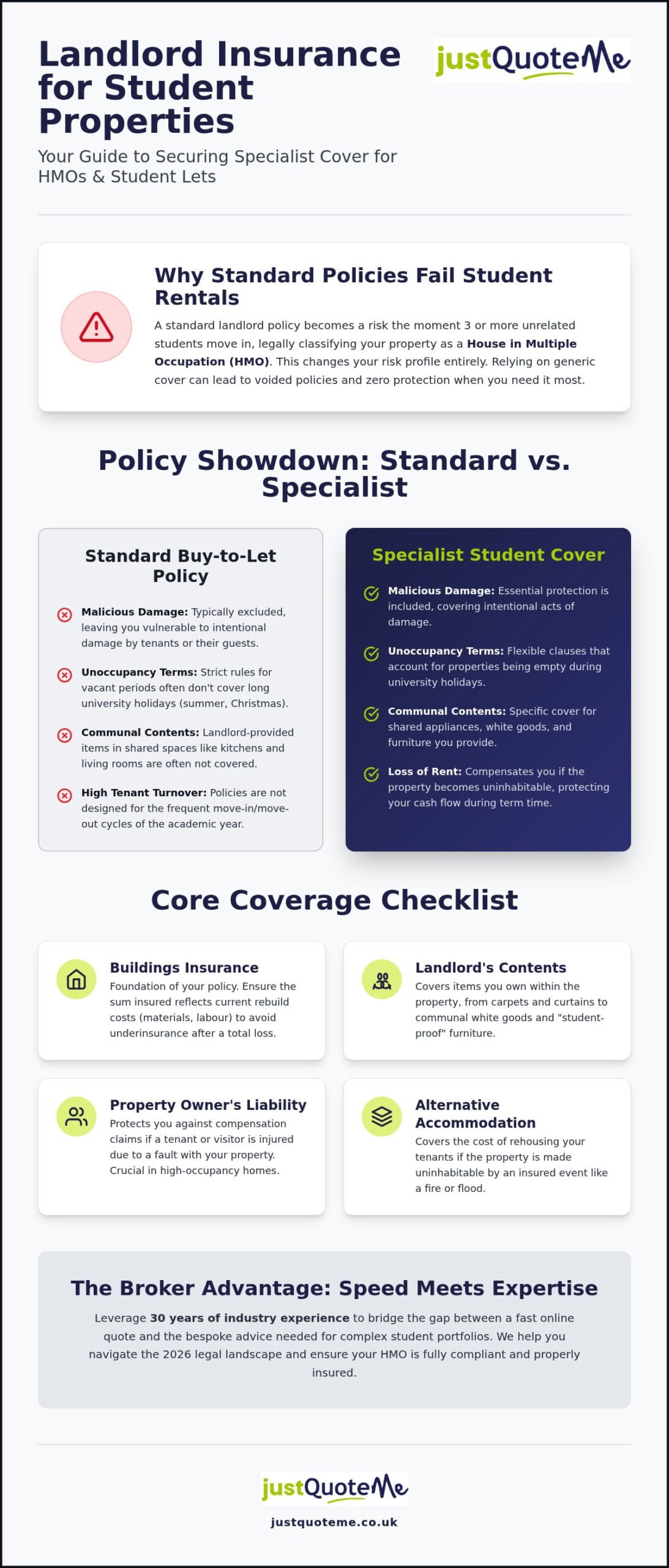
Student landlord insurance isn’t a luxury; it’s a structural requirement for any property housing three or more unrelated individuals. While a standard buy-to-let policy works for a single family, the legal shift to a House in Multiple Occupation (HMO) changes your risk profile in the eyes of an underwriter. Most standard insurers view students as a high-risk category. If you don’t declare the tenant type accurately, you risk having your entire policy voided when you need it most. Specialist landlord insurance for student properties is designed to bridge this gap, offering protection that accounts for the specific dynamics of shared student living.
The “household” rule is often where landlords get caught out. Under UK law, if three or more tenants form more than one household and share facilities, the property is classified differently. This classification triggers specific safety regulations and a different insurance category. Failing to secure landlord insurance for student properties specifically means you’re likely paying for a policy that offers zero protection for your investment. Specialist cover treats your property as a high-turnover business asset, providing the robust liability and damage protection that a standard residential policy simply isn’t built to handle.
The Risk Profile of Student Tenants in 2026
Students bring a unique set of challenges that differ from long-term professional tenants. In 2026, landlords face higher accidental damage risks because student properties often house more people per square metre than a typical family home. Frequent move-in and move-out cycles at the start and end of academic years accelerate wear and tear on carpets, walls, and communal fixtures. There’s also the matter of liability. With multiple tenants using shared kitchens and bathrooms, the chance of a small mishap turning into a major liability claim increases significantly. You need a policy that anticipates these frequent interactions and the potential for increased maintenance.
Standard BTL vs. Specialist Student Cover
Standard BTL policies often contain strict exclusions regarding malicious damage by tenants or unoccupied periods. Student properties are notorious for being empty during summer months or Christmas breaks. A specialist policy accounts for these void periods, ensuring you remain covered even when the students are home for the holidays. While residential letting insurance provides a solid foundation for many landlords, student-specific cover adds layers of protection for communal white goods and furniture that standard policies ignore. Key advantages of specialist cover include:
- Malicious Damage: Protection against intentional damage caused by tenants or their guests.
- Unoccupancy Terms: Flexible rules for properties left empty during university holidays.
- Communal Contents: Specific cover for shared appliances and furniture provided by the landlord.
- Loss of Rent: Compensation if a property becomes uninhabitable due to an insured event, which is vital for maintaining cash flow during term time.
Choosing the right cover means looking beyond the cheapest premium. It’s about ensuring your policy remains valid regardless of how many students share the kitchen or how long the house sits empty in August. For landlords aiming to provide premium housing, you can learn more about Unipad and their approach to luxury student accommodation.
Securing the right buildings insurance remains the foundation of your policy, but 2026 presents specific challenges regarding valuation. Rebuild costs have shifted significantly due to inflation in material prices and specialist labour rates. If your sum insured hasn’t been updated recently, you risk being underinsured in the event of a total loss. Beyond the structure, subsidence protection is a critical component, especially for older properties often converted into student housing. Ensuring your landlord insurance for student properties reflects current market rebuild values is the only way to fully protect your equity.
Your contents cover needs to be equally robust. In a student rental, you aren’t just covering a sofa; you’re protecting communal white goods, integrated appliances, and “student-proof” furniture designed for heavy use. While students are responsible for their own belongings, you’re responsible for the items that make the house habitable. If a fire or flood renders the property unlivable, your legal duty to provide alternative accommodation for your tenants can be financially devastating. A specialist policy handles these relocation costs, alongside protecting your loss of rent during term-time, ensuring your cash flow remains steady even when the property is empty for repairs.
Compliance with official HMO licensing requirements often dictates the level of safety equipment you must maintain, such as fire doors and industrial-grade alarm systems. Your insurance should align with these standards to ensure a claim isn’t rejected on the grounds of non-compliance. If you’re unsure if your current setup meets these benchmarks, you can speak with a broker to review your specific portfolio requirements.
Public Liability for Student HMOs
Shared facilities like communal kitchens and steep staircases in older conversions naturally increase the likelihood of third-party injury claims. Students often have guests over, which further raises your liability profile. While some basic policies offer £2 million in cover, this is often insufficient for student blocks in 2026. Rising legal settlement costs and the complexity of multi-tenant claims mean that a £5 million limit is now the recommended standard for many providers. You can find more detail on these protections through our dedicated Public Liability Insurance page.
Essential Extras for Student Landlords
Accidental damage is a non-negotiable addition for any student let. Whether it’s a red wine stain on a carpet or a smashed window, these incidents happen more frequently in high-occupancy homes. Legal expenses cover is also vital in 2026, especially with the complexities of the Renters’ Rights Act. This cover supports the costs of tenant disputes or necessary eviction proceedings. Finally, emergency home cover provides 24/7 support for boiler breakdowns and plumbing issues. It keeps your tenants happy and prevents small leaks from turning into major structural claims while you’re off-site.
HMO Licensing and 2026 Regulatory Compliance
Local councils have significant power in 2026, and their specific rules can dictate whether your insurance remains valid. While mandatory licensing applies nationwide to properties with five or more tenants, many university towns have introduced “Additional Licensing” schemes for smaller groups. If you’re renting to three or four students, you must check your local authority’s rules before securing cover. For insurers, a valid license is a binary condition. If the council requires a license and you haven’t secured one, your landlord insurance for student properties is effectively void from the moment the tenants move in.
The Renters’ Rights Act, which came into force on May 1, 2026, has fundamentally changed the landlord-tenant relationship by abolishing Section 21 “no-fault” evictions. This shift makes legal expenses and rent guarantee cover more critical than ever, as landlords must now rely on specific legal grounds to regain possession of a property. Insurers now look closely at how you manage these new legal obligations. A specialist broker helps you navigate these changes, ensuring your policy accounts for the potentially longer and more complex repossession timelines introduced by the 2026 legislation.
Fire Safety and Health Standards
In student lets, fire safety isn’t just about a few smoke alarms. You need mains-wired, interconnected systems and specific fire door ratings that meet the 2026 “Large HMO” safety thresholds. Insurers require up-to-date documentation, including a valid Electrical Installation Condition Report (EICR) and an annual Gas Safety Certificate. Maintaining these isn’t just a legal duty; it’s a core insurance requirement. Brokers often view landlords who perform termly inspections more favourably, as this proactive approach reduces the likelihood of catastrophic claims and demonstrates a commitment to property maintenance.
Insurance Implications of Non-Compliance
An unlicensed HMO is essentially uninsurable in the UK market. If a fire occurs and the property is found to be unlicensed or non-compliant with room size standards, such as the national minimum of 6.51m² for a single person, the insurer will likely reject the claim in its entirety. In insurance terms, your Statement of Fact is a legally binding declaration where you confirm that you are fully compliant with all local and national licensing laws. Falsifying this information, even unintentionally, constitutes a breach of your duty of fair presentation and leaves your high-value asset completely unprotected.
How to Secure a Bespoke Student Property Quote Online
Securing a quote for landlord insurance for student properties requires more precision than a standard home policy. While aggregator sites offer speed, they often fail to capture the nuances of multi-occupancy risks. To get an accurate price that actually protects your investment, you need to follow a structured approach that moves from basic data to specialist underwriting. A generic quote might save time today, but it could leave you with significant coverage gaps if a claim arises later.
Step 1 involves gathering specific property details. In 2026, rebuild values are more volatile than ever, so don’t rely on figures from two years ago. You’ll also need to specify construction details, such as whether the roof is standard slate or a flat felt design, as this heavily affects the subsidence and fire risk profile. Step 2 focuses on your tenants. Undergraduates often carry a different risk weight than postgraduates or international students due to perceived lifestyle differences and turnover rates. Be prepared to document the exact mix of your occupancy to ensure you get the right landlord insurance for student properties.
Step 3 is about defining your limits. Don’t just tick the minimum boxes. Ensure your contents cover accounts for high-wear communal items and your liability limit is sufficient for the number of residents. Finally, Step 4 is the most critical: consult an expert. Many specialist HMO underwriters don’t appear on price comparison websites. An independent broker can access these niche markets to find bespoke terms that match your specific portfolio requirements.
Information You Need Ready
To streamline your application and ensure your policy remains valid, have these details at hand before you start:
- Full property address and your current HMO license number.
- A detailed claims history for the last five years, including any previous insurance rejections or special terms imposed.
- An accurate sum insured for the structure and all landlord-owned contents, reflecting 2026 material costs.
- Details of fire safety equipment, such as interconnected alarm systems and fire door specifications.
The Broker Advantage vs. Standard Algorithms
Standard algorithms are designed for simple, low-risk residential lets. When you deal with student properties, you’re managing complex legal and structural variables that automated systems often misinterpret. Brokers like Just Quote Me provide a human-centric alternative to these rigid systems. We review each case manually, which is especially important for properties with non-standard construction or those requiring commercial property insurance for larger purpose-built blocks.
Our 30 years of experience allows us to present your risk to underwriters in the best possible light, often securing better rates than an impersonal algorithm could. If you’re ready to protect your rental with a policy that actually fits your needs, you can start your bespoke quote today.
Why Choose Just Quote Me for Your Student Property Insurance?
Securing landlord insurance for student properties involves more than just comparing prices. It requires a partner who understands the structural and legal nuances of the 2026 rental market. With over 30 years of industry experience, Just Quote Me has evolved alongside the UK’s shifting property regulations. We aren’t a faceless aggregator relying on rigid algorithms. Instead, we operate as an independent, FCA-authorised broker that prioritises long-term property protection over a quick, automated sale.
Our Staffordshire-based team serves landlords across the entire UK, providing a bridge between digital efficiency and human expertise. We know that a student HMO in a city centre has a completely different risk profile than a suburban professional let. By treating every client as an individual, we avoid the “one-size-fits-all” traps that often lead to rejected claims or voided policies. This bespoke approach ensures that your landlord insurance for student properties remains valid even as your tenant mix or property usage changes.
Expert Advice and Administrative Ease
Managing a student portfolio is a demanding administrative job. Between ensuring gas safety compliance and tracking the latest 2026 licensing thresholds, insurance often feels like another complex burden. We take that weight off your shoulders. Similarly, for managing other essential business costs like energy and telecom, HughesHub offers a specialist comparison service to help landlords streamline their utility overheads. Our brokers have access to a broad network of top-tier UK insurers, many of whom don’t list on comparison sites. We manage the complex underwriting conversations so you don’t have to. For landlords who employ their own maintenance staff or contractors to handle high-turnover repairs, we can also integrate Tradesman Insurance into your broader business protection plan.
Don’t leave your investment to chance with a standard policy that might not hold up during a major claim. Whether you own a single student house or a large multi-city portfolio, expert advice is only a click away. Our team is ready to help you find a policy that balances cost with comprehensive coverage.
For a deeper dive into general property protection and upcoming legislative shifts, read our comprehensive Landlord Insurance 2026 Guide.
Secure Your Student Rental Portfolio for 2026
Managing multi-occupancy rentals in the current market requires more than just regular property maintenance; it demands a robust financial safety net. We’ve explored how landlord insurance for student properties must align with 2026 regulatory standards to remain valid, ensuring your investment is protected against unique high-turnover risks. Relying on generic algorithms often leads to dangerous coverage gaps, whereas a specialist broker provides the bespoke underwriting needed for complex HMO setups.
As an independent UK broker with over 30 years of experience, Just Quote Me offers FCA-authorised advice and direct access to top UK underwriters. We bridge the gap between digital speed and expert human consultation to help you navigate the complexities of student letting with confidence. Protecting your asset shouldn’t be a source of stress; it should be a straightforward part of your business strategy.
Get Your Free Business Insurance Quote now
Request a Call back for free Expert advice
Frequently Asked Questions
Is landlord insurance for student properties a legal requirement?
UK law doesn’t strictly mandate insurance, but your mortgage lender certainly will. Most buy-to-let agreements include a clause requiring specialist cover to protect the lender’s financial interest in the asset. Beyond the contract, the high occupancy levels in student homes significantly increase your liability exposure. Choosing not to have cover means you’re personally responsible for all structural repairs and legal settlements if a tenant is injured on your property.
Does standard buy-to-let insurance cover student tenants?
Standard policies almost always exclude students because they’re classified as a higher risk category than professional families. If you move students into a property without notifying your insurer, your policy is likely invalid. Securing specialist landlord insurance for student properties ensures your underwriters understand the exact nature of the tenancy. This prevents a situation where a major claim is rejected due to a breach of the agreed tenant type conditions.
What happens if I don’t have a valid HMO license for my student property?
Operating without a required license is a criminal offence and will void your insurance immediately. Insurers view a valid license as a prerequisite for any cover to remain in force. If you make a claim for fire or flood damage and the property is found to be unlicensed, the insurer has the right to refuse payment. You could also face heavy fines from your local council and be forced to repay rent to your tenants.
Does student landlord insurance cover malicious damage by tenants?
Specialist student policies often include malicious damage as a core feature or an affordable add-on. Standard landlord insurance typically only covers accidental damage, which leaves a gap if a tenant intentionally breaks fixtures or defaces the property. Given the higher turnover in student lets, this protection is vital for maintaining your profit margins. Always check your policy schedule to confirm that damage caused by tenants and their guests is fully included.
How much does student property insurance typically cost in 2026?
Premiums are calculated based on the specific risks associated with your property’s postcode, rebuild value, and the number of residents. In 2026, rebuild costs have risen significantly, which has a direct impact on the base premium. While you might find cheaper generic quotes, they often lack the essential liability limits required for multi-occupancy homes. A broker can help you find a balance between a competitive price and comprehensive coverage that actually pays out.
Can I get insurance for a property let to a mix of students and professionals?
Yes, this is a common scenario in many UK university towns. You must declare the exact tenant mix to your broker so the policy accurately reflects the risk. Generally, the policy will be rated based on the student element as they’re considered the higher risk group. Declaring a mixed tenancy ensures you don’t fall foul of non-disclosure rules, which could otherwise lead to a rejected claim during the policy term.
What is the difference between an HMO and a student block policy?
An HMO policy is designed for standard residential houses that have been converted to house multiple unrelated sharers. A student block policy is a commercial product for larger, purpose-built accommodation complexes with many units. The safety requirements and liability limits for blocks are much higher than for a standard house. Choosing the correct classification is essential for ensuring your buildings and communal contents are protected under the right legal framework.
