

Could a single oversight in your security plan lead to a £2,500 daily fine or the immediate closure of your venue? With the 2026 regulatory environment now in full swing, many organisers are finding that what used to be “best practice” is now a strict legal requirement. Whether you’re planning a local charity gala in Staffordshire or a national conference, securing the right events insurance UK is no longer just a box-ticking exercise; it’s the foundation of your financial survival. We understand that the pressure to satisfy venue owners while managing a web of contractors and volunteers can feel overwhelming.
This guide will help you master the complexities of event risk management and secure the perfect UK-specific coverage for any occasion. You’ll gain a clear understanding of mandatory versus optional cover, from the nuances of Martyn’s Law attendance thresholds to the vital distinction between public liability and cancellation policies. We’ll break down how to satisfy demanding venue requirements and protect your budget from unpredictable British weather. By the end, you’ll have the peace of mind needed to focus on your attendees while we handle the administrative heavy lifting. If you want to simplify the process, just quote me to see how straightforward expert protection can be.
Key Takeaways
- Understand why events insurance UK is a bespoke bundle of protections designed to meet your legal duty of care to attendees, staff, and contractors.
- Learn to distinguish between essential Public Liability cover and mandatory Employers’ Liability to ensure all venue contracts and legal obligations are fully met.
- Master the risk assessment process using HSE guidelines and the Purple Guide to satisfy 2026 regulatory standards and insurer requirements.
- Evaluate whether a single-event policy or an annual multi-event plan offers the best financial value for your specific organising schedule.
- Discover why a human-centric broker provides better security than automated systems by accessing a wider panel of specialist underwriters for complex risks.
Understanding Events Insurance in the UK: Why It Matters
Events insurance UK is much more than a simple contract; it’s a bespoke bundle of liabilities and financial protections designed to safeguard your investment. It serves as a tactical safety net against the unpredictable nature of live gatherings. Whether you’re coordinating a local village fete or a national conference, this coverage ensures that a single accident doesn’t lead to total financial ruin. By grouping various covers together, you protect against third-party injuries, damage to hired equipment, and the devastating impact of forced cancellations.
Under UK law, organisers have a strict “Duty of Care” toward everyone involved in their project. This means you’re legally responsible for the safety of the public, your staff, and your attendees. If a guest trips over an unsecured cable or a stage structure fails, the liability rests squarely on your shoulders. Identifying hidden risks is where an independent broker adds immense value. We look beyond the obvious to find gaps in your protection that automated systems often miss. To secure your event without the headache of complex administration, just quote me for a tailored solution.
Many different types of organisers require this specialized protection, including:
- Wedding and private party planners
- Festival and concert organisers
- Corporate hosts and trade show managers
- Charity and community fete committees
- Sports club and tournament coordinators
Is Events Insurance a Legal Requirement in the UK?
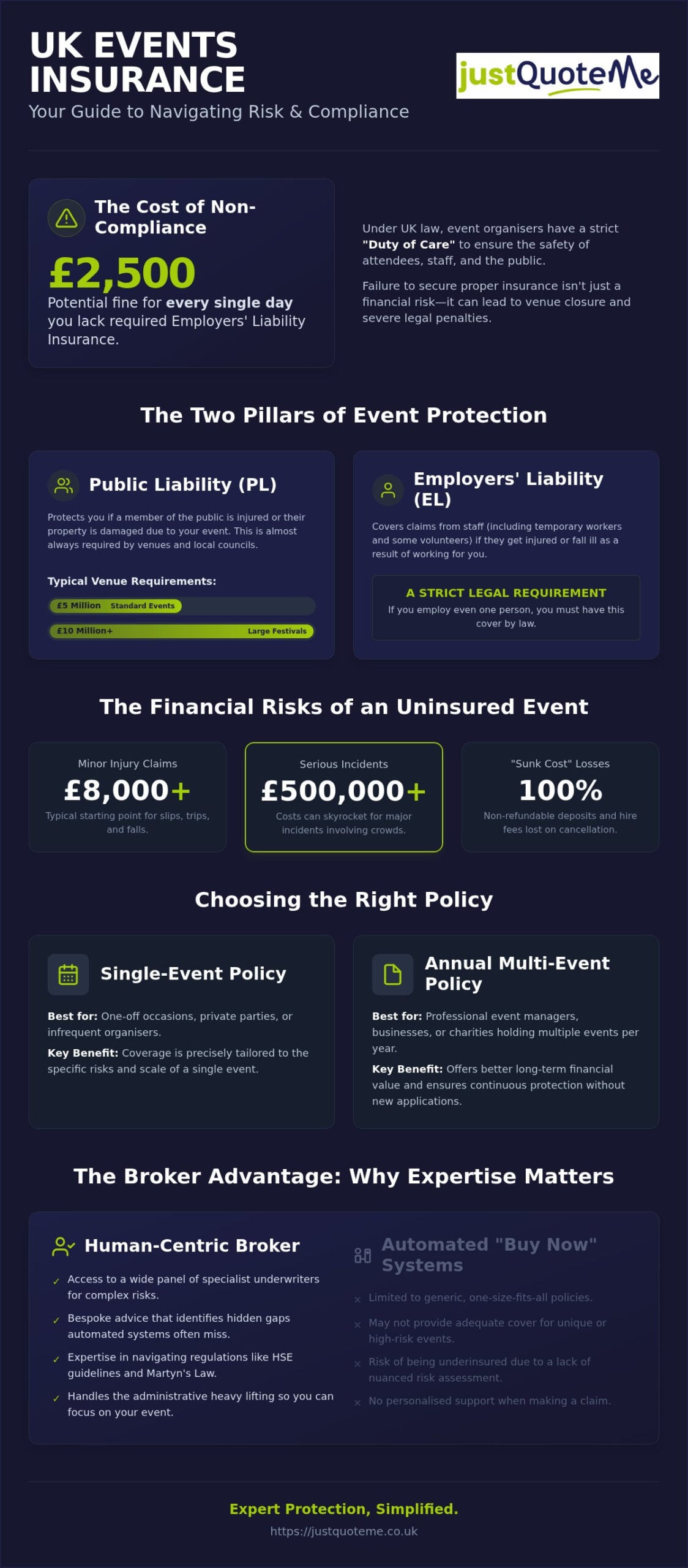
While Key Types of Event Cover like public liability aren’t always a statutory requirement by central government, they’re almost always mandated by local councils and venue owners. You’ll struggle to secure a professional space or a license for a public gathering without proving you have adequate cover. However, employers liability insurance is a different matter. Under the Employers’ Liability (Compulsory Insurance) Act 1969, it’s a legal requirement if you employ even one person, including temporary staff or certain volunteers. Failing to have this can result in Health and Safety Executive (HSE) fines of £2,500 for every single day you’re uninsured.
The Financial Risks of Uninsured Occasions
The costs of third-party injury claims can be staggering. Without public liability insurance, you’re personally liable for legal fees and compensation. In the UK festival circuit, claims for minor injuries often start around £8,000, while serious incidents involving crowds can exceed £500,000. Beyond injuries, you face significant “sunk cost” risks. Non-refundable venue deposits and equipment hire fees can vanish if an event is cancelled due to circumstances beyond your control, such as extreme weather or supplier failure. Protecting your reputation as a reliable organiser is just as vital as protecting your bank account. A single uninsured disaster can end a career in event management before it truly begins.
Key Types of Event Cover: From Public Liability to Cancellation
Selecting the right events insurance UK requires a modular approach. No two occasions are identical; a local craft fair has a vastly different risk profile compared to a multi-day music festival. The cornerstone of any policy is Public Liability (PL). This protects you if a member of the public is injured or their property is damaged during your event. Most UK venues and local authorities now mandate a minimum of £5 million in PL cover, though larger commercial festivals often require £10 million or more to satisfy their contracts.
Public Liability: The Venue Requirement
Venues demand high indemnity limits because claim values for public incidents can escalate quickly. A typical PL claim might involve a guest tripping over poorly secured flooring or a piece of heavy signage falling due to high winds. If you’re hiring external contractors to set up stages or lighting, ensure they have their own tradesman insurance. This prevents their negligence from becoming your financial burden. Effective Event Risk Management starts with identifying these physical hazards before the first guest arrives.
Employers’ Liability for Volunteers and Temp Staff
There’s a common misconception that volunteers don’t require formal protection. In the eyes of UK law, if you have “control” over someone’s work, they may be classified as an employee for insurance purposes. This includes temporary staff, students on work placements, and community volunteers. Having employers liability insurance is a legal necessity if these individuals are under your direction. Volunteer-led community events carry unique risks, as helpers may lack professional training. If an accident occurs while they’re working for you, you’re responsible for their welfare and any subsequent legal claims.
Cancellation, Weather, and Non-Appearance
Standard events insurance UK doesn’t always include cancellation by default. You must specifically add “Adverse Weather” cover if your event is outdoors, as standard cancellation often excludes rain or wind unless it poses a direct safety threat. “Non-Appearance” cover is equally vital if your event relies on a specific keynote speaker or headline artist; it protects your outlays if they can’t attend due to illness or travel disruption. For those hosting competitions, Prize Indemnity provides cover for high-value rewards, such as “hole-in-one” contests, allowing you to offer major prizes without the risk of paying them out of pocket. If you’re unsure which modules your specific occasion requires, you can consult with an independent specialist to build a bespoke policy.
UK Regulatory Compliance and Event Risk Management
Compliance in the UK event sector has evolved into a rigorous, evidence-based process. To secure competitive events insurance UK, you must demonstrate that your planning aligns with Health and Safety Executive (HSE) guidelines and, where applicable, the “Purple Guide” for larger gatherings. These resources are the benchmarks insurers use to assess your professional competence. Documenting your adherence to these standards shows underwriters that you’re proactive about safety rather than reactive to accidents. It’s the difference between a standard policy and one tailored to your specific operational risks.
Conducting a Robust Risk Assessment
A documented risk assessment is the most important piece of evidence in your planning folder. Insurers view a thorough assessment as a clear signal of a “good risk,” which can lead to more favourable terms. Your assessment must cover three essential elements: hazard identification, identifying persons at risk, and detailed mitigation measures. For example, you should pinpoint potential trip hazards, identify vulnerable groups like children or the elderly, and explain exactly how you’ll manage these risks through signage or stewarding.
Setup and breakdown phases are particularly high-risk periods that many organisers overlook. You must ensure all technical staff follow working at height safety protocols when installing lighting rigs, stage canopies, or PA systems. Insurers often look for proof that contractors have been vetted for these specific competencies. If your risk assessment lacks detail on these high-stakes activities, it could lead to higher premiums or even a refusal of cover for the build phase of your event.
Licensing and Local Authority Liaison
If your event involves alcohol, live music, or late-night entertainment, you’ll likely need to submit a Temporary Event Notice (TEN) to your local council. Most authorities require proof of Public Liability insurance before they’ll approve a TEN or a street party permit. This is especially true for public space use where the council’s own liability must be protected from third-party claims. Without a valid policy, your license may be revoked just days before the event begins.
Organisers in Staffordshire and the West Midlands benefit from specific regional frameworks and safety advisory groups (SAGs). These groups often include police and fire services who review your event management plan before the council grants permission. Presenting a plan that has already been vetted by a local SAG can significantly streamline your insurance application. It shows you’ve engaged with the community to manage public safety effectively. When the regulatory paperwork feels heavy, just quote me to find a partner who understands these regional nuances and manages the administrative burden for you.
Single vs. Multiple Event Insurance: Choosing the Right Policy
Deciding between a one-off policy and an annual plan is a critical financial decision for any organiser. Events insurance UK is highly adaptable, but the right choice depends on your frequency of work and the specific risks involved in each project. If you’re managing a single, high-stakes occasion, a one-off policy provides targeted protection for that specific date. For those with a busy calendar of markets or trade shows, an annual multi-event policy often offers better value and less administrative friction. Choosing correctly prevents you from overpaying for redundant cover or leaving gaps in your liability.
One-Off Event Insurance: For Weddings and Festivals
One-off cover is designed for organisers focusing on a single major project. A key feature to understand is the “consecutive days” rule. Most insurers allow a single policy to cover up to four consecutive days of activity, which is ideal for weekend festivals or exhibitions. This includes the necessary setup and breakdown periods. If your event involves late-night entertainment or complex liquor licensing, you might require specialized extensions. For example, organisers running late-night venues or pop-up events can benefit from nightclub insurance to cover specific risks like security and late-hour liabilities.
Multi-Event Insurance: For Stallholders and Promoters
If you plan to host or attend more than three events in a twelve-month period, an annual policy usually becomes the more cost-effective option. These plans are popular with promoters, stallholders, and exhibition organisers. However, you must be aware of attendee limits. Insurers often cap the number of attendees per event on an annual policy, sometimes at 500 or 1,000 people. If one of your events exceeds this limit, you’ll need a mid-term adjustment. This is where a broker outshines automated systems; we can adjust your cover as your business grows without requiring a completely new policy.
Your event protection shouldn’t exist in a vacuum. It often interacts with your existing business cover. For instance, if you operate a physical retail space, your shop insurance might cover your stock while in transit, but not the public liability for a stall at an external fair. Similarly, if you host events on your own premises, commercial property insurance provides the foundation, but events insurance UK fills the gaps for specific attendee risks.
Niche risks like fireworks displays, high-risk sports, or large-scale pyrotechnics require even deeper scrutiny. These aren’t typically covered by “buy now” button policies found on comparison sites. They demand bespoke underwriting to ensure you aren’t left exposed during a claim. To ensure your specific schedule is fully protected, you can consult with an independent broker to build a policy that grows with your business.
The Broker Advantage: Why Bespoke Beats “Buy Now” Buttons
Automated comparison sites are built for speed, but they often sacrifice security in the process. When you rely on a “buy now” button, you’re trusting a rigid algorithm to interpret the complexities of your specific gathering. Events insurance UK is rarely a one-size-fits-all product; it requires a nuanced understanding of venue contracts and local regulations. Independent brokers provide a human-centric alternative to these automated systems. We access a wider panel of specialist UK underwriters who offer bespoke terms that standard algorithms simply can’t process.
Having a human advocate is most critical when you need to make a claim. Instead of navigating a faceless call centre, you have a partner who understands your business and fights your corner with the insurer. Our 30+ years of experience allows us to spot “under-insurance” traps that lead to rejected claims. We ensure your indemnity limits aren’t just high enough to satisfy a venue, but robust enough to protect your personal assets if the worst happens. This proactive approach identifies gaps before they become expensive mistakes.
Tailored Solutions for Complex Risks
High-risk activities like pyrotechnics, inflatables, or specialized sporting contests often trigger automatic exclusions on standard policies. We negotiate directly with underwriters to include these risks under clear, fair terms. For large-scale projects involving significant logistics, we can streamline your protection by grouping your event cover with motor fleet insurance for transport vehicles or plant and machinery insurance for hired equipment. Just Quote Me manages the administrative burden of these multiple layers so you can focus on delivering a successful event.
Reliability and Trust in the Staffordshire Region
Our deep roots in the Staffordshire region provide a level of accessibility that national platforms lack. Whether you’re based in Stone, Stafford, or Newcastle-under-Lyme, you can speak directly to an expert who understands the local landscape. This regional expertise, combined with our FCA-authorised status, serves as a mark of professional integrity and reliability. We don’t just sell policies; we build long-term partnerships based on honest communication and pragmatic advice. To secure your next project with a steady hand in a complex market, Get Your Free Business Insurance Quote now.
Secure Your Event’s Future with Expert Protection
Organising a successful gathering in 2026 requires more than just a great venue and a solid plan; it demands a proactive approach to risk. By mastering regulatory compliance and understanding the nuances of different policy structures, you’ve already taken the most important step toward financial security. Whether you’re managing a single local fair or a complex series of national conferences, having the right events insurance UK in place provides the peace of mind to focus on your attendees. You’ve learned to identify hidden liability gaps and distinguish between mandatory covers.
You don’t have to manage these administrative burdens alone. As an FCA-authorised independent broker with 30+ years of industry experience, we offer bespoke advice from UK experts to ensure your protection is as unique as your event. We help you navigate complex liability and cancellation covers with a human-centric approach that automated systems can’t match. If you’re ready to simplify your planning process, you can secure expert support today. We’re committed to being the steady hand that protects your budget and your reputation. Good luck with your upcoming event.
Get Your Free Business Insurance Quote now
Request a Call back for free Expert advice
Frequently Asked Questions
How much does events insurance cost in the UK?
Costs vary significantly based on the scale of your gathering and the specific risks involved. A small indoor seminar requires different indemnity limits than a large outdoor music festival. Factors such as the total number of attendees, the nature of your activities, and the value of hired equipment all play a role. To get an accurate price that reflects your specific needs without paying for unnecessary extras, it’s best to request a bespoke quote.
Do I need insurance for a small community street party?
Yes, most UK local authorities mandate public liability cover before they’ll authorise a street closure or grant a license. Even for small, non-profit gatherings, you owe a legal duty of care to everyone present. If an attendee is injured by a faulty gazebo or trips over an unsecured cable, the organising committee could be held liable. Securing a policy ensures that these community-led projects don’t end in personal financial hardship for the organisers.
What is the difference between Public Liability and Event Cancellation cover?
Public liability covers your legal responsibility for third-party injuries or property damage, while cancellation cover protects your financial investment if the event cannot proceed. While public liability is often a venue requirement, cancellation cover is a tactical choice to protect your budget from unforeseen disruptions like venue damage or artist illness. Together, they form a robust events insurance UK package that covers both physical incidents and the financial risks of non-appearance or abandonment.
Does events insurance cover volunteers or just paid employees?
Standard policies can cover both, but you must ensure you have employers’ liability included if you use volunteers. Under UK law, if you’re directing the work of volunteers, they’re often treated as employees for insurance purposes. This means you’re responsible for their safety during the event. Including this cover ensures your legal fees and any compensation payouts are handled, protecting both your volunteers and your organisation’s financial stability.
Can I get insurance for a one-day event?
One-day policies are a standard offering for organisers hosting weddings, charity galas, or single-day conferences. These policies are designed to be efficient and cost-effective, providing full liability protection for the duration of your event. Most one-day covers also include the setup and breakdown periods, ensuring you’re protected from the moment you arrive at the venue until the last piece of equipment is removed. It’s the ideal solution for organisers with a one-off project.
Is adverse weather automatically included in my event policy?
Adverse weather is typically an optional extension rather than an automatic inclusion in a standard policy. Basic cancellation cover usually only applies to extreme circumstances that make the event physically impossible or dangerous. If you’re worried about rain or wind affecting an outdoor festival, you’ll need to add specific weather protection. Be aware that insurers often require you to purchase this extension at least 14 days in advance to prevent claims based on short-term forecasts.
What information do I need to provide for an events insurance quote?
You’ll need to provide the event type, expected attendance, and the venue’s location to get an accurate quote. Insurers also require details on any high-risk activities, such as the use of pyrotechnics or temporary staging. Providing a clear summary of your health and safety protocols helps underwriters assess your risk profile. This detailed information ensures that your events insurance UK policy is valid and that you have the correct indemnity limits to satisfy your venue’s contract.
