

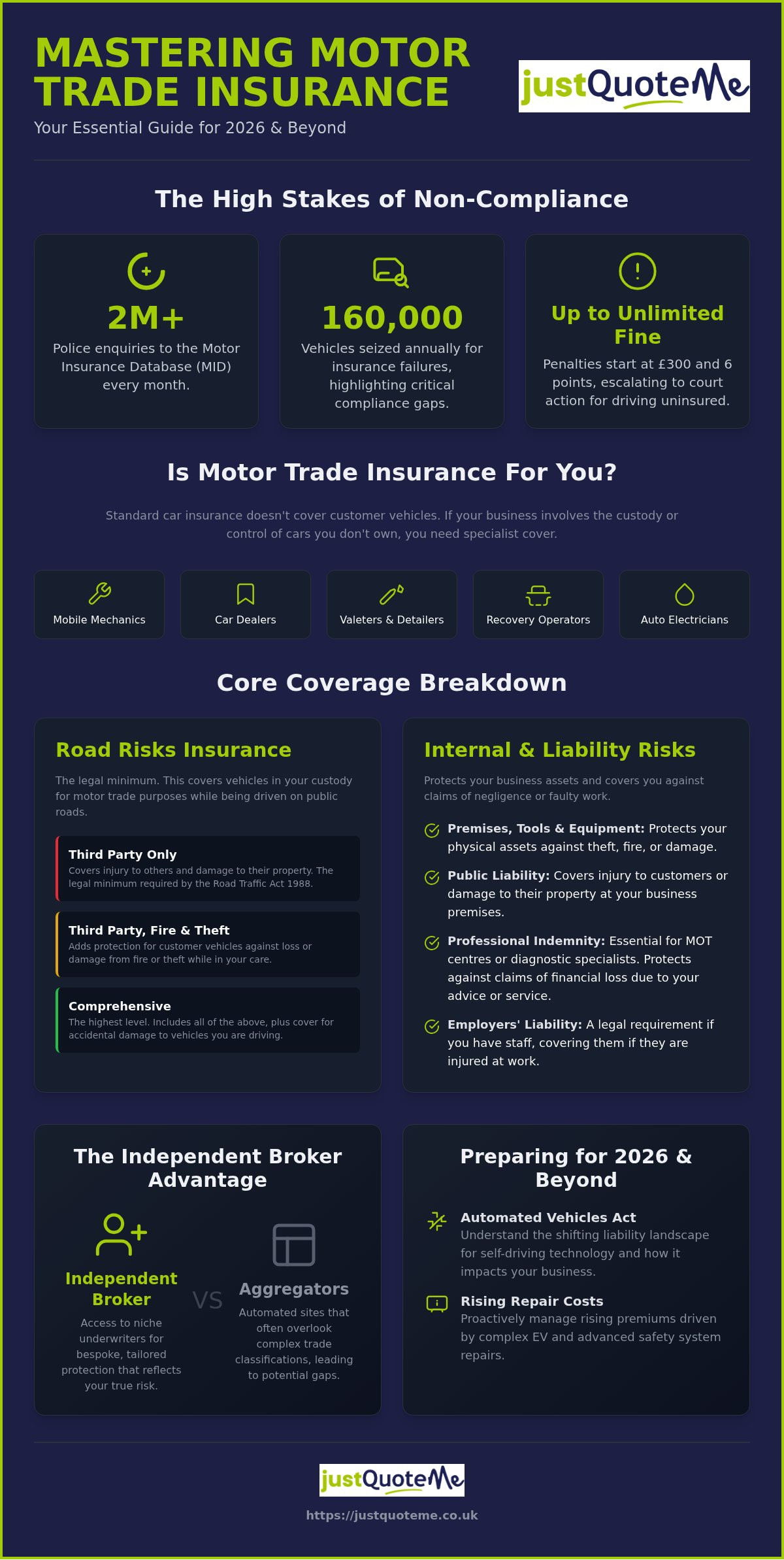
Did you know that the police currently make over 2 million enquiries to the Motor Insurance Database every month? For any automotive professional, maintaining accurate Motor Trade Insurance is no longer a simple administrative task. It is a critical operational requirement in a year where nearly 160,000 vehicles were seized for insurance failures. You likely feel the strain of rising premiums as repair costs for electric vehicles and advanced safety systems continue to climb. It is a common frustration to find that a standard policy does not reflect your actual day-to-day risks, leading to the constant fear of a rejected claim due to a wrong trade classification.
This guide will help you master these complexities with expert insights on 2026 compliance, including the legal shifts caused by the Automated Vehicles Act. We will show you how to secure bespoke protection that covers every staff member and vehicle type without unnecessary expense. You will learn to manage rising costs through proactive risk management and avoid the common errors that lead to coverage gaps. We will preview exactly how to navigate the Motor Insurance Database updates to keep your business fully legal. Just Quote Me to streamline your administrative tasks and secure a policy built for the modern road.
Key Takeaways
- Identify the specific legal obligations under the Road Traffic Act 1988 to ensure your business remains compliant while handling or transporting customer vehicles.
- Differentiate between road risks and internal coverage to protect your physical assets, including high-value diagnostic tools and vehicle stock at your premises.
- Explore the advantages of using an independent broker to access niche underwriters that automated comparison sites often overlook for complex trade classifications.
- Learn actionable strategies to reduce your Motor Trade Insurance premiums through better risk management and precise Motor Insurance Database updates.
- Prepare for 2026 legal changes regarding the Automated Vehicles Act and understand the shifting liability landscape for self-driving technology.
What is Motor Trade Insurance and Who Needs It in 2026?
Motor Trade Insurance is a specialist policy designed for businesses that handle, repair, sell, or transport vehicles belonging to others. It’s the legal backbone for automotive professionals. Under the Road Traffic Act 1988, any vehicle used on a public road must have at least third-party cover. For a trader, this means you need a policy that follows you to whatever vehicle you’re currently working on or moving. Without it, you’re essentially driving uninsured, which leads to fixed penalties of £300 and six points, or even an unlimited fine if the case goes to court.
Why does standard insurance fail? Most personal policies only cover “Social, Domestic, and Pleasure” use. Even with “Business Use” added, these policies are tied to a specific vehicle you own. They don’t extend to the “custody and control” of a customer’s car. If you’re a valeter moving a client’s Porsche or a mechanic test-driving a Ford, your personal insurance won’t help you. This specialist cover is essential for:
- Mobile mechanics and diagnostic technicians.
- New and used car dealers.
- Professional valeters and detailers.
- Vehicle recovery operators.
- Auto electricians and window tinters.
The Difference Between Motor Trade and Business Car Insurance
Business car insurance covers your private vehicle for work travel. Motor trade cover, however, is about protecting the financial value of third-party assets in your care. This is the indemnity aspect of the policy. When researching Vehicle insurance, it’s easy to see how different risks require different solutions. If your business also owns a set of delivery vans or staff cars, you might need to integrate Fleet Insurance. This ensures your own company assets are protected while your trade policy covers the customers’ cars.
Full-Time vs. Part-Time Traders
Insurers typically look at whether the motor trade is your “Main Occupation.” If it’s your primary job, you’ll have access to more comprehensive “All Risks” packages. Part-time traders, such as those who flip a few cars a month from home, can still find bespoke protection. You don’t necessarily need a physical garage or showroom to qualify. The key is honesty. You must declare all your income streams and the true nature of your business. If an insurer discovers you’re actually a full-time dealer but declared it as a hobby, they will void your policy and reject any claims.
Core Coverage Breakdown: From Road Risks to Liability Protection
Road Risks Insurance is the essential foundation of any motor trade policy. Unlike standard car insurance, it focuses on the driver’s professional activities rather than a single registration number. It allows you to drive any vehicle for trade purposes, provided it is correctly logged. You must maintain an accurate record on the Motor Insurance Database (MID) to remain compliant. With police making over 2 million enquiries to this database every month, keeping your records current is a legal necessity to avoid vehicle seizures or fines.
Beyond the road, you must consider internal risks. Your diagnostic equipment, hand tools, and vehicle stock represent a significant financial investment. A basic road risks policy won’t protect these assets against theft or fire at your premises. If your business provides MOTs or specialist technical advice, Professional Indemnity Insurance is also critical. It protects your livelihood if a client claims your professional guidance caused them a financial loss.
Road Risks: Choosing the Right Level of Protection
You have three primary levels of road risk cover to choose from. Third Party Only is the legal minimum required to operate on UK roads. Third Party, Fire and Theft adds protection against vehicle loss through fire or criminal activity. Comprehensive cover is the most robust option, protecting both your own vehicles and customer cars against accidental damage. Watch for specific exclusions in 2026. Many underwriters now set strict limits on high-performance vehicles or classic cars. Driver age is another factor; policies often exclude drivers under 25 unless specifically agreed. For a deeper look at these specific 2026 requirements, see The Ultimate Guide to Motor Trade Insurance in the UK: 2026 Edition.
Employers’ Liability and Public Liability
Public Liability Insurance is your first line of defense against non-motor accidents. If a customer trips over a tool in your workshop or you damage a client’s property during a mobile repair, this cover handles the legal costs and compensation. For businesses with staff, Employers’ Liability Insurance is a strict legal requirement. Even if you only hire one part-time employee or an apprentice, you must hold this cover or face fines of up to £2,500 per day.
Managing multiple individual policies is inefficient and creates administrative strain. A combined Motor Trade Insurance policy simplifies your life by bundling road risks, liability, and premises protection into one manageable point. This structure ensures there are no gaps in your protection. You can compare bespoke insurance options to find a package that reflects the unique risks of your specific trade sector.
Independent Brokers vs. Aggregators: The Bespoke Advantage
Many business owners start their search on comparison sites, attracted by the promise of a quote in minutes. However, these platforms rely on rigid algorithms that frequently struggle with the nuances of the automotive industry. If your business model doesn’t fit a standard box, you’ll likely encounter the ‘computer says no’ problem. An independent broker offers a human-centric alternative. We have access to niche underwriters who don’t appear on aggregators, allowing us to build a policy that reflects your actual daily operations.
Just Quote Me brings over 30 years of industry experience to every consultation. This tenure has allowed us to build deep relationships with top-tier UK insurers, giving our clients a distinct advantage. During the 2026 claims process, having a human advocate is invaluable. We don’t just provide a policy number; we manage the administrative burden so you can focus on your workshop or showroom. We understand that Motor Trade Insurance is a significant investment, and our role is to ensure that investment is protected when you need it most.
Why Bespoke Policies Save Money Long-Term
Bespoke Motor Trade Insurance isn’t just about better coverage; it’s a pragmatic way to control costs. Automated platforms often force you into generic categories, which can lead to ‘over-insurance’ where you pay for risks you don’t actually face. Professional advice ensures you only pay for the specific activities you perform. Our risk assessment consultations help identify potential issues before they become disputes. Additionally, managing mid-term adjustments (MTAs) is much simpler through a broker. You won’t face the high, automated fees often hidden in the fine print of digital-only platforms. We also ensure you meet all legal benchmarks, such as navigating the Employers’ Liability legislation to keep your staff protected correctly within a combined policy structure.
The Local Broker Advantage in Staffordshire
Operating from our base in Stone, we understand the specific regional risks facing businesses in Stafford and Newcastle-under-Lyme. This regional expertise is a marker of quality that automated systems cannot replicate. You aren’t just a digital record to us; you’re a local partner. For more details on how we support businesses in our area, see our Commercial Insurance Broker Staffordshire guide. This face-to-face accountability builds a level of trust that a call center simply cannot provide. We know your business name, your location, and the specific challenges of the West Midlands market.
Managing the Motor Insurance Database (MID) and Reducing 2026 Premiums
Maintaining your records on the Motor Insurance Database (MID) is a non-negotiable part of running a modern automotive business. In 2025, nearly 160,000 vehicles were seized in the UK for lacking valid insurance. This highlights the efficiency of the police’s digital enforcement tools. The MID is the UK’s central record of insured vehicles, updated by law by every policyholder. Failing to keep this database current doesn’t just risk a fine; it puts your entire fleet at risk of being impounded during routine checks. Since police make over 2 million enquiries to this database every month, any delay in registration is a gamble you can’t afford to take.
Your claims history remains your most valuable asset when it comes to lowering annual costs. A robust No Claims Bonus (NCB) signals to underwriters that you manage risk effectively. When preparing for a new quote, have your annual turnover, specific trade type, and full driver history ready. Accuracy at this stage prevents the “wrong” trade classification that often leads to claim rejections. If you want to see how these factors impact your specific business, you can get a Motor Trade Insurance quote tailored to your operations.
Step-by-Step MID Management
Accuracy is the key to digital compliance. You should register vehicles on the database immediately upon taking them into your custody. While some insurers allow a 14-day window, aim for same-day updates to eliminate the risk of police seizure. Manage your trade plates with equal care. They are for temporary use during transit or testing; using them for permanent personal travel is a breach of policy terms. Ensure every plate is logged correctly to maintain a clean record with both the DVLA and your insurer.
2026 Strategies for Cheaper Motor Trade Insurance
Lowering your premium requires a proactive approach to risk management. Start by reviewing your driver list. Restricting your policy to drivers over 25 can significantly drop your base costs, as underwriters view younger drivers as a higher risk. You might also consider increasing your voluntary excess. This reduces the insurer’s potential payout on small claims, which they reward with lower monthly or annual premiums.
Investing in physical security is another proven way to secure better rates. CCTV systems, high-grade alarms, and secure perimeter fencing for your workshop or yard make your business a more attractive prospect for underwriters. Some insurers now offer discounts for telematics, which track driving behavior across your staff. These data-driven insights provide proof of your commitment to safety, often leading to more favorable terms during your annual renewal.
Securing Your Bespoke Quote with Just Quote Me
Securing the right protection shouldn’t be an obstacle to your business growth. At Just Quote Me, we’ve refined our process over 30 years to be as efficient as possible. Whether you’re operating from Stone or anywhere across the UK, we move you from an initial inquiry to comprehensive cover without the typical stress of automated systems. Our team specializes in those complex, ‘hard to place’ risks that standard forms often reject. For example, Nightclub Insurance clients managing a promotional vehicle fleet or owners of Thatched Pubs running delivery services need a level of nuance that algorithms lack. We provide that human touch.
Our promise is straightforward: we offer professional, reassuringly direct service that removes the administrative weight from your shoulders. If you’re looking to transition your current Motor Trade Insurance or you’re starting a new venture, we provide the confidence you need. We don’t just sell policies; we build partnerships that protect your livelihood. We manage the complex administrative burdens so you don’t have to, ensuring your business stays compliant and fully protected on the road and at your premises.
Expert Advice for West Midlands Businesses
We have a deep-rooted understanding of the local trade landscape in Staffordshire. For businesses in the hospitality and construction sectors, the intersection of general liability and motor risks is a common challenge. We understand that a mechanic in Stone has different logistical needs than a dealership in Birmingham. This regional knowledge allows us to spot potential coverage gaps that a generic software program would miss. If your daily operations involve heavy equipment, we can integrate specialist cover for Plant and Machinery within your broader insurance strategy. This regional expertise ensures that your policy reflects the specific risks of your location and industry, offering a level of personalized support that national aggregators cannot match.
Ready to Protect Your Trade?
Working with an FCA-authorised broker means you receive advice grounded in regulatory standards and three decades of industry experience. We manage the complex administrative burdens, from MID compliance to policy adjustments, allowing you to focus on your day-to-day operations. Protecting your Motor Trade Insurance interests is about more than just a certificate; it’s about having a steady hand in a complex market. Our human-centric alternative to automated systems means you always have an expert to talk to when your business needs change.
Take Control of Your 2026 Motor Trade Protection
Managing the complexities of Motor Trade Insurance requires more than just a standard policy; it demands a proactive approach to compliance and risk. By prioritizing immediate Motor Insurance Database updates and selecting coverage that reflects your specific trade activities, you protect your business from both legal penalties and financial gaps. You’ve seen how independent brokers provide a human-centric alternative to rigid automated systems, ensuring that even complex professional sectors receive the bespoke protection they deserve.
Just Quote Me brings over 30 years of industry experience to help you navigate this shifting market. As an FCA-authorised independent broker, we provide access to a panel of top UK insurers to secure the best possible terms for your workshop, dealership, or mobile service. We manage the administrative burdens so you can focus on your craft with complete confidence. It’s time to move away from generic results and secure a policy built for your unique needs.
Get Your Free Business Insurance Quote now
Request a Call back for free Expert advice
We’re ready to help your business thrive on the roads of 2026 and beyond.
Frequently Asked Questions
Can I drive my own personal car on a motor trade policy?
You can drive your personal car on this policy provided you have declared the vehicle and it is used for trade purposes. Most insurers allow you to include a private vehicle for “Social, Domestic and Pleasure” use, but this is not an automatic feature. You must ensure the vehicle is logged correctly to avoid gaps in your personal protection while operating your business.
Is motor trade insurance a legal requirement for part-time traders?
Yes, any individual handling or driving customer vehicles for profit must hold a valid policy under the Road Traffic Act. Even if you only sell a few cars a month from home, a standard personal policy will not cover your business activities. Operating without the correct cover carries a fixed penalty of £300 and six points on your driving license.
What is the Motor Insurance Database (MID) and how often must I update it?
The MID is the central record of all insured vehicles in the UK, used by the police and DVLA for enforcement. You should update it as soon as a vehicle enters or leaves your custody. While many insurers specify a 14-day window for updates, immediate changes are the safest way to avoid being flagged during the 2 million enquiries police make every month.
How much does motor trade insurance cost in 2026?
Costs vary significantly based on your trade type, location, and the specific risks involved in your daily operations. For instance, mobile mechanics often see annual figures between £600 and £1,500, while large dealerships with significant stock on site can face costs exceeding £6,000. These figures reflect the rising costs of electric vehicle repairs and specialized parts observed throughout 2026.
Can I include my employees on my motor trade insurance policy?
You can include employees on your policy, but you must also hold Employers’ Liability Insurance by law if you have any staff members. A combined Motor Trade Insurance policy allows you to name specific drivers who are authorized to move customer vehicles. You will need to provide their full driving history and any previous convictions to ensure the underwriter accepts the risk.
Does motor trade insurance cover my tools and equipment?
Standard road risks policies do not cover tools, but you can add this protection through a combined premises or “tools in transit” agreement. This covers diagnostic equipment, hand tools, and machinery against theft or damage at your workshop or while traveling. For automotive professionals, protecting these high-value assets is just as critical as insuring the vehicles themselves to ensure business continuity.
What happens if I forget to add a vehicle to the MID?
Forgetting to add a vehicle leaves it flagged as uninsured on police systems, which often leads to immediate roadside seizure. In 2025, nearly 160,000 vehicles were seized in the UK for insurance offenses. Beyond the risk of losing the vehicle, you may face an unlimited fine in court and a rejected claim if an accident occurs while the database is inaccurate.
Can under-25s be covered on a motor trade policy?
Under-25s can be covered, though many insurers apply strict criteria or higher excesses for younger drivers. Because underwriters view this age group as a higher risk, including them on a Motor Trade Insurance policy will likely increase your annual premium. Some specialist policies might exclude younger drivers entirely unless they are apprentices or family members with a clean driving record.
