

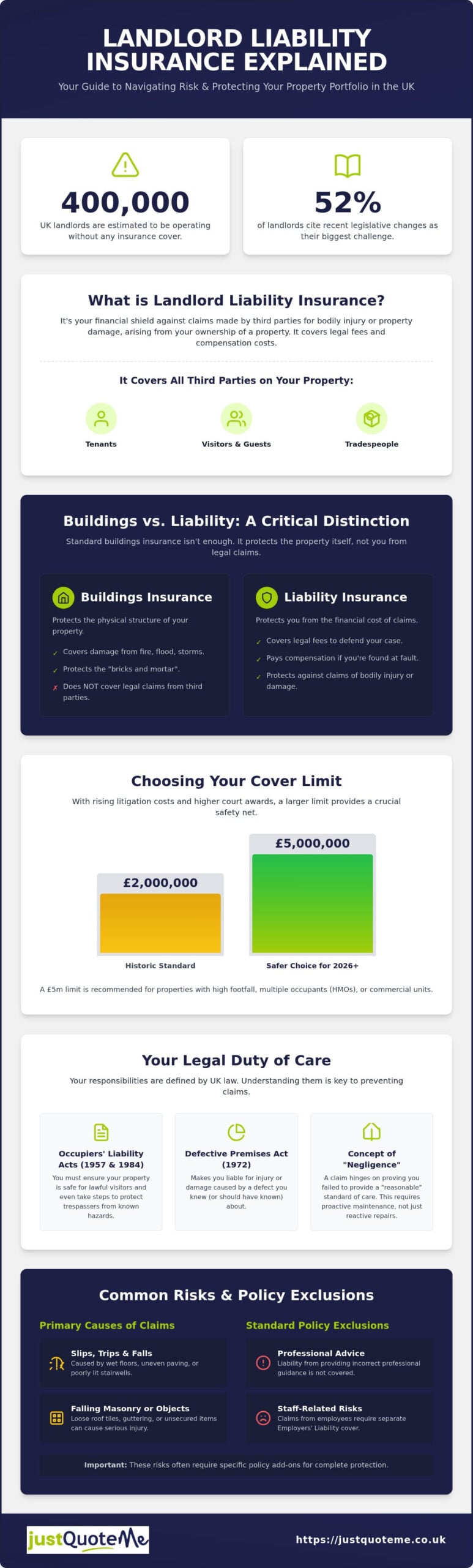
Did you know that an estimated 400,000 UK landlords are currently operating without any insurance? In a year defined by the most significant rental reforms in three decades, including the abolition of Section 21 and the launch of the mandatory Private Rented Sector Landlord Ombudsman, this lack of protection is a high-stakes gamble. We understand that 52% of landlords now cite these legislative changes as their biggest challenge, often leading to valid concerns about rising premiums and the increased risk of legal claims.
It’s easy to feel overwhelmed by the transition to periodic tenancies and the new Housing Health and Safety Rating System standards. This guide provides landlord liability insurance explained in clear, pragmatic terms to help you navigate these shifts. You’ll master the essentials to protect your property portfolio from costly legal claims and negligence suits while learning to distinguish between basic buildings cover and vital liability protection. We will show you how to choose the right cover limits and implement risk-lowering strategies to keep your 2026 costs manageable. If the administrative burden of new regulations feels heavy, let Just Quote Me simplify your protection so you can focus on your tenants with confidence.
Key Takeaways
- Master your statutory obligations under the Occupiers’ Liability Act to understand exactly when you are legally at fault for an accident on your property.
- Identify the primary causes of third-party claims, such as slips and falling masonry, to build a more resilient risk management strategy for your portfolio.
- Get landlord liability insurance explained so you can confidently distinguish between essential liability cover and standard buildings insurance.
- Learn why professional advice and staff-related risks require specific add-ons that standard liability policies typically exclude.
- Discover why a bespoke policy from an independent broker offers more reliable security for your property assets than a generic, automated quote.
What is Landlord Liability Insurance? UK Definitions and Essentials
Getting landlord liability insurance explained is the first step toward a secure property portfolio. This cover is your financial shield against claims made by third parties for bodily injury or property damage. While many people think only of their tenants, a “third party” actually includes anyone who steps foot on your property. This means visitors, tradespeople, and even random passers-by are covered if your building causes them harm.
You have a legal duty of care to keep your premises safe. If you fail in this duty, the costs can be devastating. Many property owners mistakenly believe their standard buildings insurance is enough. It isn’t. Buildings insurance protects the bricks and mortar from fire or flood, but it won’t pay for a solicitor or a compensation settlement if a tenant sues you for a slip. A robust residential letting insurance policy should include liability cover to bridge this gap. Even if a claim is eventually dropped, the legal fees to defend your reputation can reach thousands of pounds; your policy covers these costs so you don’t have to.
Property Owners’ Liability vs. Public Liability
In the insurance industry, we typically refer to this as Property Owners’ Liability. It’s a specific form of public liability insurance designed for the unique risks of landlords. While a shop needs cover for customers tripping over stock, a landlord needs cover for structural failures or maintenance issues. If you own a freehold property, you’re responsible for the whole site. If you own a leasehold flat, you’re responsible for everything inside your front door. Just Quote Me to find a policy that matches your specific ownership structure.
Minimum Cover Limits: £2m vs. £5m
The Legal Framework: Understanding Negligence and Your Duty of Care
When we have landlord liability insurance explained, the conversation often centers on policy documents, but the true foundation is built on UK statutory law. As a property owner, your legal responsibilities are primarily governed by the Occupiers’ Liability Act 1957 and the Occupiers’ Liability Act 1984. These acts dictate that you must take reasonable care to ensure your property is safe for anyone entering it. While the 1957 Act covers lawful visitors like tenants and delivery drivers, the 1984 Act surprisingly extends a limited duty of care even to trespassers. If a hazard is known to you and you fail to provide adequate warnings or repairs, you could be held liable for injuries sustained by someone who shouldn’t even be on the premises.
Negligence is the pivot point of any liability claim. In the eyes of the law, negligence is not merely an accident; it is a demonstrable failure to maintain the standard of care that a “reasonable” person would provide. This concept of reasonable care is what keeps many landlords awake at night. It requires you to be proactive rather than reactive. If you’re unsure how these legal standards apply to your specific portfolio, seeking professional landlord insurance advice can help clarify your individual risk profile.
Statutory Duties and the Landlord’s Responsibility
The Defective Premises Act 1972, specifically Section 4, places a heavy burden on landlords who have a duty to repair or maintain a property. If a defect results in injury or damage, and you knew (or ought to have known) about it, the law sits firmly on the side of the claimant. This is why administrative compliance is inseparable from legal safety. For instance, annual gas safety checks are a cornerstone of UK government legislation regarding rental properties. If a landlord neglects to perform a mandatory inspection and a tenant suffers harm from a faulty boiler, that missed paperwork serves as primary evidence to prove negligence in court.
Proving Negligence: The Three-Step Test
For a compensation claim to succeed against you, the claimant’s legal team must satisfy a three-step test. This framework determines if you are financially responsible for the incident:
- Duty of Care: It must be established that you owed a duty to the person involved. For landlords, this is almost always a given regarding tenants and visitors.
- Breach of Duty: The claimant must prove you failed to uphold that duty through action or, more commonly, inaction.
- Causation: It must be proven that your specific breach of duty directly caused the injury or loss.
Understanding this framework is essential when having landlord liability insurance explained because your policy is designed to defend you against these specific legal hurdles. Whether a claim is legitimate or frivolous, the legal framework requires a robust defense to protect your assets from the high costs of UK litigation.
Common Liability Claims and Risk Management for Landlords
When you have landlord liability insurance explained, you quickly realize that most claims aren’t the result of catastrophic structural failures. Instead, they usually stem from small, overlooked maintenance issues that spiral into expensive legal battles. Slips, trips, and falls remain the most frequent cause of liability claims in the UK. A loose carpet on a staircase or an uneven paving slab in the garden can lead to serious injury. If a court decides you failed to address these hazards, the compensation payouts for medical care and loss of earnings can be substantial.
External hazards are equally risky. Falling objects, such as loose roof tiles or crumbling chimney stacks, pose a direct threat to passers-by and neighbours. Similarly, faulty wiring and poor fire safety measures are major triggers for litigation. Keeping your Electrical Installation Condition Report (EICR) up to date is your best defense. These certificates prove you’ve taken proactive steps to ensure the property is safe, making it much harder for a claimant to prove negligence. You must also manage “silent killers” like carbon monoxide and Legionella. Failing to install required detectors or neglecting Legionella risk assessments can lead to criminal prosecution as well as civil liability claims.
Mitigating Risk to Protect Your Premiums
Your best defense against a negligence suit is a meticulous paper trail. Under the Defective Premises Act 1972, you’re responsible for defects you ought to have known about. Documented regular property inspections are essential. By keeping a log of every repair, from the date the issue was reported to the moment it was fixed, you create evidence of “reasonable care.” Integrating a robust maintenance plan with comprehensive residential letting insurance ensures that you’re protected both physically and financially. This proactive approach doesn’t just lower your risk; it helps keep your insurance premiums competitive by demonstrating to insurers that you’re a low-risk client.
What to Do if a Claim is Made Against You
If an accident occurs on your property, your natural instinct might be to apologize. However, you must follow the “No Admission of Liability” rule. Apologizing or admitting fault at the scene can prejudice your insurer’s ability to defend you later. Instead, focus on gathering evidence immediately. Take clear photos of the area, the hazard, and any relevant signage. Secure witness statements and record the incident in your own logs. In the UK, a typical liability claim begins with a “Letter of Claim” from the claimant’s solicitor. Once you receive this, don’t respond yourself. Forward it immediately to your broker so their legal team can take over the communication. This structured response is a vital part of having landlord liability insurance explained, as it ensures your policy remains valid throughout the litigation process.
Standard Exclusions: What Landlord Liability Does Not Cover
Having landlord liability insurance explained involves more than just listing what it covers; you must also understand the boundaries. While this policy is vital for accidents and injury claims, it isn’t a universal safety net for every risk associated with property management. For instance, liability cover focuses on physical harm or property damage. If you provide professional advice to a tenant that leads to their financial loss, you’d need Professional Indemnity Insurance instead. Additionally, no policy will protect you from the consequences of your own intentional acts or criminal behaviour. If a landlord is found to have deliberately caused harm or ignored safety laws with malicious intent, the insurer will void the claim.
Another critical distinction is the difference between sudden accidental damage and gradual wear and tear. If a roof tile falls and hits a visitor because of a freak storm, your liability cover typically responds. However, if that same tile falls because the roof has been neglected for twenty years, the insurer may argue that the incident was preventable through basic maintenance. Wear and tear is a standard exclusion across the industry because insurance is designed to cover the unforeseen, not the inevitable results of aging buildings. To ensure your policy aligns with your property’s actual condition, you can compare landlord insurance options with our expert team.
The Employers’ Liability Trap
Many landlords fall into a legal trap when they hire help for their properties. If you employ a regular gardener, cleaner, or maintenance person, you are likely legally required to hold Employers’ Liability Insurance. Standard landlord liability only covers third parties, not people working under your direction. The penalties for failing to have this cover are severe, with the Health and Safety Executive (HSE) able to fine you up to £2,500 for every day you are uninsured. In a domestic property setting, the threshold for employment is typically met when you exert control over how, when, and where the work is performed, even if the individual only works a few hours a week.
Liability for Commercial Landlords
If your portfolio includes retail units or office spaces, your risk profile changes significantly. High footfall areas naturally increase the statistical likelihood of a claim. When you arrange Commercial Property Insurance, the liability element must account for the specific use of the building. Commercial leases also introduce the concept of “Contractual Liability.” This means you might be held responsible for certain risks based on the specific wording of your lease agreement with the tenant. Understanding these nuances is where landlord liability insurance explained by a human broker adds real value, as automated systems often miss the specific clauses that could leave a commercial landlord exposed.
Why Choosing a Specialist Broker Secures Better Property Protection
Choosing the right protection shouldn’t feel like a transaction with a machine. While automated comparison sites offer speed, they often lack the nuance required for complex property portfolios. Having landlord liability insurance explained by a human expert ensures that your specific risks, from the age of your building to the nature of your tenancies, are fully understood. As an independent broker with 30 years of industry experience, Just Quote Me provides access to a broad network of top UK insurers. We aren’t tied to a single brand, which allows us to find the most competitive pricing without compromising on the quality of your cover.
The value of a broker is most apparent when things go wrong. If a tenant or visitor makes a claim against you, you need a steady hand to manage the administrative burden. We act as your advocate, working directly with insurers to ensure fair settlements and clear communication. This human-centric approach transforms insurance from a grudging necessity into a genuine partnership. We handle the complex legal and administrative details so you can focus on managing your assets with confidence.
Local Expertise in Stone and Stafford
Regional knowledge is a significant marker of quality in the insurance market. Our deep roots in Staffordshire and the West Midlands mean we understand the local property landscape in areas like Newcastle-under-Lyme, Stone, and Stafford. Whether you’re letting out a Victorian terrace or a modern commercial unit, our regional expertise allows for more accurate risk assessments than a “one-size-fits-all” online form. We understand the specific challenges facing landlords in this part of the UK, providing tailored advice that generic national providers simply cannot match.
Consolidating Your Portfolio
If you manage multiple properties, administrative simplicity is vital. We can help you consolidate your entire portfolio under a single, simplified policy, reducing paperwork and ensuring there are no gaps in your protection. For those who manage properties for others, we also provide Professional Indemnity Insurance to protect against errors in professional advice or service delivery. This holistic view of your business ensures every angle is covered. To move beyond general information and get landlord liability insurance explained in the context of your specific properties, the next step is a direct consultation with our expert team.
Secure Your Property Portfolio for the Future
Protecting your rental assets in 2026 requires more than a basic buildings policy. We have explored how the legal landscape under the Occupiers’ Liability Act and the Defective Premises Act is increasingly complex; a single overlooked maintenance issue can result in life-altering legal expenses and compensation claims. Having landlord liability insurance explained by a specialist ensures you aren’t just buying a generic policy, but securing a robust legal defense tailored to your unique property risks.
Just Quote Me brings 30+ years of expert brokerage experience to your side, offering a human-centric alternative to impersonal automated systems. As an FCA authorised and regulated firm, we provide direct access to top-tier UK insurers, ensuring your cover is as reliable as it is competitive. You don’t have to navigate these administrative burdens or rising premiums alone. Just Quote Me to secure your tailored landlord insurance today and rest easy knowing your property portfolio is protected by local experts who understand the Staffordshire market. We are here to help you build a safer, more resilient future for your rental business.
Frequently Asked Questions
Is landlord liability insurance a legal requirement in the UK?
No, landlord liability insurance isn’t a legal requirement under UK law, but it’s a standard requirement for most buy-to-let mortgage agreements. Without this protection, you are personally responsible for any compensation claims or legal fees arising from injuries on your property. Given that 52% of landlords cite legislative changes as their biggest challenge in 2026, having this safety net is more critical than ever.
Does landlord liability cover my tenants’ personal belongings?
No, your policy does not cover the personal property of your tenants. Tenants are responsible for securing their own contents insurance to protect their furniture, electronics, and clothing. Your liability cover only triggers if your negligence, such as failing to repair a known structural defect, directly results in damage to their possessions or causes them physical harm.
How much does landlord liability insurance cost on average in 2026?
In 2026, the average cost for landlord insurance typically ranges between £200 and £750 per year. Basic buildings-only policies sit at the lower end, while comprehensive cover including high liability limits can exceed £600. Factors such as the property’s age, location, and whether you rent to students or professionals will significantly influence your final premium.
Can I get liability cover if I only own the leasehold of a property?
Yes, leaseholders definitely need their own liability protection. While the freeholder’s insurance usually covers the external structure and communal areas, you are responsible for everything inside your specific unit. If a visitor trips on a loose floorboard inside your flat, the claim will be directed at you rather than the freeholder.
What is the difference between public liability and property owners’ liability?
Property owners’ liability is a specialized subset of public liability designed specifically for the risks associated with owning land or buildings. While getting landlord liability insurance explained, it’s important to note that this cover focuses on hazards like falling masonry or faulty wiring, whereas general public liability usually covers broader business activities and off-site incidents.
Does my policy cover me if a tradesman is injured while working on the house?
Yes, your policy can cover you if a tradesman is injured due to a hazard you failed to manage, such as a broken step you didn’t warn them about. However, if the injury is caused by the tradesman’s own tools or poor working practices, their own business insurance should handle the claim. Always ensure any contractors you hire have their own valid public liability cover; for help finding reputable professionals, you can visit TradeLink-Hub to connect with verified service providers.
How much cover do I need if I have a large portfolio of properties?
For large portfolios in 2026, we generally recommend a minimum of £5,000,000 in cover. Rising litigation costs and claims inflation mean that lower limits may not provide a sufficient cushion for serious injury claims. If you manage multiple high-occupancy buildings or commercial units, higher indemnity limits are often a requirement for full financial security.
What happens if I don’t have liability insurance and a tenant sues me?
If you are uninsured and lose a negligence case, you must pay the compensation and all legal fees from your own pocket. This can result in costs totalling hundreds of thousands of pounds, often leading to the forced sale of property assets or personal bankruptcy. Having landlord liability insurance explained by a broker ensures you understand how to avoid these catastrophic financial risks.
Request a Call back for free Expert advice
