

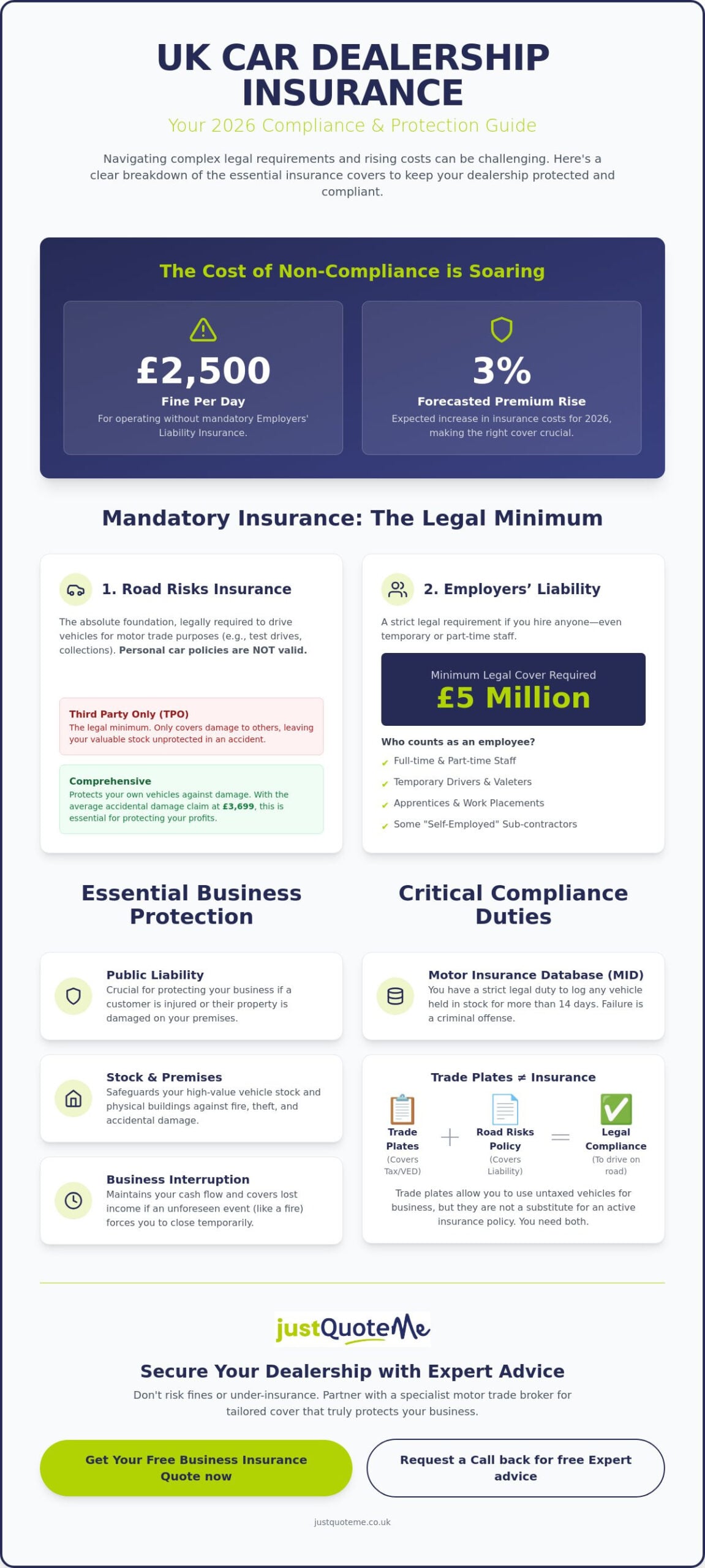
Did you know that operating without the correct employers’ liability cover can result in a fine of up to £2,500 for every single day you’re uninsured? Staying compliant with car dealership insurance requirements uk is becoming more complex in 2026, especially as the Automated Vehicles Act shifts liability and repair costs continue to rise. You likely feel the pressure of high premiums and the constant worry that a single oversight in your policy might leave you exposed during a claim. It’s frustrating to deal with legal jargon when you’d rather be on the forecourt closing deals.
This guide simplifies the administrative burden by outlining exactly what you need to stay protected and legal. We’ll provide a clear checklist of mandatory versus recommended cover, from road risk basics to the £5 million legal minimum for staff protection. You’ll also discover how to safeguard your stock against 2026’s forecasted 3% premium increases and manage the impact of the latest FCA redress schemes. To secure your business with a partner who understands the motor trade inside out, Just Quote Me. Here is everything you need to know to keep your dealership running smoothly and securely this year.
Key Takeaways
- Understand the mandatory car dealership insurance requirements uk, starting with statutory Road Risks cover to ensure you are legally permitted to move and sell vehicles.
- Identify your legal obligations regarding Employers’ Liability insurance, including the severe daily penalties for non-compliance when hiring any staff.
- Learn why Public Liability and Business Interruption cover are critical for protecting your physical lot and maintaining cash flow during unforeseen disruptions.
- Discover how to effectively safeguard your high-value vehicle stock against fire, theft, and accidental damage while navigating 2026’s rising premium trends.
- Find out why partnering with an experienced motor trade broker provides a more secure, tailored alternative to generic online insurance forms.
The Legal Baseline: Statutory Road Risks Insurance
Road Risk insurance is the absolute foundation of car dealership insurance requirements uk. It’s the specific legal cover that allows you to drive vehicles you don’t own, or vehicles you own but haven’t yet registered in your name, on public highways. Without it, you cannot legally perform road tests with customers, move stock between sites, or collect new acquisitions from auctions. It’s the floor of your compliance strategy.
Don’t make the mistake of relying on a personal car insurance policy. Even if your personal cover includes “business use,” it almost certainly excludes motor trade activities. Insurers view buying and selling vehicles as a distinct, professional risk category. If you’re caught using a personal policy for dealership business, the consequences are severe. Your vehicle could be seized on the spot; you’ll likely face a hefty fine and points on your license. This makes securing trade insurance even more expensive in the future.
When choosing your road risk cover, you need to decide between Third Party Only (TPO) and Comprehensive. TPO is the legal minimum, covering damage to others but leaving your own stock unprotected. In 2026, the average accidental damage claim has risen to £3,699. If you only have TPO, a single minor collision during a test drive could wipe out the profit from several sales. Comprehensive cover protects your stock value, ensuring a mistake on the road doesn’t become a financial disaster for your business.
Why Trade Plates Aren’t a Substitute for Insurance
Trade plates are a vital tool, but they aren’t insurance. They simply allow you to drive unlicensed or untaxed vehicles for business purposes without paying individual Road Tax (VED) for every car in your stock. You still need an active motor trade policy to cover the driver and the vehicle. Think of trade plates and insurance as a partnership; one handles the tax, while the other handles the legal liability. Using plates without the backing of a road risk policy is a fast track to legal trouble.
Understanding the Motor Insurance Database (MID)
You have a strict legal duty to keep the Motor Insurance Database (MID) updated with every vehicle you hold in stock. Generally, any vehicle you own for more than 14 days must be registered on the database. Failing to do this is a criminal offense. It also makes your stock a target for police ANPR cameras. Using an efficient broker portal makes this easy. You can update your vehicle list instantly, keeping you compliant without the administrative headache. This ensures your dealership remains invisible to the authorities for all the right reasons.
Statutory Requirements for Dealerships with Staff
While road risks cover the vehicles on your forecourt, staff protection is where the law becomes most rigid. If you employ even one person, employers liability insurance is a non-negotiable part of car dealership insurance requirements uk. This isn’t just a commercial recommendation; it’s a statutory obligation. The Employers’ Liability (Compulsory Insurance) Act 1969 mandates a minimum of £5 million in cover for any business with employees.
The law is intentionally broad regarding who qualifies as an employee. It doesn’t matter if your staff are full-time, part-time, or temporary drivers hired for a single afternoon. Even apprentices and students on work placement fall under this requirement. If you control their work schedule, provide their equipment, and pay them a wage, you’re legally responsible for their safety. For most dealers, having a robust Employers’ Liability (EL) insurance policy is the only way to meet these strict 2026 compliance standards.
Who Counts as an Employee in a Dealership?
Many dealership owners are caught out by the status of sub-contractors and valeters. If you hire a self-employed valeter who uses your chemicals and works exclusively on your site, an inspector may still classify them as an employee. Family-run businesses are sometimes exempt, but this only applies if the business isn’t a limited company. If you’ve incorporated your dealership, even directors are often counted as employees. This nuance is why EL is typically the first document a Health and Safety Executive (HSE) inspector checks during a site visit. If you’re confused about the status of your casual workers, it’s best to consult with a specialist broker to avoid accidental non-compliance.
The Consequences of Non-Compliance
The penalties for failing to secure EL cover are designed to be severe enough to threaten the business’s survival. You can be fined £2,500 for every single day you operate without valid insurance. There’s also a secondary requirement regarding your insurance certificate. You must display it where staff can easily read it, either as a physical printout or on a shared digital drive. Failing to display the certificate or refusing to show it to an inspector can result in an additional fine of £1,000. These costs far outweigh the price of a standard premium, making it a risk no sensible trader should take.
Commercial Essentials: Public Liability and Indemnity
While the previous sections focused on statutory mandates, meeting the full scope of car dealership insurance requirements uk involves more than just checking legal boxes. It’s about commercial survival. Public Liability Insurance is the cornerstone of this protection. It safeguards your business against claims made by third parties, such as customers or delivery drivers, who suffer injury or property damage while on your premises. Whether it’s a slip on a rain-slicked forecourt or a trip over a workshop cable, the financial fallout from a single accident can be devastating without the right cover.
The Health and Safety at Work Act establishes a clear duty of care for business owners to maintain a safe environment for everyone. In a dealership, risks are everywhere. You have members of the public walking between high-value assets in potentially hazardous areas. Standard cover levels for motor traders typically start at £1 million, but many professional dealers opt for £5 million to ensure they’re fully insulated against rising legal costs and compensation awards. This isn’t just “extra security”; it’s a fundamental part of a pragmatic business plan.
Sales and Service Indemnity: Protecting Your Reputation
There’s a critical distinction between a standard liability claim and one involving the vehicles you sell or repair. If a customer’s car is damaged due to a faulty part you fitted or a negligent service check, a basic public liability policy won’t cover it. This is where Sales and Service Indemnity becomes vital. It bridges the gap between the “product” (the vehicle itself) and the “service” (your professional work or advice). For dealerships that offer in-house warranties or minor repairs, this cover ensures that a mechanical failure doesn’t lead to a reputation-damaging legal battle. It’s an essential safeguard for any dealer who stands behind the quality of their stock.
Professional Indemnity for Finance and Advice
As we move through 2026, the Financial Conduct Authority (FCA) is placing dealership finance agreements under much tighter scrutiny. If your business provides car finance advice or arranges loans, you face a unique set of risks. Professional Indemnity Insurance protects you against claims of mis-selling, incorrect technical advice, or administrative errors. With the FCA’s industry-wide redress scheme currently in operation, having a safety net for advice-based claims is more important than ever. It ensures that a dispute over a finance agreement doesn’t derail your dealership’s financial stability.
Safeguarding Assets: Stock, Premises, and Business Continuity
Protecting your physical inventory is a core pillar of car dealership insurance requirements uk. For most traders, the vehicles on the lot represent the bulk of their business capital. This stock is constantly exposed to risks like fire, theft, and accidental damage. In 2026, repair costs continue to climb due to complex vehicle technology, making even a minor on-site collision a significant financial hit. If your stock isn’t correctly insured, a single incident could drain your liquid assets and halt your operations entirely.
Calculating the “Sum Insured” for your stock is a precision task that requires regular review. Because dealership stock levels fluctuate throughout the year, a static policy might leave you under-insured during peak buying seasons. You should base your cover on the maximum value of vehicles you expect to hold at any one time, rather than an average. To ensure your policy remains accurate as your inventory grows, it’s wise to speak with an advisor who can adjust your limits to match your business reality.
Security isn’t just a recommendation; it’s often a strict policy condition. Insurers expect specific physical protections to be in place before they’ll cover theft or vandalism. This typically includes perimeter fencing, CCTV, and the use of high-quality key safes. If a vehicle is stolen because keys were left in an unsecured office drawer, your claim will likely be rejected. Demonstrating a proactive approach to security helps keep your premiums manageable and ensures your claims are settled without dispute.
Covering Your Compound and Showroom
Your physical site needs its own layer of protection. Commercial Property Insurance covers the bricks and mortar of your showroom, along with your office equipment and diagnostic tools. Dealerships face a unique risk regarding “Money and Keys” cover. If your safe is breached or your key cabinet is compromised, the cost of replacing locks and managing the loss of cash can be substantial. Specialized premises cover ensures these specific motor trade risks are fully addressed.
Business Interruption: Surviving the Unexpected
Many dealers overlook the impact of a forced closure. If a fire or flood makes your site unusable, your fixed costs like rent and staff wages don’t simply disappear. Business Interruption insurance ensures that a dealership can survive the loss of income following a catastrophic physical event. It protects your profit margins and provides the financial breathing room needed to rebuild or relocate without the pressure of mounting debt. It’s the ultimate safety net for long-term business continuity.
Navigating UK Dealership Insurance with Just Quote Me
Meeting the various car dealership insurance requirements uk isn’t just about finding the lowest price on a comparison site. It’s about ensuring your livelihood is protected by a policy that actually stands up when you need to make a claim. Many “one-size-fits-all” online forms fail to capture the unique risks of a busy forecourt, often leaving traders dangerously under-insured. An independent broker acts as a steady hand in this complex market, managing the administrative burdens so you can focus on moving stock.
Just Quote Me brings over 30 years of experience to the motor trade sector. We don’t believe in generic solutions. Whether you’re managing a prestige showroom in Stafford, a used car lot in Stone, or a large-scale fleet operation across the West Midlands, our regional expertise allows us to provide a level of service that national generalists simply can’t match. We take a pragmatic approach, tailoring every policy to your specific stock type and business model. This ensures you aren’t paying for unnecessary extras while still maintaining total compliance with 2026 regulations.
The Just Quote Me Advantage
Our role is to simplify your professional life. We provide direct access to a broad network of top UK motor trade insurers, many of whom don’t work with the general public. This allows us to find specialized cover that fits your exact needs. Beyond the initial setup, we provide ongoing support for mid-term adjustments and the daily management of the Motor Insurance Database (MID). If you want to understand the broader landscape of the industry, you can explore The Ultimate Guide to Motor Trade Insurance in the UK: 2026 Edition.
Get Your Dealership Protected Today
Efficiency is at the heart of our service delivery. We’ve refined our processes to be as frictionless as possible because we know your time is valuable. Just Quote Me. We’re a human-centric alternative to automated systems, positioning ourselves as a trusted advisor who is always just a phone call away. If you’re tired of confusing jargon and want honest, straightforward advice from experts who understand the UK motor trade, we’re ready to help. Let us handle the complexities of your insurance so you can run your dealership with total confidence.
Securing Your Dealership’s Future in 2026
Navigating the complexities of 2026 regulations doesn’t have to be a burden. You’ve seen that while road risks and employers’ liability are the legal non-negotiables, true business resilience comes from protecting your stock and ensuring continuity after an incident. Staying on top of car dealership insurance requirements uk is a continuous process of adjustment and refinement. By balancing statutory mandates with pragmatic asset protection, you create a foundation for long-term growth.
Just Quote Me offers the steady hand you need in an evolving market. With over 30 years of motor trade experience and access to a wide panel of top UK insurers, we provide the FCA-authorised expert advice required to keep your showroom secure. We handle the administrative heavy lifting so you can secure your dealership’s future with confidence. Take the next step toward a fully protected business today.
Frequently Asked Questions
Is Road Risks insurance a legal requirement for car dealers?
Yes, Road Risks insurance is the absolute legal minimum for any motor trader in the UK. It’s the cover that permits you to drive vehicles you don’t own, such as stock or customer cars, on public highways. Without this specific protection, you’re driving uninsured, which can lead to vehicle seizure, heavy fines, and points on your license.
Do I need insurance if I only sell cars from home part-time?
You definitely need a motor trade policy even if you’re a part-time trader working from home. Meeting car dealership insurance requirements uk is mandatory for anyone buying and selling vehicles for profit. Standard personal insurance policies explicitly exclude business activities related to the motor trade, meaning any claim made while conducting business would be rejected.
What is the minimum amount of Employers’ Liability insurance required by law?
The legal minimum for Employers’ Liability insurance is £5 million. This is a statutory requirement under the 1969 Act for any business with employees, including part-time staff or apprentices. While £5 million is the law, most reputable insurers provide £10 million as their standard level of cover to ensure you’re fully protected against high-value compensation claims.
Does car dealership insurance cover my own personal vehicles?
Yes, most motor trade policies can be extended to cover your personal vehicles. You’ll need to specify that you want social, domestic, and pleasure use included for these cars. It’s essential to ensure every personal vehicle is accurately registered on the Motor Insurance Database (MID) to avoid being stopped by the police.
What happens if I forget to update a vehicle on the MID?
Forgetting to update the MID is a criminal offense that can result in your vehicle being impounded. Police use ANPR cameras to scan for uninsured vehicles instantly. If a vehicle in your possession isn’t listed on the database, it’s flagged as uninsured, which can lead to fines and significant complications if you need to make a claim during that time.
Can I include breakdown cover in my dealership insurance policy?
Breakdown cover is a common optional extra that you can add to your motor trade policy. It’s a pragmatic choice for dealers who often collect stock from auctions or deliver vehicles to customers across the country. Including it in your main policy often simplifies your administration and ensures you aren’t left stranded with a new acquisition.
How much does car dealership insurance cost in 2026?
Insurance costs depend on factors like your location, the value of your stock, and your previous claims history. With motor insurance premiums forecasted to rise by 3% in 2026, it’s more important than ever to get a bespoke quote. Because every dealership is different, a personalized assessment is the only way to find a price that fits your budget.
Does my insurance cover customer test drives?
Test drive cover is typically included in comprehensive motor trade policies, but you must check your specific terms. You’ll need to verify that the customer meets your insurer’s criteria, such as age limits or license duration. Ensuring you have this cover is vital for closing sales while protecting your stock from accidental damage during the trial.
