
What if the vehicle insurance you rely on every day is legally invalid the moment you load your tools for a job? For many UK professionals, the distinction between a standard car policy and commercial vehicle insurance for sole trader is a source of constant stress and financial risk. You work hard to build your business, and the fear of a rejected claim or a hefty fine shouldn’t be part of your daily routine. Just Quote Me to bridge the gap between confusion and total protection.
This comprehensive 2026 guide provides the clarity you need to safeguard your livelihood with the right cover tailored for your specific trade. We’ll examine the critical differences between classes of use, the importance of protecting your equipment against theft, and practical ways to drive down your annual premiums. Whether you’re a new startup or an established professional, you’ll find the expert insights required to maintain legal compliance and secure competitive pricing from a trusted UK broker.
Key Takeaways
- Understand the critical legal differences between standard business use and a dedicated commercial vehicle insurance for sole trader policy to ensure your claims are never rejected.
- Evaluate the cost-benefit ratio of comprehensive versus third-party cover to protect your business assets without overpaying for unnecessary features.
- Identify essential add-ons that safeguard the contents of your vehicle, particularly as tool theft trends continue to evolve in 2026.
- Learn how to leverage your No Claims Discount and implement practical risk-reduction steps to drive down your annual premium costs.
- Discover the value of working with a local broker who brings over 30 years of industry experience to simplify your administrative requirements.
Why Standard Car Insurance Often Fails the UK Sole Trader
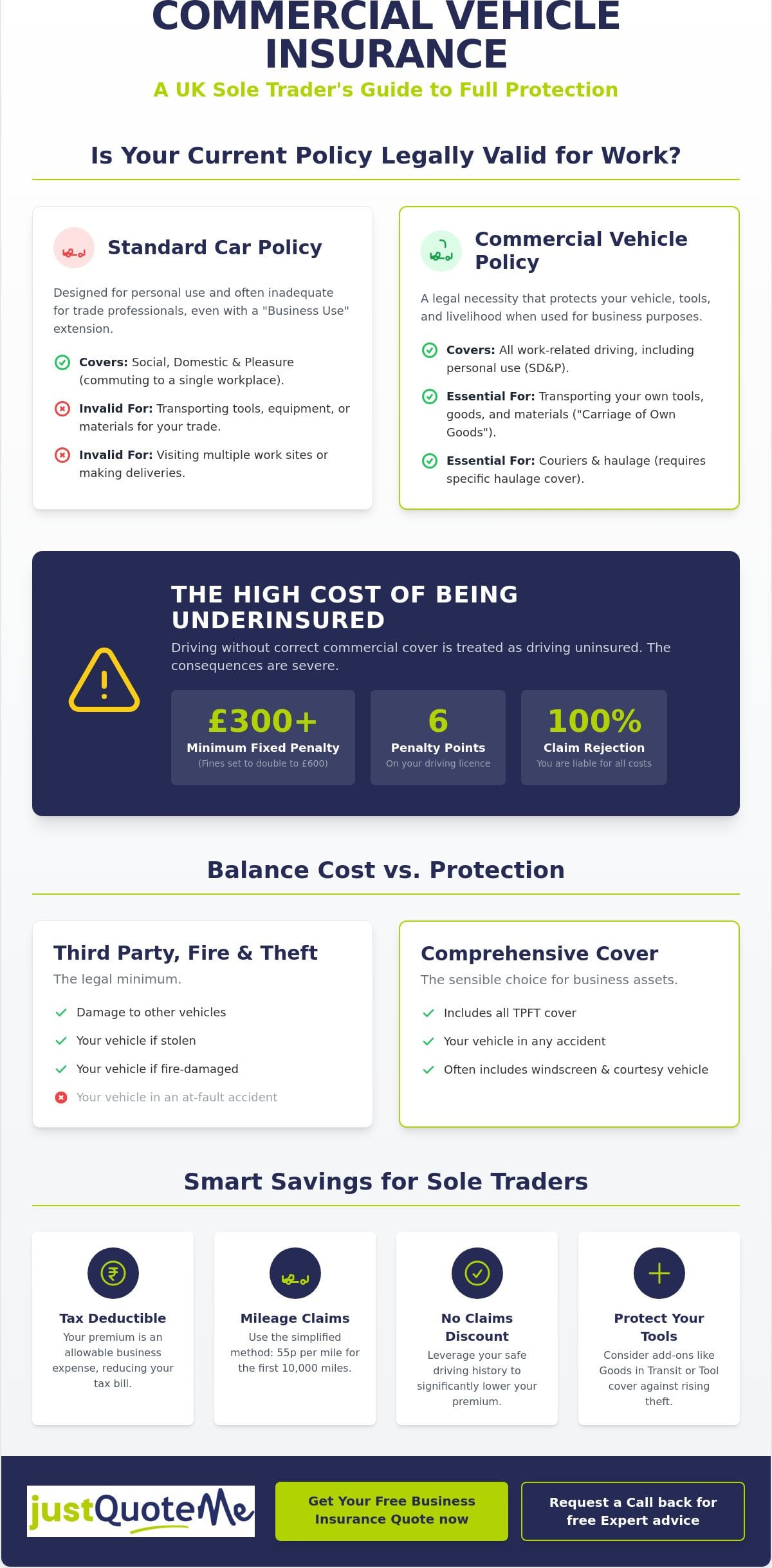
Commercial vehicle insurance for sole trader is a legal necessity for any vehicle used primarily for trade or professional services. While standard vehicle insurance provides a baseline for personal travel, it rarely meets the demands of a self-employed professional. Many sole traders mistakenly believe that adding “Business Use” to a personal policy offers sufficient protection. In reality, these extensions are often designed for office-based workers who drive to occasional meetings. If you carry tools, transport goods, or visit multiple work sites daily, a dedicated commercial policy is the only way to ensure your livelihood remains protected.
Social, Domestic, and Pleasure (SD&P) cover is designed for personal life. It assumes your vehicle is parked in a safe location during the working day and isn’t subjected to the high-mileage wear and tear common in trade industries. When you use a vehicle for work without the correct policy, you’re essentially driving uninsured. This exposure is a primary cause of rejected claims, leaving many professionals to foot massive repair bills out of their own pockets.
The Risks of Incorrect Class of Use
Insurers are increasingly sophisticated in how they identify undeclared business use during a claim. If an accident occurs while you’re performing a trade-related task on a personal policy, your insurer will likely void the cover immediately. This leaves you personally liable for all repair costs and third-party damages. Beyond the financial ruin of a voided policy, the legal repercussions are severe. Driving without the correct commercial cover is treated as driving without insurance, resulting in a fixed penalty of at least £300 and six points on your license. Government plans for 2026 suggest these fines could double to £600, making the risk of an incorrect class of use far too high for any serious professional.
Sole Trader vs. Limited Company Vehicle Needs
Your business structure dictates how you manage your vehicle and its insurance. As a sole trader, the vehicle is typically registered in your personal name, but its primary function is business. This differs from a Limited Company, where the vehicle is a corporate asset. For the self-employed, commercial vehicle insurance for sole trader is a tax-deductible expense. You can claim the actual costs of the policy or use the simplified mileage method, which recently increased to 55p per mile for the first 10,000 miles. Just Quote Me simplifies this transition for new professionals, ensuring you have the right documentation to satisfy both HMRC and the Road Traffic Act. We provide a steady hand to help you manage these administrative burdens so you can focus on your trade.
Choosing the Right Level of Commercial Vehicle Cover
Selecting the right tier of cover is about balancing upfront costs against the potential for total business disruption. While Third Party, Fire and Theft (TPFT) is the minimum required to protect against external liabilities, it leaves your own vehicle vulnerable in an at-fault accident. For high-mileage traders, comprehensive cover is often the most cost-effective choice. It typically includes essential extras like windscreen cover and courtesy vehicles that keep you on the road after a mishap. Since vehicle insurance is classified under allowable business expenses, the tax-deductible nature of the premium makes the jump to comprehensive cover a sensible investment for your primary business asset.
You should evaluate the current market value of your vehicle against the annual premium. If you drive an older van with low resale value, TPFT might seem attractive on paper. However, you must consider the replacement cost. If losing that vehicle would stop you from earning, the protection offered by a comprehensive policy is invaluable. When setting up your commercial vehicle insurance for sole trader, you also need to decide between “Named Driver” and “Any Driver” options. A named driver policy is generally cheaper and suits those who are the sole operators of their business. “Any Driver” cover provides much more flexibility if you occasionally need others to drive, though it usually carries a higher price tag.
Carriage of Own Goods vs. Haulage
The distinction between “Carriage of Own Goods” and “Haulage” is a common area of confusion that can lead to rejected claims. Carriage of Own Goods is the standard requirement for tradespeople, such as electricians or carpenters, who transport their own tools and materials to a job site. If you’re paid to transport goods belonging to other people, such as a delivery driver or courier, you require Haulage or Courier cover. Selecting the wrong category means you’re technically uninsured for your specific work activities. It’s often best to speak with a specialist broker to verify your specific classification before signing a policy.
Personal Use on a Commercial Policy
Don’t assume your commercial vehicle insurance for sole trader automatically covers personal trips like the school run or a weekly shop. To maintain protection during non-work hours, you need a “Dual Use” clause or a Social, Domestic, and Pleasure extension on your commercial policy. This ensures a single policy covers your entire life, providing seamless protection from the job site to your own driveway. For more information on balancing these professional and personal requirements, you can explore our guide on Insurance for Sole Traders & Self-Employed in the UK.
Essential Add-ons: Beyond the Basic Policy
A standard commercial vehicle insurance for sole trader policy primarily protects the metal shell of your van and your liability to other road users. It rarely extends to the thousands of pounds worth of specialized equipment stored in the back. In 2026, while vehicle premiums have stabilized, tool theft remains a persistent threat to trade professionals. Thieves often target commercial vehicles specifically for high-value power tools and diagnostic equipment. If you rely on your gear to complete a day’s work, a basic road-risk policy isn’t enough. You must integrate your vehicle cover with a wider business insurance portfolio to ensure every aspect of your operation is secure.
Beyond physical assets, a truly comprehensive portfolio includes protection for the business owner themselves. For expert help navigating complex health and life insurance plans, you can Just Ask The Insurance Guy for a free one-on-one consultation tailored to the needs of individuals and small businesses.
Most basic policies treat the contents of your vehicle as “personal effects” with very low claim limits. This is why many professionals opt for specific van and tools insurance as a vital add-on. This ensures that if your vehicle is broken into, you aren’t left to fund an entire new kit out of your own pocket. Integrating these protections into your commercial vehicle insurance for sole trader creates a comprehensive shield that keeps you working even after a setback.
Tool and Equipment Cover
Standard vehicle policies often exclude “goods and tools” entirely or offer negligible payouts. When selecting an add-on, you must pay close attention to the “Night-Time” clause. Many insurers require tools to be removed from the vehicle overnight or for the van to be parked in a locked building or a secure, well-lit driveway. Failing to meet these security criteria can result in a rejected claim. To simplify the process, maintain a digital inventory of your equipment with photos and serial numbers. This pragmatic step speeds up the claims process and ensures you receive the full value of your assets.
Public Liability and Goods in Transit
Your vehicle is often the place where your road risk and site risk overlap. If you cause an accident while driving, your motor policy responds. However, if you injure a pedestrian while unloading a heavy piece of plant machinery, you need public liability insurance to cover the legal costs. Furthermore, if you transport items belonging to customers, you require Goods in Transit cover. Bundling these protections with a trusted broker like Just Quote Me is significantly more efficient than managing multiple separate policies. We help you identify these gaps in your cover, ensuring your business is compliant and fully protected without the administrative burden of juggling different renewal dates.
How to Reduce Your Commercial Insurance Premiums
Lowering the cost of commercial vehicle insurance for sole trader doesn’t mean you have to settle for inferior protection. It’s about presenting a lower risk profile to insurers through pragmatic choices. Your No Claims Discount (NCD) is your strongest asset here. In the commercial market, a clean driving history is a major factor in pricing. Many professionals choose to pay a small supplement to protect their NCD, ensuring a single minor incident doesn’t reset years of earned discounts. An independent broker can often access “offline” rates not available on comparison sites, giving you a distinct advantage in a crowded market.
Your business location significantly influences your quote. For example, a professional based in Staffordshire towns like Stone, Stafford, or Newcastle-under-Lyme will typically see more favorable rates than a trader in London. Since London premiums can be nearly double the national average, regional traders should leverage their local advantage when seeking a quote. To see how much you could save based on your specific location and trade, get a personalized insurance review today.
Security Measures and Telematics
Insurers favor vehicles equipped with Thatcham-approved security hardware. Installing an alarm, immobiliser, or a high-quality tracker can lead to immediate premium reductions. Telematics, often called “black box” insurance, is another viable route for many sole traders. While it involves monitoring your driving style and mileage, the data can prove you’re a low-risk driver, leading to lower costs over time. Dashcams are equally valuable. They provide objective evidence in the event of an accident, which speeds up the claims process and protects your NCD from fraudulent claims or disputes.
The Broker Advantage: Tailoring Your Risk
Just Quote Me to bypass the frustration of automated comparison systems that don’t understand your specific trade. We act as your advocate, searching a panel of the UK’s leading insurers to find the best possible value. Unlike generic websites, we understand that a plumber in Stafford has different needs than a consultant in Newcastle-under-Lyme. We handle the complex administrative searching so you can stay focused on your work. Request a Call back for free Expert advice to review your current policy and ensure you aren’t overpaying for your cover.
Getting Your Quote with Just Quote Me
Securing commercial vehicle insurance for sole trader doesn’t have to be a slow or frustrating process. With over 30 years of experience in the UK market, we’ve refined our approach to move you from an initial inquiry to full protection with maximum efficiency. We understand that your vehicle is your office and your delivery hub. Any delay in getting the right cover is time you aren’t earning. Our role is to act as your steady hand, managing the complex administrative burdens so you can focus on your trade with total confidence. Just Quote Me to simplify your renewal and ensure your 2026 cover is both comprehensive and cost-effective.
A Local Service with National Reach
While we provide coverage across the UK, we’re particularly proud of our roots as a commercial insurance broker Staffordshire businesses can rely on. Whether you’re based in Stone, Stafford, or Newcastle-under-Lyme, we offer a human-centric alternative to the impersonal chatbots and automated phone systems of larger competitors. This regional expertise allows us to understand local risks and provide a level of individualized service that generic providers simply can’t match. We’re committed to the West Midlands business community, ensuring that local sole traders have access to the same high-tier insurance products as national firms.
Start Your Quote Today
Get Your Free Business Insurance Quote now
Request a Call back for free Expert advice
Secure Your Professional Future Today
Your vehicle is more than just a mode of transport; it’s the heart of your daily operations. Ensuring you have the correct commercial vehicle insurance for sole trader is the only way to protect your primary business asset and stay legally compliant. By selecting comprehensive cover and integrating essential protections for your tools, you build a resilient foundation that can withstand the unexpected challenges of 2026. Correct classification is non-negotiable if you want to avoid the financial ruin of a voided claim.
Relying on automated comparison sites often leaves you with dangerous gaps in your cover or unnecessarily high premiums. As an FCA-authorised independent broker with over 30 years of industry experience, we provide a steady hand in a complex market. We leverage our access to a broad network of top UK insurers to find a policy that fits your specific trade perfectly. Don’t leave your livelihood to chance. Take the next step toward total peace of mind and secure your business assets with Just Quote Me today. We’re ready to manage the administrative burden so you can get back to work with confidence.
Get Your Free Business Insurance Quote now
Request a Call back for free Expert advice
Frequently Asked Questions
Is commercial vehicle insurance more expensive than personal insurance?
Commercial vehicle insurance for sole trader is usually more expensive than personal cover because business vehicles are on the road more often. In 2026, the market is very competitive, so the price difference is less significant than in previous years. The premium reflects the professional nature of your work and the increased liability risks associated with trade use.
Can I use my personal No Claims Discount on a sole trader commercial policy?
Most UK insurers let you transfer your personal No Claims Discount to a commercial policy. This is a great way to lower your initial costs when starting out as a self-employed professional. You’ll need to provide written proof of your discount from your previous personal insurer during the quote process.
Do I need commercial insurance if I only use my car for occasional business meetings?
If you only drive to occasional meetings, a “Business Use” extension on your personal policy might be enough. However, if your vehicle is a primary tool of your trade or used to transport goods, you require a dedicated commercial vehicle insurance for sole trader policy. Using a personal policy for trade work can leave you uninsured and facing legal penalties.
What happens if my tools are stolen from my van overnight?
Tools stolen from your van aren’t covered by a standard motor policy. You need a specific tool insurance add-on to protect your equipment. Always check your policy for “Night-Time” clauses, as many insurers require tools to be removed or the vehicle to be parked in a secure location after hours.
Does commercial vehicle insurance cover me for driving other cars?
Driving other cars is almost never included in commercial policies. This is a common feature of personal insurance but is excluded from business contracts to manage risk more precisely. If you need to drive another vehicle, you’ll generally need to be added as a named driver on that specific policy.
How much public liability insurance does a sole trader need?
Most sole traders start with £1 million in public liability insurance, but many clients or trade bodies require £2 million or £5 million. The amount you need depends on the specific contracts you hold and the level of risk involved in your daily work. It’s an essential safeguard alongside your vehicle cover.
Is my trailer covered under my commercial vehicle policy?
Your commercial policy usually provides third-party cover for a trailer while it’s hitched to your vehicle. This covers damage you might cause to others. If you want to protect the trailer itself against theft or damage, you’ll need to add specific trailer insurance to your business portfolio.
Can I pay for my sole trader insurance monthly?
Yes, you can pay for your insurance through monthly direct debits to help manage your business cash flow. While paying annually is often cheaper, spreading the cost over the year is a pragmatic choice for many growing businesses. We can help you set up a payment plan that fits your budget.
