

Whether having no gas safety certificate invalidates landlord insurance depends on the policy wording. Most landlord policies require a valid certificate, and a policy may be void if the landlord has none. A missing record can put cover at risk, but the effect varies by policy.
It’s understandable to worry that one missed check could leave a rental property uninsured. The key is to separate the insurer’s terms from the landlord’s gas-safety duties: according to the Health and Safety Executive, landlords must arrange a gas safety check every 12 months for rental properties with gas appliances.
This article explains what a gas safety certificate records, how a missing or overdue check may affect a landlord insurance claim, and what to do if you discover a gap. It also covers how inspection records and policy conditions can help you understand your property’s protection.
Key Takeaways
- Understand how the gas safety check cycle works and what records landlords need to retain.
- Learn what the Gas Safety (Installation and Use) Regulations 1998 require of landlords.
- See why a Gas Safety Record, often called a CP12, matters when tenants move in and during a tenancy.
- Find out how a gas-related incident can bring insurance policy conditions and claim evidence into focus.
- Know what to review in your landlord policy if a safety-check gap could affect your cover.
Annual gas safety checks
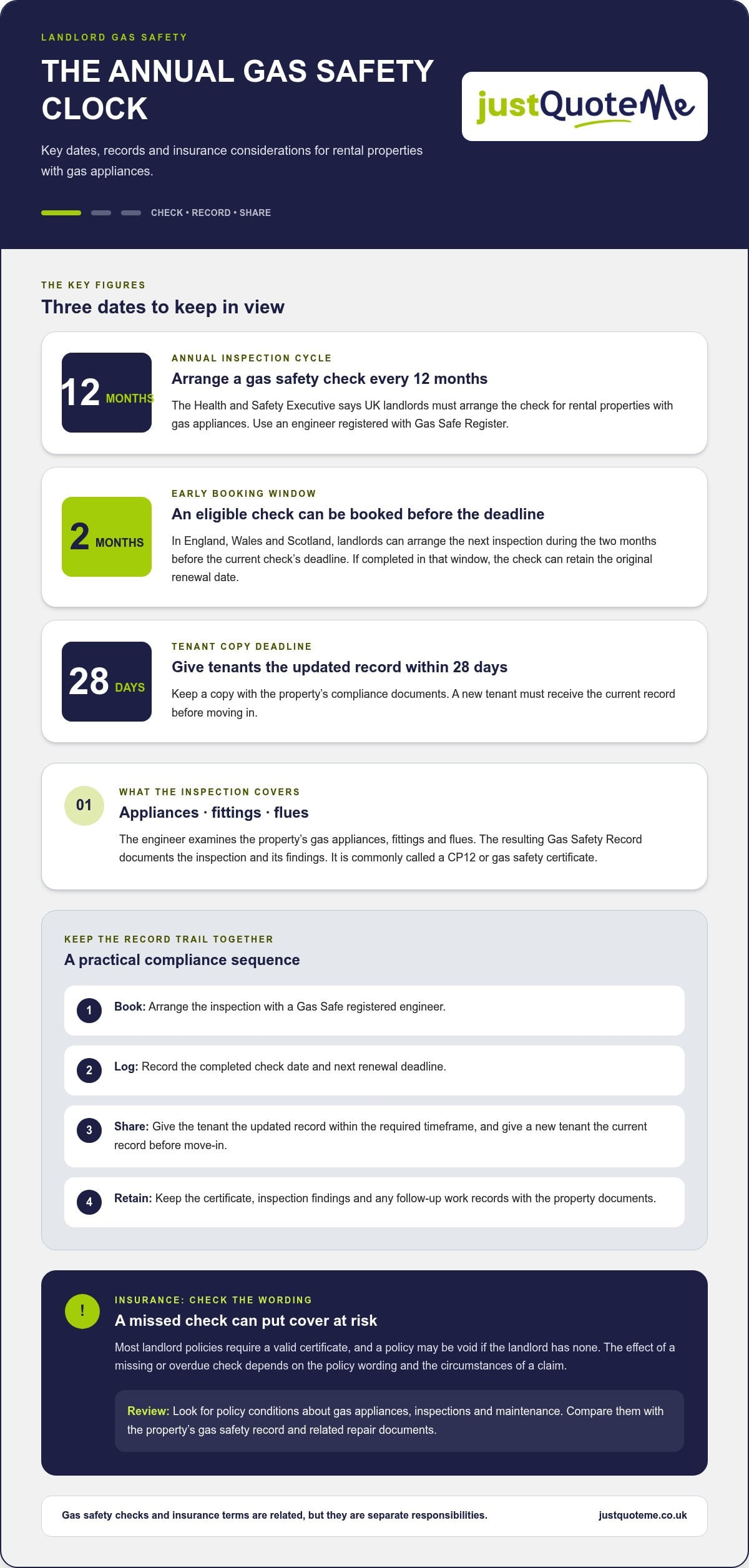
For a rental property with gas appliances, the inspection date is a recurring compliance deadline, not an optional maintenance reminder. According to the Health and Safety Executive, UK landlords must arrange a gas safety check every 12 months. The inspection should be carried out by an engineer registered with Gas Safe Register, who examines the property’s gas appliances, fittings and flues. The resulting gas safety record documents the inspection and its findings.
Keep the renewal date visible alongside tenancy and property records. In England, Wales and Scotland, landlords can arrange the next inspection during the two months before the current check’s deadline. Under the 2018 amendment, a check completed in that window can retain the original renewal date. UK legislation allows this arrangement, helping landlords book an engineer earlier without shifting the regular annual cycle.
For example, if a certificate is approaching its expiry date, the landlord can schedule the engineer within that two-month window rather than waiting until the final day. The new record can then follow the existing renewal date. This leaves time to arrange access or address faults identified during the visit. The window is a scheduling option, not permission to let the deadline pass without a completed check.
After the inspection, handle the record as part of the tenancy paperwork. According to the Health and Safety Executive, landlords must give tenants a copy of the Gas Safety Certificate within 28 days of the check. A new tenant must receive the current record before moving in. Keep the inspection date and a copy of the record with the property’s other compliance documents.
- Book a Gas Safe registered engineer for the inspection.
- Record the completed check date and the next renewal deadline.
- Give the tenant the updated record within 28 days.
- Provide the current record to a new tenant before they move in.
A missed check raises two separate concerns: a possible gap in safety compliance and questions about policy conditions if a claim follows. The insurance effect depends on the wording and the circumstances of the incident, so inspection records help show what was done and when. If an engineer identifies a problem, keep the report and follow-up work records with the certificate.
These dates are useful when reviewing landlord insurance documents. Look for conditions about gas appliances, inspections and maintenance, then compare them with the property’s gas safety record. A current inspection does not replace reading the policy terms, but organised records help clarify the timeline if an insurer asks about compliance after an incident.
What are the Landlord Gas Safety Regulations?
According to UK legislation, the Gas Safety (Installation and Use) Regulations 1998 set out landlords’ gas safety duties. Core rules cover Great Britain, while Northern Ireland has a separate framework, so the property’s location matters. UK law requires landlords letting homes with gas appliances to maintain gas safety compliance, including a valid record of checks.
Landlord Gas Safety Duties
Landlords have a duty to keep relevant gas fittings, appliances and flues safe and arrange inspections of covered equipment. Responsibility remains with the landlord for equipment they provide, even when a tenant uses it. If a tenant owns an appliance, the landlord is still responsible for ensuring the installation pipework is safe.
Treat gas safety as an ongoing property responsibility, not a task completed once at the start of a tenancy. Inspection records show when an engineer examined appliances and what action followed. If a report identifies a fault, arrange the necessary work and keep the documentation with the property records. For landlords seeking professional support with day-to-day oversight, working with real estate and property management specialists like Regal Gateway Property can help ensure ongoing property maintenance and compliance records remain fully organized.
Legal Requirement for a Valid Certificate
Yes. For a rental property with gas appliances, landlords must arrange the required checks and keep a current gas safety record. The record documents the engineer’s inspection, but it does not replace the duty to keep appliances and fittings safe. A certificate records a check at a particular time; the duty to maintain safety continues.
The relevant duties are set out in the Gas Safety (Installation and Use) Regulations 1998. A landlord preparing to let a property should ensure the record is current and provide it to the incoming tenant before occupation. For landlords seeking support with residential lettings and tenancy management, professional agencies such as winfieldsproperty.co.uk can assist in keeping documentation organized. Keeping the document with tenancy records makes it easier to demonstrate the inspection history if compliance is questioned.
Some related requirements vary by nation. Carbon monoxide alarm rules illustrate these differences:
- In England, an alarm is required in a living-accommodation room with a fixed combustion appliance, excluding a gas cooker.
- In Wales, an alarm is required in a room containing a gas, oil or solid-fuel appliance.
- In Scotland, an alarm is required where a fixed combustion appliance is present, except one used solely for cooking, or where there is a flue.
The property’s location matters when assessing wider safety duties. In England, consider the fixed-appliance rule; in Wales, account for the broader appliance wording. In Scotland, the flue requirement also matters. In Northern Ireland, follow the rules that apply there rather than assuming Great Britain’s framework covers every detail.
Gas safety compliance and insurance are related, but they are separate questions. A landlord may meet legal duties and still need to understand the policy conditions. Conversely, a current record does not remove the responsibility to maintain safe installations between inspections. Keep the certificate, inspection findings and repair records together to show a clear compliance history.
Landlord Gas Safety Record and CP12
A Landlord Gas Safety Record, commonly called a CP12 or gas safety certificate, documents an engineer’s inspection of gas appliances, fittings and flues. It records whether each item checked was safe and identifies any defect requiring action. The record is evidence of an inspection, not a guarantee that equipment remains safe indefinitely. Landlords should keep it with the property’s tenancy and maintenance documents.
Check that the record identifies the property and inspection date, and includes the engineer’s registration details. The required record includes the registration number of the individual engineer or their employer under regulation 3(3). That detail helps connect the inspection to the person or business responsible for the work. If a record is incomplete or difficult to match to the property, resolve the paperwork issue promptly.
Keep earlier records as well as the current certificate. According to the Health and Safety Executive, landlords must keep gas safety check records for at least two years. A sequence of documents can show when checks took place and help establish whether the inspection cycle was maintained. If a landlord cannot evidence the two previous inspections within the legal timeframe, the 12-month cycle resets from the most recent check.
A practical filing system makes that history easier to follow. For each property, retain:
- The current CP12 and earlier gas safety records.
- The inspection date and the next check deadline.
- Any report identifying defects or remedial work.
- Documents showing follow-up work was completed.
The record also matters when a landlord needs to demonstrate compliance in a possession matter. In England, possession rules changed on 1 May 2026, when Section 21 no-fault evictions were abolished. A gas safety record does not itself secure possession, but a clear inspection history helps document whether safety obligations were addressed. Keep the certificate accessible alongside tenancy documents, rather than relying on memory or an engineer’s separate files.
For a new tenancy, provide the incoming tenant with the latest gas safety record before they occupy the property. Keep evidence of when it was supplied, such as a dated email or signed acknowledgement. During the tenancy, provide the replacement record within 28 days of the check. These steps create a simple timeline: inspection, record, delivery and retention. That timeline can help answer questions from tenants, an authority or an insurer after a gas-related incident.
If a gas safety certificate is missing, first establish whether the inspection took place and whether the record can be retrieved. A completed check with missing paperwork is different from an inspection that never happened, but both require clear records. If no inspection occurred, arrange the required check and keep the resulting report with any follow-up documentation. Preserve evidence relevant to the property and incident, as policy conditions may also matter.
Insurance claims after gas-related incidents
A gas-related claim brings the incident, policy terms and property safety history into focus. Most landlord insurance policies require a valid gas safety certificate, and a policy may be void if the landlord has none. The insurer’s decision depends on the applicable wording and the facts surrounding the damage or injury. A missing document can raise a serious coverage issue, particularly if the incident involved an appliance or fitting that should have been inspected.
No. A certificate records an inspection at a particular time; it does not automatically protect a landlord from liability after an injury. The landlord’s actions, any known defect and the response to warnings can also matter. For example, a recent inspection record would not explain why a reported fault remained unrepaired.
After an incident, keep a clear account of what happened. Record the date, affected appliance or area, who reported the problem and what action followed. Preserve the gas safety record, engineer’s findings, repair documents and relevant tenant communications. If a Gas Safe registered engineer attends, retain their report and details of any work completed. These documents can help establish the sequence of events for the insurer.
When contacting the insurer, describe the incident accurately and follow the policy’s notification requirements. Do not assume a gas-related event automatically falls within cover, or that a missing certificate automatically settles every part of a claim. The insurer considers the applicable section, exclusions and conditions, the cause of loss and the evidence provided. A property damage claim may raise different questions from an alleged injury claim.
A useful claim file can include:
- The current and earlier inspection records for the rental property.
- Reports from the engineer who attended after the incident.
- Receipts or records for repair work and replacement parts.
- A dated account of tenant reports and the landlord’s responses.
If there is no current certificate, be precise about whether the inspection was missed or the paperwork is missing. Evidence that an engineer completed a check differs from evidence that no check took place. Look for a copy of the record, appointment correspondence or engineer report, and provide relevant documents through the insurer’s claims process.
Keep claim handling separate from any investigation into legal duties. A certificate is evidence of an inspection, not proof that every later safety concern was addressed. If an incident reveals an unresolved hazard, record the steps taken to make the property safe and preserve the related documents. Clear records help the insurer assess the claim and help the landlord explain decisions made before and after the incident.
Insurance cover and breaches of landlord obligations
A missing gas safety certificate creates two separate risks: possible non-compliance and possible insurance consequences. Most landlord insurance policies require a valid certificate, and a policy may be void if the landlord has none. Read the policy conditions alongside the property’s inspection records. A certificate gap matters, but its effect on cover depends on the relevant wording and the facts behind a claim.
Insurers may consider whether a gas-related loss is connected to the breach. For example, a fire involving a gas appliance raises different questions from unrelated storm damage. Relevant details include whether an inspection took place, whether a Gas Safe registered engineer identified defects, and whether the landlord acted on those findings. The cause of damage and the policy conditions help determine how the breach affects the claim.
Separate the insurance question from the landlord’s health and safety duties. A current certificate documents an inspection, but it does not prove every later fault was addressed. If a tenant reported a smell of gas or an appliance fault, the landlord’s response and repair records may be important. A serious incident can bring the inspection history, maintenance decisions and policy terms under close review.
Failure to comply with gas safety regulations in Great Britain is a criminal offence. Prosecution can result in an unlimited fine or imprisonment for up to six months. These penalties are separate from an insurance decision: criminal enforcement concerns legal duties, while a claim assessment applies the policy wording to the loss and available evidence.
After a breach or incident, organise the relevant documents before making a claim. Include the certificate or inspection history, engineer reports, records of remedial work and dated tenant communications. Explain accurately whether the check was missed or the certificate itself is missing. These are different circumstances, and clear evidence helps show what happened at the property.
- Compare the policy’s gas safety conditions with the property’s records.
- Keep engineer reports and evidence of follow-up repairs together.
- Record tenant reports and the landlord’s response dates.
- Notify the insurer in line with the policy’s claims process.
Don’t assume a certificate automatically guarantees a claim will be paid, or that every certificate gap voids every part of cover. The policy’s terms, the cause of loss and the landlord’s actions all matter. If you’re reviewing protection for a rental property, explore residential letting insurance in light of the property’s risks and compliance records.
Just Quote Me: Public Liability Insurance
Just Quote Me helps landlords consider how their insurance needs fit their property and its risks. Landlord Insurance is relevant when arranging cover for a rental property. Public Liability Insurance is a separate option and does not replace landlord cover or gas safety compliance.
If a missing certificate has raised questions about your policy, review the wording and inspection records together. For property-specific cover, explore residential letting insurance as part of that review. Just Quote Me also offers Employers Liability Insurance and Professional Indemnity Insurance for other relevant needs.
Contact Just Quote Me to discuss your landlord insurance requirements.
Make your next insurance review count
Whether a missing gas safety certificate invalidates your landlord insurance depends on the policy terms and the circumstances of a claim. Bring your insurance documents and property records together, then identify any gaps that need attention. Understanding your cover helps you make practical decisions about your rental property and its ongoing risks.
For protection beyond the property itself, Just Quote Me offers Public Liability Insurance, Employers Liability Insurance and Professional Indemnity Insurance. These are distinct types of cover, and the right option depends on the risks you need to address.
Explore your insurance options with Just Quote Me and take the next step with a clearer view of your cover.
Frequently Asked Questions
What Is a Gas Safety Certificate?
A Gas Safety Certificate, often called a CP12, is the record produced after a Gas Safe registered engineer inspects a rental property’s gas appliances, fittings and flues. It identifies the items checked and records the inspection findings. For example, if an engineer finds a fault with a boiler, the record can help show what was inspected and what action remains. Keep it with the property’s maintenance documents.
What Happens if a Property Fails Its Gas Safety Check?
If an inspection identifies an unsafe appliance or defect, the engineer records the finding and the landlord must address the safety issue. The next steps depend on the fault and the engineer’s advice. For example, a report might identify a boiler problem that needs repair before the inspection can be treated as satisfactory. Keep the report and evidence of the work together so the property file shows how the issue was handled.
What could happen if gas appliances are not properly maintained?
Poorly maintained gas appliances can create a risk of a gas-related incident or injury to tenants. A certificate records an inspection at a particular time; it does not show whether later faults were repaired. If a tenant reports a problem after the check, record the report and response, then arrange appropriate attention. This creates a clearer account of how the landlord handled the developing safety concern.
What happens if you don’t comply with your gas safety responsibilities?
Failure to comply with gas safety regulations in Great Britain is a criminal offence. Prosecution can result in an unlimited fine or imprisonment for up to six months. The Gas Safety (Installation and Use) Regulations 1998 set out landlords’ duties, so a missed inspection or unresolved safety concern can have consequences beyond an insurance claim. Keep inspection and repair documents available to show the actions taken.
Does missing a gas safety certificate automatically invalidate landlord insurance in the UK?
No, the absence of a certificate does not automatically invalidate every landlord policy. Most landlord insurance policies require a valid certificate, and a policy may be void if the landlord has none. The wording and circumstances matter. For example, an insurer may consider whether the loss involved gas appliances and whether the missing certificate relates to the cause of the claim.
What do UK landlord insurance policies say about gas safety certificate requirements?
Policy conditions may require landlords to keep a valid gas safety certificate and meet relevant safety obligations. Read the wording for requirements about inspections, maintenance and what to do after discovering a defect. Check the policy schedule and any endorsements as well as the main terms. A clause requiring a certificate may affect how the insurer assesses a claim linked to gas appliances.
Can an insurer reject a landlord claim if the landlord lacks a gas safety certificate?
An insurer may reject a claim if the policy terms allow it in the circumstances. The missing certificate alone does not explain the whole decision: the insurer may consider the cause of the loss, the relevant policy condition and evidence of inspections or repairs. For instance, a gas-related fire and unrelated storm damage may raise different questions under the same policy.
Does a missing gas safety certificate affect buildings, contents, liability, or rent guarantee cover differently?
Different policy sections address different types of loss. A gas-related fire may involve buildings or contents cover, while an injury claim may raise liability issues. Rent guarantee cover concerns a different loss. The policy wording and the link between the missing certificate and the claim are central. To consider your options, Get Your Free Business Insurance Quote now or Request a Call back for free Expert advice.
