

What if the £2 million cover you’ve carried for years is the very thing stopping you from winning your next big local council contract? In 2026, the UK construction landscape is more demanding than ever, and securing the right public liability insurance for builders is no longer just about basic protection; it’s a strategic tool for growth. You likely feel that insurance is an escalating cost that complicates your admin without offering clear value. It’s frustrating to see premiums rise while you’re left worrying if the fine print will actually protect your business during a major claim.
We understand that you want to get on with the job, not get bogged down in paperwork. This guide is designed to help you master the essentials of your coverage, ensuring you satisfy legal requirements and win more lucrative contracts. We’ll examine the latest 2026 standards, including specific tender requirements for regions like Staffordshire where minimums are strictly enforced. You’ll learn how to find policies that cover high-risk activities like working at height, how to avoid common claim rejections, and the most efficient way to get your certificate so you can start your next project without delay.
Key Takeaways
- Understand the core distinction between third-party injury and property damage to ensure your business stays protected against devastating legal fees.
- Discover why public liability insurance for builders is essential for winning Staffordshire County Council tenders, which frequently require a minimum of £5 million in cover.
- Learn how to structure your protection using the three pillars of construction insurance, including the legal necessity of Employers’ Liability.
- Identify why bespoke policies from an independent broker outperform generic comparison sites for high-risk work like working at height.
- Master the indemnity limits required for different contract sizes to ensure you’re never underinsured on a new job site.
Understanding Public Liability Insurance for Builders in the UK
In the construction trade, your workspace isn’t a controlled office; it’s a dynamic environment where risks change by the hour. Liability insurance serves as the foundational safety net for this volatility. For a builder, this specific coverage addresses the unique duty of care you owe to the public, visitors, and neighbouring property owners. Public Liability insurance protects builders from the financial fallout of accidental damage or injury caused to a third party during construction activities. Whether you’re a sole trader or managing a large firm, public liability insurance for builders ensures that a single mishap doesn’t end your career.
Why Builders Public Liability is Essential in 2026
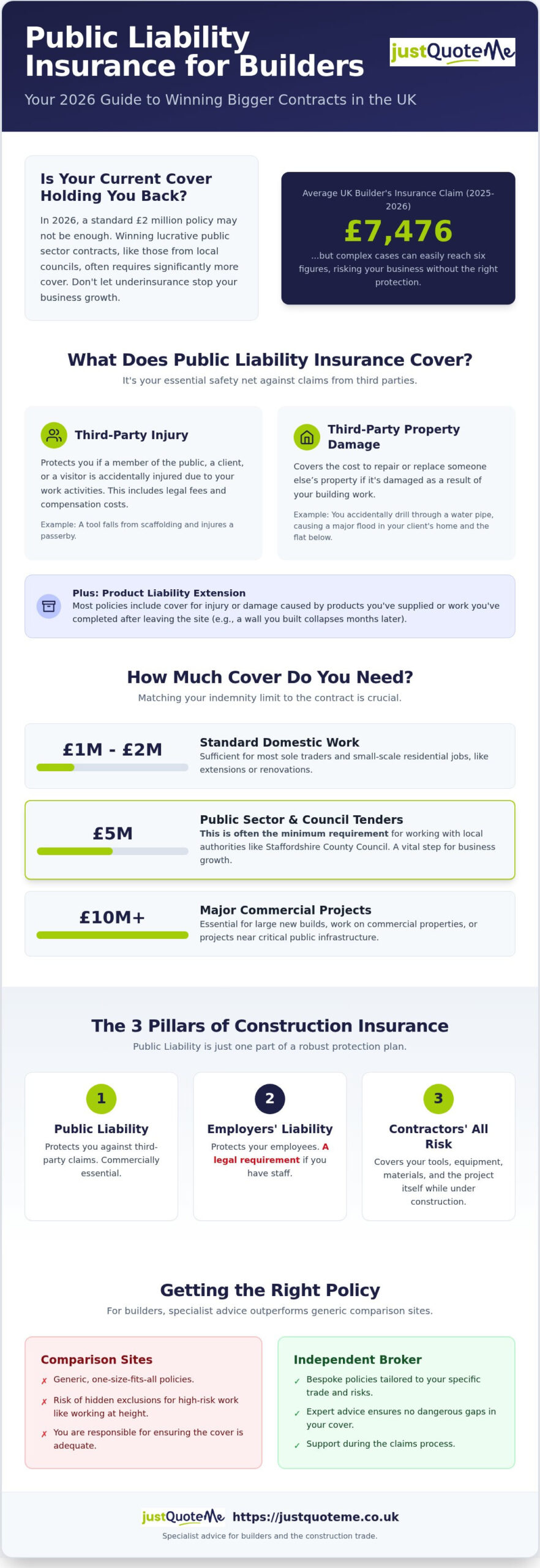
The UK construction sector has seen a steady rise in the cost of legal litigation. Data from the industry shows that the average builders’ insurance claim reached £7,476 between June 2025 and May 2026. While that figure might seem manageable, complex cases involving structural damage or long term injuries can easily escalate into six figures. Without a robust policy, these costs fall directly on your shoulders.
For many small businesses, a single successful claim for accidental injury can lead to immediate bankruptcy. Beyond the financial shield, there’s the peace of mind factor. Having professional cover allows you to focus on the build, knowing that legal fees and compensation costs are handled by experts who understand the nuances of the construction industry.
Legal Requirements vs. Client Expectations
It’s a common misconception that all insurance is legally mandated. Unlike Employers’ Liability, public liability insurance for builders isn’t a statutory requirement under UK law. However, it’s rarely optional in a commercial sense. Most reputable trade associations require proof of cover for membership, and you’ll find it nearly impossible to secure work as a subcontractor without it.
Main contractors and local authorities demand a valid certificate before you’re even allowed on site. This oversight aligns with the Health and Safety Executive (HSE) guidelines, which emphasise rigorous risk management. If you can’t prove you’re insured, you simply can’t compete for the best jobs in the market. In 2026, being uninsured is a fast track to being excluded from the most profitable tenders.
What Does Builder’s Public Liability Actually Cover?
A policy for public liability insurance for builders is designed to handle the fallout when things go wrong on site. While the previous section touched on its necessity, understanding the specific mechanics of your cover helps you avoid nasty surprises during a claim. This insurance primarily addresses two areas: third-party injury and third-party property damage. It also provides a vital legal shield, covering your defence costs even if a claim against you is fraudulent or wildly exaggerated.
Most comprehensive policies include “Product Liability” as an extension. This is critical for builders because it covers injuries or damage caused by materials you’ve installed or work you’ve completed after you’ve left the site. If a wall you built collapses six months later due to a perceived defect, this extension is what protects you. Following the Health and Safety Executive (HSE) guidelines helps prevent these incidents, but insurance is your fail-safe when human error or equipment failure occurs.
Common Claim Scenarios for UK Builders
To see how this works in practice, consider these frequent industry scenarios:
- Scaffolding Accidents: A passerby is struck by a falling bracket or a piece of timber that slips from a scaffold lift.
- Accidental Pipe Strikes: During a kitchen renovation, a drill bit hits an unmapped water pipe, causing significant flooding to the client’s home and the flat below.
- Excavation Issues: While digging foundations for an extension, the ground shifts, causing structural cracks in the neighbouring property’s boundary wall.
In each case, your policy manages the communication with the claimant and settles the compensation and legal fees. If you’re unsure if your current work fits these categories, you can speak with a specialist broker to review your risks.
Key Exclusions: What Is Typically Not Covered?
You shouldn’t assume your public liability policy is a “catch-all” for every business problem. It specifically excludes damage to your own property, such as your tools, plant, or materials stored on site. If your van is broken into or a digger is stolen, you’ll need separate plant and machinery insurance. It also won’t cover injuries to your own staff, which requires Employers’ Liability, or mistakes in your architectural drawings, which falls under Professional Indemnity.
The Importance of “Working at Height” Clauses
Height limits are one of the most common reasons for claim rejection. Many standard policies have a “height limit” clause, often capping work at 10 metres. If you’re working on a multi-storey project or a steep roofing job that exceeds this limit without a specific endorsement, your cover is effectively void. Always check your schedule for these restrictions. For more detailed advice on managing these risks, read our working at height guide to ensure your policy matches the scale of your projects.
Public Liability vs. Employers’ Liability and Contractors All Risk
Construction insurance isn’t a single policy but a combination of protections. While public liability insurance for builders is your primary shield against third-party claims, it leaves significant gaps in other areas of your operation. To build a robust business, you need to understand how these three pillars work together to cover your people, your projects, and the public.
Imagine a scenario where a scaffold collapses during a storm. Public liability handles the claim from an injured passerby. Employers’ Liability covers your injured worker. Contractors All Risk pays to replace the damaged structure and materials. This integrated approach is what separates a professional trade business from a high-risk gamble. Relying on just one element leaves your business exposed to the others.
Why You Need Employers’ Liability Insurance
If you employ even one person, Employers’ Liability is a legal requirement under the Employers’ Liability (Compulsory Insurance) Act 1969. The law is strict on this; the standard required coverage level is £10 million. This isn’t just for full-time staff. It extends to casual labour, apprentices, and even labour-only subcontractors who work under your supervision. Failing to carry this cover can result in heavy fines for every day you are uninsured. For a detailed breakdown of your legal obligations, visit our employers liability insurance page.
Protecting the Project with Contractors All Risk
One of the most dangerous gaps in a builder’s portfolio is the “works in progress” gap. Public liability covers damage to a client’s existing property, but it doesn’t cover the new extension you’re currently building if it burns down or is flooded. While Public Liability covers people, Contractors All Risk protects the project itself from fire, flood, or theft.
This policy covers both permanent and temporary works, including the materials you have stored on-site waiting for installation. It is particularly valuable for handling “Acts of God” such as severe storms or sudden subsidence that could otherwise leave you with a total financial loss. You can find out more on our contractors all risk insurance page.
The Role of Plant and Machinery Insurance
Your tools and equipment are the lifeblood of your trade. Whether you own your excavators and mixers or rely on hired-in kit, plant and machinery insurance provides the necessary protection against theft or breakdown. Many hire agreements mandate that you insure the equipment for its full replacement value. This ensures you aren’t paying out of pocket for expensive repairs or replacements while a job is at a standstill.
How Much Cover Do You Need to Win Staffordshire Tenders?
While £1 million might cover a minor domestic repair, it’s increasingly seen as the bare minimum in the UK construction industry. Most policies for public liability insurance for builders offer indemnity limits in fixed tiers: £1 million, £2 million, £5 million, or £10 million. Choosing the right level isn’t just about risk management; it’s a commercial decision that dictates which jobs you can actually pitch for. If you’re aiming to grow your business, carrying a higher limit is often the most cost effective way to open doors to larger contracts.
For those looking to secure public sector work, the bar is set high. Staffordshire County Council typically requires a minimum of £5 million in public liability insurance and £10 million in employers’ liability insurance for most works type agreements. If you don’t meet these thresholds, your bid is often rejected before the technical assessment even begins. High level insurance acts as a vital pre qualification tool, proving to procurement officers and main contractors that your business is stable, professional, and fully accountable.
Regional Requirements: Staffordshire and the West Midlands
Local tender processes in Newcastle under Lyme, Stone, and Stafford are highly competitive. Being a local, fully insured builder builds immediate trust with both commercial clients and Staffordshire homeowners. Residents in the West Midlands are becoming more savvy; they often check for robust insurance credentials before allowing a builder onto their property. Just Quote Me has been a local Staffordshire broker since 1989, helping tradespeople navigate these regional expectations with bespoke policies that satisfy both local authority rules and private client demands.
How to Calculate Your Ideal Indemnity Limit
To find your ideal limit, you must look beyond the contract value. A small project in a busy city centre carries a higher risk of third party injury than a large build on a rural site. You should factor in the scale and environment of your projects. While residential extensions might only require £2 million, commercial builds usually demand at least £5 million. Always evaluate the maximum potential “worst case scenario” for a single site. If a structural failure affected a neighbouring building or caused a serious injury, would your current limit cover the rebuild, compensation, and escalating legal fees?
If you’re a domestic builder taking on a one off commercial contract that requires £10 million, you don’t necessarily need to overhaul your entire annual policy. You can often use “excess layer” insurance to top up your existing cover for the duration of that specific project. This flexibility allows you to scale your business without committing to permanent overheads you don’t yet need. Get expert advice on your indemnity limits from our local team today to ensure you’re ready for your next big tender.
The Just Quote Me Difference: Tailored Advice for Builders
In an industry where a single error can lead to a claim worth thousands, relying on a generic algorithm is a risk few can afford. Just Quote Me stands as the human alternative to faceless comparison sites. As an independent, FCA-authorised broker with over 30 years of experience, we don’t just sell policies; we build protections. Our deep roots in the construction sector mean we understand the specific challenges you face on site, from the first dig to the final sign-off. By working with a panel of top UK insurers, we ensure your public liability insurance for builders isn’t just a certificate, but a robust financial shield tailored to your specific trade.
We pride ourselves on being a steady hand in a complex market. While automated systems treat your business as a data point, we treat you as a partner. Our team manages the complex administrative burdens so you don’t have to, providing a pragmatic and helpful service that speaks directly to your needs. This individualized approach is what has defined our reputation in Staffordshire and across the West Midlands since 1989.
Why a Bespoke Policy Beats a “Cheap” Online Quote
Many builders are lured in by the lowest price on a comparison screen, only to find the fine print excludes their most common activities. Generic policies often carry hidden exclusions for specific trades or high-risk tasks. If you’re a roofer or working on multi-storey projects, a “one size fits all” policy might leave you completely exposed when you need it most. We’ve seen many tradespeople struggle with claim rejections because their online policy didn’t account for the reality of their work.
We take a different approach by looking at your specific risk profile to ensure there are no gaps in your cover. If you ever need to make a claim, you won’t be dealing with an automated phone menu or a chatbot. You’ll have an expert advocate who knows your business and will fight your corner with the insurer. This level of personal service and professional restraint is why thousands of tradespeople trust us to manage their risk. For a wider look at how we protect different sectors, see our tradesman insurance guide.
Get Started with Just Quote Me Today
Securing the right public liability insurance for builders shouldn’t be a headache that keeps you from the job site. Whether you’re based in Stafford, Stone, or anywhere across the UK, our process is designed for maximum efficiency. You can use our online system for a quick indication or request a callback to speak with a specialist who understands the nuances of 2026 tender requirements. We’re committed to providing a frictionless experience that gets you the cover you need at a price that makes sense for your business.
Get Your Free Business Insurance Quote now
Secure Your Trade and Win Your Next Contract
Mastering your insurance requirements is a strategic move that sets your business apart from the competition. Having the correct level of public liability insurance for builders is more than a safety net; it’s a prerequisite for high-value tenders and local authority work in Staffordshire. By aligning your indemnity limits with client expectations and understanding how your coverage integrates with Employers’ Liability and Contractors All Risk, you eliminate the risk of underinsurance and project delays.
Don’t leave your business’s future to a generic online algorithm that might miss the nuances of your trade. Just Quote Me offers the human-centric expertise you need to navigate a complex market. As an independent, FCA-authorised broker with over 30 years of experience, we provide the steady hand and local Staffordshire service required to protect your livelihood. We’re here to manage the administrative burden so you can focus on the build. Get your trade protected today and step onto your next site with complete confidence.
Frequently Asked Questions
Is public liability insurance a legal requirement for builders in the UK?
Public liability insurance is not a legal requirement under UK law, but it’s almost always a contractual mandate. Most trade associations, main contractors, and local authorities like Staffordshire County Council won’t allow you on site without a valid policy. While you won’t be fined by the government for not having it, you’ll find it nearly impossible to win professional work or join reputable industry bodies without proof of cover.
How much does public liability insurance for builders cost in 2026?
The cost of public liability insurance for builders depends on several variables, including your annual turnover, the number of employees, and the specific risks of your trade. Working at height or using heat can increase premiums, as can your claims history. While basic policies are accessible, the most accurate way to find a price that reflects your specific business needs is to request a tailored quote from an independent broker.
Does builders public liability cover my tools and equipment?
A standard public liability policy does not cover your own tools or equipment. It is designed specifically to protect you against claims from third parties for injury or property damage. To protect your mixers, excavators, or hand tools, you should add a specific tools or plant and machinery extension to your policy. This ensures that if your gear is stolen or damaged on site, you can replace it quickly.
What is the difference between public liability and employers’ liability?
The main difference lies in who is being protected. Public liability insurance for builders covers claims made by the general public, clients, or other third parties for accidents caused by your work. Employers’ liability insurance is a legal requirement if you have staff and covers claims made by your own employees or labour only subcontractors for work related injuries. Most builders carry both as part of a comprehensive insurance package.
Can I get public liability insurance for a single building project?
Yes, you can obtain short term cover for a single project, though this is often less cost effective than an annual policy if you work regularly. Single project insurance is useful for specific high risk jobs that exceed your standard policy limits or for builders who only take on occasional contracts. However, most active tradespeople find that a rolling annual policy provides better value and ensures they are always ready to start new work.
Do I need insurance if I am a self-employed builder or sole trader?
Self employed builders and sole traders definitely need this insurance. Even if you work alone, you still owe a duty of care to your clients and the public. A single accident, such as dropping a tool on a passerby or striking a water pipe, could result in a massive compensation claim that you’d have to pay personally. Having a policy in place protects your personal assets from the fallout of business related accidents.
What happens if I work without public liability insurance?
Working without insurance exposes you to total financial ruin. If a claim is made against you for a serious injury or structural damage, you’ll be responsible for all legal defence fees and compensation payouts. Beyond the financial risk, many commercial clients and local councils will immediately terminate your contract if they discover you’re uninsured. It can also lead to long term damage to your professional reputation and exclusion from future tenders.
