

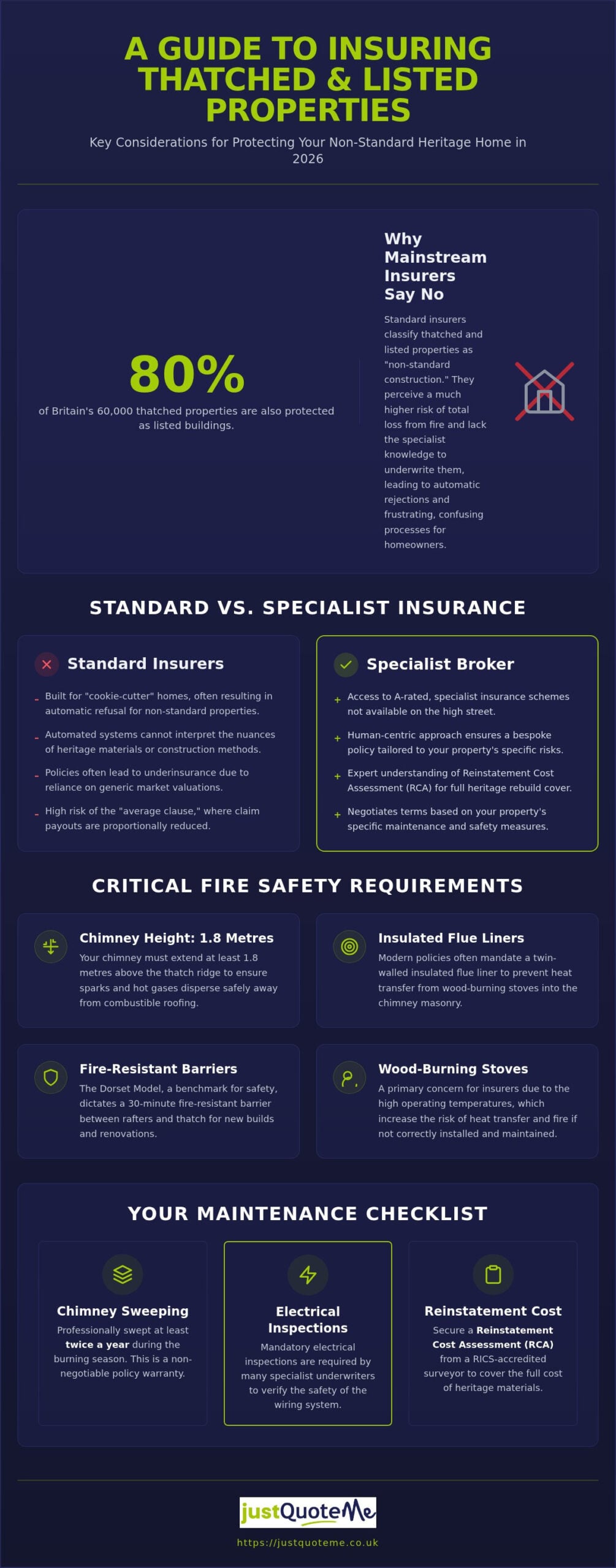
Did you know that approximately 80% of the 60,000 thatched properties across Britain are also protected as listed buildings? This dual status creates a complex challenge when you are searching for listed building insurance for thatched property, especially as standard insurers often retreat at the first mention of a straw roof or a heritage listing. It’s frustrating to face automatic rejections or confusing demands regarding chimney liners when you simply want to protect your home.
We understand that your property is more than just a building; it’s a piece of history that requires a specialist touch. This guide provides the expert clarity you need to secure comprehensive protection for 2026. You’ll discover how to navigate strict fire safety regulations, meet 1.8-metre chimney height standards, and ensure your policy covers the full specialist rebuild costs of heritage materials. By following our pragmatic advice on electrical inspections and maintenance, you can move beyond the fear of underinsurance and find a policy that balances robust security with affordable premiums.
Key Takeaways
- Understand why specialist underwriting is essential for non-standard homes to avoid the high rejection rates common with mainstream insurers.
- Learn how adhering to the Dorset Model, including specific chimney heights and lining regulations, can help secure more competitive market rates.
- Ensure your policy covers the full reinstatement costs of heritage materials to avoid the financial risks of underinsurance.
- Discover the essential maintenance steps required for listed building insurance for thatched property, including mandatory electrical and chimney inspections.
- Access bespoke advice from regional experts who manage the complex administrative burdens of heritage property protection on your behalf.
Understanding Listed Building Insurance for Thatched Properties
Insuring a home with a thatched roof requires a departure from the standard insurance market. While most homeowners can secure a policy in minutes online, those seeking listed building insurance for thatched property find themselves in a different category altogether. This is because thatched properties are classified as “non-standard construction.” Mainstream insurers often reject these risks because they perceive a higher probability of total loss in the event of a fire. The speed at which fire spreads through dry thatch means that insurers without specialist knowledge simply won’t take the gamble.
Working with an independent broker provides access to specialist A-rated insurance schemes that aren’t available on the high street. These underwriters understand the nuances of heritage materials and the specific risks involved. One of the most critical aspects of this cover is the Reinstatement Cost Assessment (RCA). If your property is underinsured, you risk being hit by the “average clause,” where the insurer reduces your payout proportionally to the level of underinsurance. This is a common pitfall for owners of heritage homes who rely on generic market valuations instead of specialist rebuild figures provided by a RICS-accredited surveyor. These specialist schemes are not limited to private residences; they also provide essential cover for commercial risks such as thatched pub insurance, where fire safety requirements are even more stringent.
The Definition of Non-Standard Construction
Insurers look closely at the specific materials used in your roof. There is a significant difference between water reed, which is generally more durable, and long straw, which may require more frequent re-ridging. Understanding Listed Building status is equally vital; whether your home is Grade I, II, or II*, the legal requirement to repair it using authentic materials and traditional methods drives up the cost of any claim. Standard home insurance rarely accounts for the specialist heritage craftsmanship needed to restore a 17th-century timber frame or a hand-knotted thatch. The listing status ensures the building’s character is preserved, but it also means repairs cannot be completed with modern, cheaper alternatives.
The Broker Advantage vs. Comparison Sites
Automated comparison sites are built for “cookie-cutter” brick-and-mortar homes. They struggle to interpret the nuances of a property with a thatched roof, often resulting in inaccurate quotes or outright refusal. A broker can negotiate terms based on your specific maintenance history, such as the date of your last electrical inspection or the height of your chimney. Bespoke insurance is a policy tailored to the exact architectural risks of a property. Unlike automated systems, a human-centric approach ensures you aren’t paying for cover you don’t need while guaranteeing that every heritage feature is fully protected. This personalised service is particularly valuable when documenting your proactive fire safety measures to lower your annual premiums.
Fire Safety Compliance: The Dorset Model and Beyond
Fire prevention isn’t just a safety choice; it’s a mandatory requirement for maintaining valid listed building insurance for thatched property. In 2026, the Dorset Model remains the definitive benchmark for fire safety in new builds and major renovations. It dictates specific structural protections, such as installing a 30-minute fire-resistant barrier between the rafters and the thatch. For existing heritage homes, underwriters look for equivalent risk mitigation. Wood-burning stoves are a primary concern because they operate at much higher temperatures than traditional open fires, increasing the risk of heat transfer through the chimney structure to the thatch.
To mitigate these risks, insurers insist on a chimney height of at least 1.8 metres above the ridge. This ensures that sparks and hot gases are dispersed safely away from the combustible roofing material. Modern policies often require the installation of a twin-walled insulated flue liner, which prevents heat from leaching into the surrounding masonry. If you’re unsure about your property’s current compliance level, speaking with an expert insurance broker can help you identify exactly what your specific underwriter requires before you commit to a policy.
Chimney and Flue Maintenance Standards
Regular maintenance is a non-negotiable policy warranty. If you use a solid fuel appliance, you’ll typically need to have your chimney professionally swept at least twice a year during the burning season. Many specialist underwriters now mandate a CCTV chimney survey every five years to check for internal cracks or structural decay. Regarding spark arrestors, the 2026 consensus among many fire professionals is to avoid them unless specifically required by your specialist thatched cover. This is because they can become clogged with soot, actually increasing the risk of a chimney fire.
Electrical Safety and Thatch-Safe Wiring
Electrical faults are a significant secondary cause of thatch fires. You must possess a valid Electrical Installation Condition Report (EICR), usually updated every five years, to prove your system is safe. In the loft space, where the thatch is most vulnerable, all wiring should be enclosed in fire-resistant, rodent-proof conduit. Rodents chewing through cables in the roof void is a common cause of ignition that is easily prevented. Additionally, modern safety standards require interlinked smoke and heat detectors on every floor and within the roof void itself. These systems ensure that if a fire starts in the thatch, you’re alerted immediately, providing vital minutes to evacuate and call emergency services.
Comparing Specialist Thatched Cover vs. Standard Insurance
Standard insurance policies often fall short because they assume a property can be repaired with mass-produced materials and general labour. When you’re arranging listed building insurance for thatched property, the policy must account for the reality that a total loss could take years, not months, to resolve. Standard alternative accommodation limits, often capped at 12 or 24 months, are frequently insufficient for heritage rebuilds. Specialist policies offer extended periods to cover the time needed for heritage planning permissions and the limited availability of master thatchers. This ensures you aren’t left paying for a rental home out of your own pocket while your property remains a building site.
Heritage material clauses are another critical differentiator. A standard policy might only cover “modern equivalent” materials. This would be a legal and financial disaster for a listed property where you’re legally required to use authentic thatch. You should also look for cover that includes hired-in plant. Scaffolding for a thatched roof isn’t a standard setup; it often requires specialist structures to protect the building while work is underway. These costs escalate quickly and aren’t always included in basic cover. Additionally, fire excesses on these properties are typically higher, reflecting the increased risk underwriters take on non-standard homes.
The Specialist Rebuild Cost Assessment
In 2026, the cost of sourcing authentic water reed or long straw remains high due to specialist labour shortages and material transport costs. Standard rebuild calculators used by comparison sites often underestimate the cost of a thatched roof by 50% or more. This leads to severe underinsurance. A professional assessment ensures your sum insured reflects the actual cost of master craftsmanship. Adhering to Fire Safety Compliance: The Dorset Model during a rebuild is often a requirement of the settlement, and your policy must provide the funds to meet these modern safety standards without compromising the building’s historic character.
Specialist Liability for Thatched Businesses
For business owners, the risks extend beyond the structure itself. If you run a hospitality business, thatched pub insurance is essential to manage the unique liabilities of a heritage environment. Historic buildings often have uneven floors, low beams, and narrow staircases that increase the risk of guest injury. Consequently, your public liability insurance should be set at a higher limit, typically £5 million or £10 million, to protect against claims in a high-risk setting. This cover ensures that your employees and guests are protected while in a building with non-standard fire risks, providing a safety net that standard commercial policies simply can’t match.
Your Thatched Property Maintenance Checklist
Proactive maintenance is the most effective way to lower your premiums and ensure your claims are handled without delay. For homeowners seeking listed building insurance for thatched property, a detailed maintenance log serves as vital evidence of your commitment to risk management. Insurers reward those who can demonstrate a history of professional care. Use the following five steps to keep your heritage property compliant with modern underwriting standards.
- Step 1: Document your thatching history. Keep a record of the materials used and the specific date of your last re-ridge.
- Step 2: Conduct a chimney inspection. Ensure your stack meets the 1.8-metre ridge height rule and that it has been swept by a registered professional within the last six months.
- Step 3: Update your EICR. Ask your electrician to verify that no junction boxes are exposed in the loft and that all wiring is rodent-proof.
- Step 4: Audit your fire safety equipment. Test your interlinked smoke alarms and ensure fire extinguishers and blankets are within their service dates.
- Step 5: Review your commercial property insurance. If you operate a business from your thatched premises, you must ensure your cover accounts for commercial liabilities.
Roof Condition and Re-thatching Schedules
The age and condition of your thatch directly impact your insurability. While a full coat of water reed can last up to 50 years, the ridge is a sacrificial layer that requires replacement every 10 to 15 years. Neglecting the ridge can lead to water ingress and rot, which insurers may classify as wear and tear rather than an insurable event. We recommend finding a Master Thatcher to conduct an annual visual inspection. Keeping these signed inspection reports on file proves to underwriters that the building is structurally sound, helping you maintain access to the best market rates.
External Risk Management
In 2026, underwriters have tightened rules regarding external heat sources. You should ensure that bonfires and firework displays are kept at a safe distance, typically a minimum of 100 metres from the thatch. Overhanging trees also present a risk; they trap moisture, preventing the thatch from drying out, and can cause physical damage during high winds. Beyond physical risks, high-value heritage homes should consider how physical security and cyber insurance work in tandem to protect your assets. If you need help organising your specialist cover, you can talk to our expert team for a personalised assessment.
Bespoke Thatched Property Insurance in Staffordshire
Just Quote Me stands as a Staffordshire-based independent broker with over 30 years of industry experience. We specialise in helping homeowners in Stone, Stafford, and Newcastle-under-Lyme navigate the complexities of non-standard risks. Large national insurers often rely on rigid automated systems that lack the flexibility to assess a heritage home accurately. When you encounter a “computer says no” response because of your roof type, we provide a human-centric alternative. We understand that finding listed building insurance for thatched property requires a partner who looks at the individual merits of your home rather than just a postcode on a map.
Our long-standing presence in the region allows us to manage the administrative burdens of insurance so you don’t have to. We maintain relationships with a panel of top UK specialist underwriters who trust our local expertise and pragmatic approach. This trust enables us to secure comprehensive cover that larger, more impersonal competitors often cannot access. Whether you own a private residence or need to protect a commercial asset, our focus remains on providing reliable, straightforward advice that simplifies the entire process.
Local Expertise for Staffordshire Homeowners
Personal service is vital when you’re dealing with the nuances of Grade II* listings or traditional water reed thatch. We know the local landscape and can often recommend regional surveyors who understand the specific architectural styles found across Staffordshire. This local knowledge helps us present your case to underwriters in the best possible light when you are arranging listed building insurance for thatched property. For owners who aren’t living in their heritage properties, we also provide specialised landlord insurance to ensure your investment is protected while occupied by tenants. Building a relationship with a local broker means you have a steady hand to guide you through any claims or renewals.
How to Get Your Bespoke Quote Today
Requesting a quote should be a frictionless experience. You can bypass the frustration of automated forms by requesting a call back for free expert advice from our team. When you speak with us, having a few details ready will help us move quickly. We’ll need to know the date of your last professional chimney sweep, the age of your electrical wiring, and the specific material used in your thatch. Because we offer a human-to-human service, we can discuss your maintenance history in detail, which often helps in lowering premiums through demonstrated safety compliance. All the advice we provide is free and comes with no obligation, ensuring you feel fully informed and secure in your choices for 2026.
Securing Your Heritage Home for 2026
Protecting a historic property requires more than a standard policy; it demands a partnership with specialists who understand the nuances of non-standard construction. By following the maintenance checklists and safety standards outlined in this guide, you can confidently navigate the 2026 insurance market. Proactive management remains your best tool for lowering premiums, whether you’re meeting Dorset Model requirements or ensuring your rebuild costs account for authentic craftsmanship.
Finding listed building insurance for thatched property doesn’t have to be a source of frustration. Our Staffordshire-based team at Just Quote Me leverages over 30 years of experience to provide the human-centric service that automated systems simply cannot match. We manage the complex administrative burdens so you don’t have to, ensuring your home is protected by top UK specialist underwriters who value your commitment to property care.
Ready to secure bespoke protection for your home or business? Get Your Free Business Insurance Quote now or Request a Call back for free Expert advice from our local advisors. We look forward to helping you preserve your piece of history with confidence and reliable security.
Frequently Asked Questions
Is it harder to get insurance for a thatched property in 2026?
Obtaining cover is more challenging in 2026 as mainstream insurers continue to withdraw from non-standard risks. With the average combined premium for a thatched home reaching approximately £2,404 in early 2026, owners often face limited options on standard comparison sites. Specialist brokers are now the primary route for securing listed building insurance for thatched property, as they have access to A-rated underwriters who understand heritage risks and provide bespoke terms based on safety compliance.
What is the Dorset Model and do I need to follow it for insurance?
The Dorset Model is a set of fire safety guidelines for thatched buildings, often referenced in UK Building Regulations. It includes requirements like a 30-minute fire-resistant barrier and chimneys at least 1.8 metres above the ridge. While technically for new builds or extensions, many specialist insurers use these standards as a benchmark for all properties. Adhering to these principles can significantly improve your insurability and help you access more competitive market rates.
Does a wood-burning stove make thatched property insurance more expensive?
Wood-burning stoves generally increase premiums because they are responsible for 70% of fires in thatched homes. These appliances operate at higher temperatures than open fires, increasing the risk of heat transfer through chimney walls. To manage this risk, underwriters usually mandate specific safety measures, such as twin-walled insulated flue liners and regular CCTV inspections. Demonstrating that your stove installation meets current HETAS standards is essential for maintaining valid cover and preventing premium spikes.
How often do I need to sweep my chimney for thatched insurance compliance?
Most specialist policies require you to have your chimney professionally swept at least once a year if it is in use. However, if you use a wood-burning stove or solid fuel appliance, many insurers now mandate a minimum of two sweeps per year. You must use a registered sweep and retain the certificates as proof of maintenance. Failure to provide these records during a claim can result in the insurer rejecting your settlement.
Can I get combined buildings and contents insurance for a thatched home?
You can certainly secure combined buildings and contents insurance through specialist providers. These bespoke policies are designed to cover the high reinstatement costs of heritage materials alongside your personal belongings. In 2026, the average combined premium for a thatched property was significantly higher than the £379 UK average for standard homes, reflecting the specialised labour and materials required. Combining your cover often simplifies the claims process and ensures there are no gaps in your protection.
What happens if my thatched property is underinsured?
Underinsurance triggers the “average clause,” which allows the insurer to reduce your payout by the percentage you are underinsured. For example, if you insure your home for £200,000 but the actual rebuild cost is £400,000, you might only receive 50% of any claim value. Given that full thatched roof replacements in 2026 typically range between £10,000 and £30,000, ensuring your sum insured reflects current specialist labour and material costs is vital for financial security.
Are there specific electrical standards for thatched properties?
Insurers typically require a valid Electrical Installation Condition Report (EICR) every five years. For listed building insurance for thatched property, there are additional expectations, such as ensuring all loft wiring is enclosed in fire-resistant, rodent-proof conduit. Junction boxes must also be properly secured and not left exposed in the roof void. These standards prevent common ignition sources and are often a mandatory condition for maintaining your policy’s fire cover.
Does the type of thatch (water reed vs. long straw) affect my premium?
The material used in your roof does influence your premium, as water reed is generally considered more durable and fire-resistant than long straw. Long straw often requires more frequent maintenance, such as re-ridging every 10 to 15 years, which insurers factor into their risk assessments. Providing your broker with the exact date of your last re-ridge and confirming the material type helps them negotiate more accurate and potentially lower rates with specialist underwriters.
