
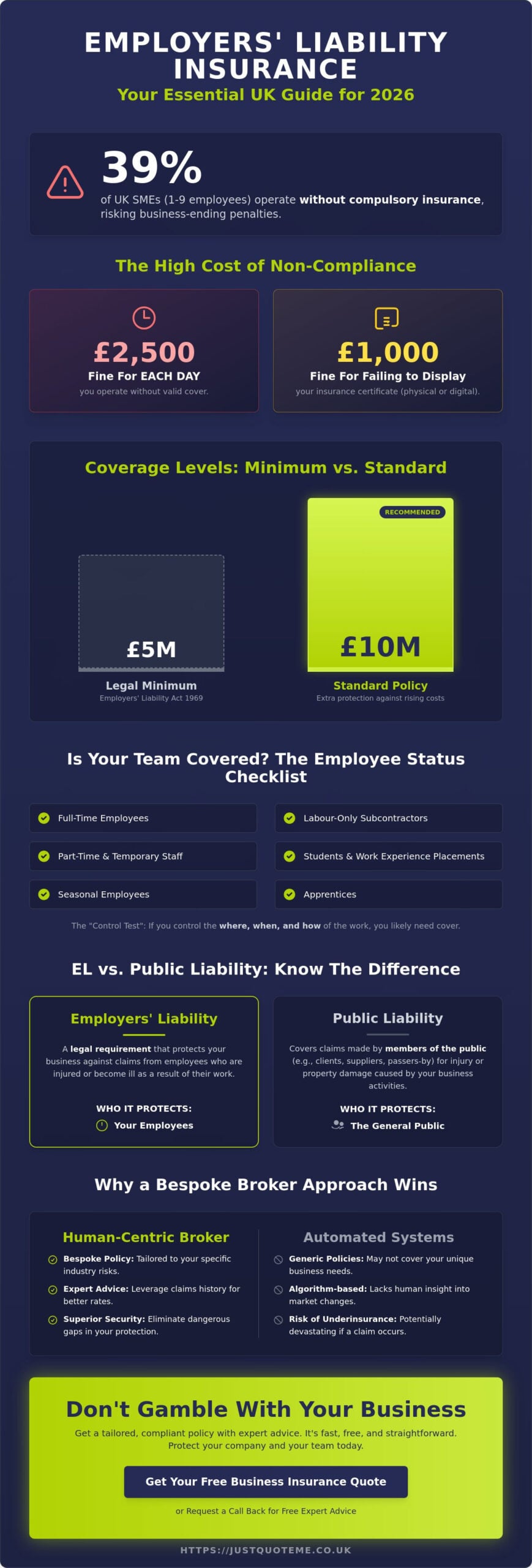
Did you know that 39% of UK small and medium-sized enterprises with one to nine employees were operating without compulsory employers liability insurance as of January 2026? This statistic highlights a massive financial gamble that could lead to business-ending penalties. You likely started your company to build something lasting; you didn’t sign up for the stress of £2,500 daily fines from the Health and Safety Executive or the headache of deciphering complex legal jargon regarding subcontractors and temporary staff.
We believe that managing your legal obligations should be straightforward and stress-free. This guide will help you master the legal requirements and cost-saving strategies available in the current softening market. You’ll gain a clear understanding of the £5 million legal minimum, learn how to protect your business against injury claims, and discover why a tailored approach is vital for full compliance. We’ll show you how to navigate policy limits and avoid the £1,000 fine for failing to display your certificate, ensuring your business remains secure and professional.
Get Your Free Business Insurance Quote now.
Request a Call back for free Expert advice.
Key Takeaways
- Understand your specific obligations under the Employers’ Liability (Compulsory Insurance) Act 1969 to avoid severe regulatory penalties.
- Use our definitive status checklist to confirm if your subcontractors, students, or part-time staff require mandatory coverage.
- Clarify the distinction between Public Liability and employers liability insurance to eliminate dangerous gaps in your company’s protection.
- Uncover the primary factors that influence your premiums and how you’ll leverage your claims history for better rates.
- Learn why a human-centric, bespoke broker approach offers superior security when it’s compared to automated systems.
Understanding Employers Liability Insurance: Legal Requirements for 2026
Running a business in the UK involves several administrative hurdles, but few are as critical as securing employers liability insurance. If you employ at least one person, this coverage is almost certainly a legal requirement rather than an optional extra. The primary goal is to ensure that if an employee is injured or becomes ill due to their work, your business can cover the resulting compensation and legal fees without facing financial ruin. It acts as a vital safety net for both your staff and your company’s stability. We’ve seen how quickly legal expenses can escalate, which is why we prioritise clarity over complex jargon when helping you set up your policy.
The legal foundation for this requirement is the Employers’ Liability (Compulsory Insurance) Act 1969. This legislation mandates that most employers must maintain a valid policy through an authorised insurer. Failure to comply isn’t just a minor oversight; it’s a criminal offence. The Health and Safety Executive (HSE) enforces these rules strictly across all sectors. If they find you’re operating without the correct cover, they can fine your business up to £2,500 for every single day you’ve been uninsured. For a small firm, these penalties can be devastating, often exceeding the cost of the insurance premium itself by a significant margin.
The £5 Million Minimum and Why Most Policies Offer £10 Million
By law, your policy must provide a minimum of £5 million in cover. While this is the statutory floor, you’ll find that most standard insurance policies actually offer £10 million as a default. This higher limit provides extra breathing room, especially as legal costs and medical compensation awards continue to rise in 2026. For businesses in high-risk sectors, such as construction or heavy manufacturing, even £10 million might be insufficient if multiple employees are involved in a single incident. At Just Quote Me, we specialise in structuring bespoke limits that reflect the unique risks of your specific trade, ensuring you aren’t underinsured when it matters most.
The Legal Role of the Health and Safety Executive (HSE)
The HSE doesn’t just wait for an accident to happen; they conduct regular inspections to ensure your employers liability insurance is up to date and valid. These inspections often occur alongside regular health and safety audits, so keeping your documentation organised is essential for a smooth visit. You’re required to display your insurance certificate where employees can easily read it. In 2026, digital certificates are the standard. You can satisfy legal requirements by making the certificate available on your company intranet or a shared digital drive, provided all staff know how to access it and have the means to do so. If an inspector asks to see your certificate and you can’t produce it or prove it’s accessible, you could face an immediate fine of £1,000.
Get Your Free Business Insurance Quote now.
Request a Call back for free Expert advice.
Who Needs Employers Liability Insurance? The Employee Status Checklist
Determining who requires coverage isn’t always as simple as looking at a payroll list. Many business owners mistakenly believe that only full-time staff count, but the law uses a much broader definition. According to UK government guidelines on employers’ liability insurance, you generally need cover for anyone you have a contract of service or apprenticeship with. This includes part-time staff, temporary workers, and seasonal employees. Even if you only hire someone for a single weekend, you are legally responsible for their safety while they work for you.
The “Control Test” is the primary tool used to decide if someone is an employee for insurance purposes. If you control where, when, and how the work is done, you likely need employers liability insurance for that person. Other indicators include providing the equipment they use, deducting National Insurance and tax from their pay, or preventing them from sending a substitute in their place. If you’re unsure where your team fits, our specialist advisors can help you clarify your status to ensure you’re fully protected.
Bona-Fide vs. Labour-Only Subcontractors
This is a common area of confusion that leads to significant legal gaps. Labour-only subcontractors work under your direct supervision and typically use your materials and tools. For insurance purposes, they’re treated as employees and must be covered by your policy. Bona-fide subcontractors, however, usually work on a specific project basis, provide their own equipment, and carry their own builders insurance. Always check their insurance certificates before they start work, as you could be held liable if they’re injured while working under your direction without their own cover.
Exemptions: When Is EL Insurance Not Required?
While the law is strict, there are a few specific exemptions. You don’t usually need employers liability insurance if your business is a limited company with only one employee who also owns 50% or more of the share capital. Family businesses are also often exempt if they only employ “close” family members, such as a spouse, parent, or sibling. However, this family exemption doesn’t apply if the business is incorporated as a limited company. Be cautious with complex partnership structures; assuming you’re exempt without professional verification is a risk that could lead to the heavy HSE fines mentioned earlier.
Get Your Free Business Insurance Quote now.
Request a Call back for free Expert advice.
Employers’ Liability vs. Public Liability: Knowing the Difference
Understanding the distinction between these two policies is vital for any UK employer. While they often appear together in a single business package, they serve entirely different purposes. Public Liability insurance covers claims made by third parties, which includes anyone who isn’t your employee, for injury or property damage. If a client slips in your office, Public Liability handles it. However, it specifically excludes your staff due to the ‘contract of service’ clauses found in standard commercial wording. If that same accident happens to an employee, your employers liability insurance is the only policy that can respond to the claim. Together, they create a comprehensive shield for your business operations. You can read more about third-party risks in our Public Liability guide.
Why One Policy Is Legal While the Other Is Commercial
The most significant difference lies in their legal status. As we’ve seen, UK government legal requirements make employers liability insurance mandatory for almost all businesses with staff. Public Liability, while not legally required by the state, is often a commercial necessity. Many trade associations, local authorities, and private clients won’t hire you without proof of both. This ensures that any damage you cause to their property or visitors is fully funded. To simplify your coverage, consider how these three pillars work together:
- Mandatory Protection: EL is a legal requirement for businesses with staff to cover workplace injuries.
- Commercial Credibility: Public Liability is often a contractual requirement for winning work and protecting the public.
- Expert Safeguard: Professional indemnity insurance covers you for financial losses resulting from professional errors or advice.
Case Study: An Accident on a Construction Site
Consider a scenario on a busy construction site. If a piece of scaffolding fails, it could cause a complex chain of events that triggers multiple insurance layers. If the falling material injures a site worker, the resulting compensation claim and legal defence fees fall under your EL policy. If that same material strikes a passing car or a member of the public walking nearby, your Public Liability policy takes over. In cases where the site itself, your expensive plant, or the ongoing works are damaged, you might also need contractors all risk insurance to cover the physical assets. Managing these overlaps requires a broker who understands how these policies interact on a practical level, ensuring there are no grey areas where a claim could fall through the cracks.
Get Your Free Business Insurance Quote now.
Request a Call back for free Expert advice.
Calculating the Cost of Employers Liability Insurance in 2026
Predicting the exact price of your coverage involves looking at several variables that insurers use to measure risk. In 2026, the commercial insurance market is experiencing a “softening” trend, with rates having decreased by approximately 6% in the latter half of 2025. This competitive environment offers a prime opportunity for businesses to secure better terms. Your primary cost drivers remain your total payroll and the nature of your trade. For example, low-risk office-based roles typically see premiums around £60 per employee annually. In contrast, manual labor sectors like construction can expect costs of £200 to £250 or more per worker due to the increased likelihood of workplace accidents.
Your claims history acts as a direct reflection of your business’s safety culture. A single significant claim can lead to premium loading for several years, as insurers view past incidents as predictors of future risk. Conversely, a clean record demonstrates reliability. While it’s tempting to search for the lowest possible price, you must ensure the policy remains fully compliant with the £5 million legal minimum. Choosing a “cheap” policy that contains restrictive exclusions or high deductibles can leave you exposed to the heavy HSE fines we discussed earlier. To find the right balance between price and protection, compare employers liability insurance with an expert broker.
High-Risk Industries and Premium Loading
Certain sectors naturally carry a higher risk profile, which is reflected in the premium. Industries like roofing, security insurance, and nightclub insurance often face higher rates because the work environments are inherently more dangerous or prone to conflict. At Just Quote Me, we leverage our 30 years of industry experience to negotiate with specialised underwriters. We present your business in the best possible light, highlighting your specific safety measures to secure rates that automated “one-size-fits-all” systems simply cannot access.
How to Lower Your Risk Profile
Insurers are increasingly rewarding businesses that demonstrate mature risk management practices. You can actively lower your premiums by maintaining robust documentation, including up-to-date risk assessments and detailed employee training logs. For those in sectors where road safety is a factor, you may check out Pass4you Driving School to understand how professional training contributes to a safer workforce. Enforcing strict PPE (Personal Protective Equipment) rules and keeping maintenance records for all machinery shows a commitment to safety that underwriters value. Additionally, ensure your business is correctly registered with the ELTO (Employers’ Liability Tracing Office). This database helps employees find their employer’s insurer even years after an incident, and being organised with your data helps your broker fight for the most competitive pricing available.
Get Your Free Business Insurance Quote now.
Request a Call back for free Expert advice.
Securing Your Policy: Why a Bespoke Broker Approach Wins
Choosing employers liability insurance shouldn’t feel like a transaction with a faceless algorithm. Many business owners get trapped in a “call centre” loop, where staff follow rigid scripts and lack real-world understanding of your specific trade. An independent broker offers a human-centric alternative. We prioritise efficiency without sacrificing the personal touch that defines a local service provider. With over 30 years of industry experience, Just Quote Me understands that your business is unique. We don’t just sell policies; we manage the administrative burden so you can focus on running your company with confidence.
Our independent status provides a significant advantage for your bottom line. Unlike direct insurers who only offer their own products, we access a broad panel of leading UK underwriters to find the most competitive rates. This is especially useful in 2026 as market conditions soften, allowing us to negotiate better terms that aren’t available to the general public. We also stand by you during the entire lifecycle of your policy. If a staff member makes a claim, you aren’t left to navigate the complex legal and medical jargon alone. We provide the steady hand and professional advice needed to ensure the process moves quickly and fairly, protecting your reputation and your finances.
Personalised Advice for Staffordshire and West Midlands Businesses
Local knowledge is invaluable when assessing regional trade risks. Whether your business operates in Stone, Stafford, or Newcastle-under-Lyme, we understand the local economic landscape and the specific challenges facing West Midlands firms. Regional expertise allows us to identify nuances in your operations that a national call centre would likely overlook. For example, a manufacturing firm in the Potteries has a different risk profile than a logistics hub in Stafford. A face-to-face meeting or a detailed phone consultation with an expert often uncovers these details. This ensures your employers liability insurance is tailored to your actual day-to-day activities, avoiding the dangerous gaps found in generic digital policies.
Getting Your Free Business Insurance Quote Now
Obtaining a bespoke quote is a simple, straightforward process designed for busy business owners. We prioritise efficiency and avoid the hyperbolic marketing speak common in the insurance industry. Our goal is to provide a personalised experience that leaves you feeling fully informed and secure in your choices. As an FCA-authorised broker, we adhere to the highest professional standards, ensuring your data and your business are protected by robust regulatory safeguards. Just Quote Me to simplify your administrative burdens and secure a policy that truly fits your needs.
Get Your Free Business Insurance Quote now.
Request a Call back for free Expert advice.
Protecting Your Business Future with Expert Guidance
Securing the right employers liability insurance is a fundamental step in safeguarding your company’s longevity and reputation. By understanding the broad legal definition of an employee and maintaining robust safety documentation, you position your business to thrive even in a complex regulatory environment. We’ve explored how a tailored approach prevents the pitfalls of generic policies while ensuring you meet the mandatory £5 million minimum. This clarity allows you to operate without the constant fear of HSE inspections or unexpected financial liabilities.
As an FCA Authorised independent broker with over 30 years of UK industry experience, Just Quote Me provides the steady hand you need. We leverage our access to a broad network of top UK insurers to find the most competitive terms available in the 2026 market. Our team manages the administrative weight so you don’t have to; providing expert support from the initial quote through to any potential claims. You deserve a partner who understands the nuances of your trade and the regional risks of the West Midlands. Just Quote Me today to simplify your insurance journey and gain the professional protection your business deserves.
Get Your Free Business Insurance Quote now.
Request a Call back for free Expert advice.
Frequently Asked Questions
Is employers liability insurance a legal requirement for a limited company with one director?
No, you’re exempt if you’re the sole employee and own at least 50% of the share capital. This exemption recognises that you’re unlikely to sue your own company for a workplace injury. However, the moment you hire a second person or take on an apprentice, the exemption vanishes. You must then secure a policy to avoid the heavy daily penalties enforced by the Health and Safety Executive.
What happens if I employ a family member without employers liability insurance?
You’re generally exempt if your business isn’t incorporated and you only employ close family like a spouse, sibling, or child. However, this exemption doesn’t apply to limited companies. If your family business is a limited company, you must have cover for everyone. Operating without it could result in a £2,500 daily fine, regardless of your personal relationship with the staff member.
Does employers liability cover subcontractors and freelancers?
Coverage depends on the “Control Test” rather than their tax status. Labour-only subcontractors who use your tools and follow your direct supervision must be covered by your employers liability insurance. In contrast, bona-fide subcontractors who provide their own equipment and work independently usually carry their own insurance. Always verify their certificates to ensure your business isn’t left exposed to an injury claim.
What is the minimum level of employers liability cover required in the UK?
The law requires a minimum of £5 million in cover under the Employers’ Liability (Compulsory Insurance) Act 1969. While this is the legal floor, most insurers in 2026 provide £10 million as a standard offering. This higher limit offers essential protection against rising legal fees and complex medical compensation awards. High-risk trades often require even higher limits to satisfy specific contract requirements.
Can I be fined if I don’t display my employers liability certificate?
Yes, you can be fined £1,000 if you fail to display your certificate or refuse to show it to an HSE inspector. In 2026, digital display is perfectly acceptable. You can store the certificate on a company intranet or a shared drive, provided all employees have easy access and know where to find it. Keeping your documentation organised is a simple way to avoid these unnecessary administrative fines.
Does employers liability insurance cover me for claims from former employees?
Yes, the policy covers claims from former staff for injuries or illnesses that occurred while they were in your employment. This is particularly important for industrial diseases that may take years or even decades to develop. Because of this long-term exposure, you should keep records of your insurance certificates indefinitely. The ELTO database also helps track these historical policies to ensure claims are handled correctly.
Is employers liability insurance tax-deductible for my business?
Yes, your insurance premium is considered a necessary business expense and is fully tax-deductible. You can offset the cost against your company’s Corporation Tax or your self-employed taxable income. This helpfully reduces the net cost of staying legally compliant. Always keep your invoices and policy documents safe to provide evidence for your annual tax returns or in case of an HMRC audit.
What is the difference between employers liability and professional indemnity?
Employers liability covers physical injury or illness suffered by your staff due to their work. Professional indemnity insurance protects you against financial losses a client suffers because of your professional errors, omissions, or bad advice. While EL is a legal mandate for businesses with staff, PI is a commercial necessity for most service providers. Both are essential pillars of a robust business protection strategy in 2026.
Get Your Free Business Insurance Quote now.
Request a Call back for free Expert advice.
