

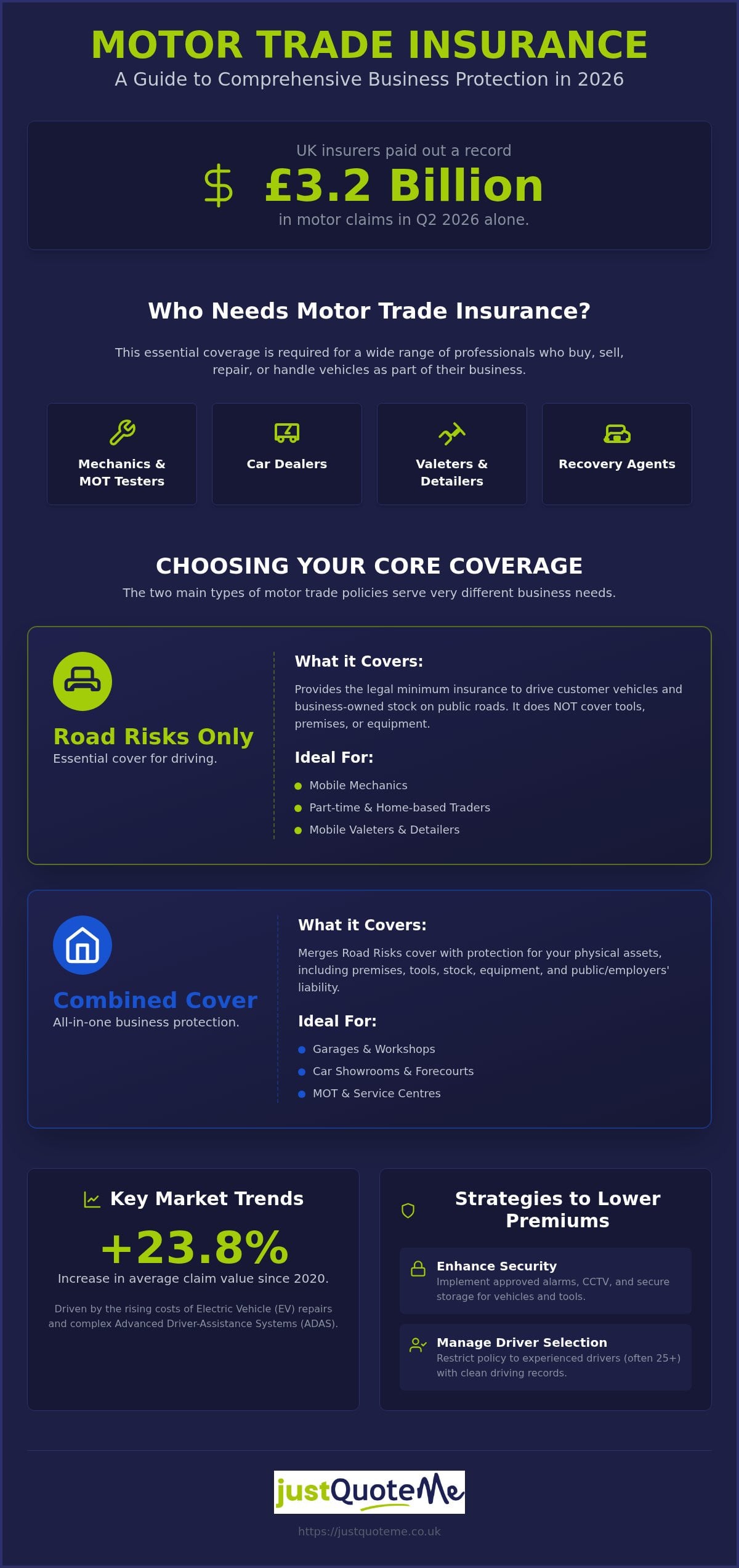
Did you know that UK insurers paid out a record £3.2 billion in motor claims during the second quarter of 2026 alone? This surge, driven by the rising costs of electric vehicle repairs and advanced driver assistance systems, is pushing motor trade insurance premiums to new heights. You probably feel the weight of these increasing overheads, especially when trying to differentiate between simple road risk and complex combined cover. It’s frustrating to manage the Motor Insurance Database (MID) while worrying about the high costs associated with younger drivers or high-risk stock.
We understand that you need reliability and clarity rather than automated responses. This guide will help you master the complexities of motor trade insurance with expert insights on road risks, combined policies, and how to secure the best coverage for your business. We’ll explore how to achieve comprehensive protection for customer vehicles, maintain legal compliance, and lower your annual premiums through pragmatic, expert advice. From the impact of the Automated Vehicles Act 2024 to the latest Euro 7 emissions standards, we’ll provide the structured information you need to stay protected and profitable in 2026.
Key Takeaways
- Understand the legal requirements for anyone trading in vehicles and how to maintain strict compliance with the Motor Insurance Database.
- Learn the essential differences between road risks and combined motor trade insurance to ensure your tools, premises, and stock are fully protected.
- Discover how to tailor your coverage to specific sub-trades, such as mobile mechanics or valeters, to avoid common gaps in protection.
- Identify practical strategies to lower your premiums by implementing enhanced security measures and managing driver selection more effectively.
- Find out how a bespoke, broker-led approach provides a more reliable alternative to automated systems for managing complex business risks.
What is Motor Trade Insurance and Who Needs It?
Motor trade insurance is a multi-faceted business policy designed for anyone who handles customer vehicles or operates a business centered around the automotive industry. It’s not just about driving cars; it’s about protecting your livelihood. While standard Vehicle Insurance Basics apply to private motorists, they are legally insufficient for commercial activities. If you’re moving, repairing, or selling vehicles as a business, you’re “trading,” and that requires a dedicated motor trade insurance policy to stay compliant.
The Motor Insurance Database (MID) plays a central role in this ecosystem. It’s the central record that the police and the DVLA use to verify that a vehicle is insured. As a motor trader, you’re responsible for keeping this database current. Failing to update the MID promptly can lead to significant legal headaches, including vehicle impoundment and heavy fines. We act as a steady hand, helping you understand these administrative burdens so you can focus on your work.
Who Qualifies for a Motor Trade Policy?
This insurance isn’t reserved for large dealerships. It’s essential for a wide range of professionals who handle vehicles they don’t own. Core trades that typically require this cover include:
- Mechanics and MOT testers
- Car dealers, whether operating from a forecourt or home
- Valeters and professional detailers
- Breakdown and recovery agents
The Legal Framework in 2026
Under the Road Traffic Act, you must have at least third-party insurance to operate on public highways. In 2026, the shift toward electric vehicles and autonomous technology has only made these obligations more complex. Failing to keep the Motor Insurance Database updated can result in immediate fixed penalty notices, vehicle seizure by the police, and a potential court prosecution.
Legal compliance is about more than just the vehicles themselves. For businesses that also provide technical advice or safety reports, such as vehicle inspectors, adding professional indemnity insurance can provide a vital extra layer of security against claims of professional negligence. Balancing these different legal requirements ensures your business remains robust against both road accidents and administrative errors.
Road Risks vs. Combined Motor Trade Insurance
Determining the right structure for your motor trade insurance depends entirely on your business model. It’s the difference between covering just the vehicles you drive and protecting your entire physical operation. For many, the choice boils down to whether you operate as a mobile service or from a dedicated workshop. We provide the steady hand you need to make these choices without the confusion of automated systems.
Deep Dive into Road Risks Only
Road Risk cover is the foundational level of protection. It allows you to legally drive customer vehicles and those owned by your business on public highways. You can choose from three tiers: Third Party, Third Party Fire & Theft, or Comprehensive. Comprehensive is often the wisest choice given that the average value of claims has risen by 23.8% since 2020. This increase is largely due to expensive ADAS components and electric vehicle technologies that make even minor bumps costly.
This setup suits mobile mechanics, valeters, and small-scale traders who don’t have a business premises. Since you’re likely operating out of a vehicle, you should also consider van tools insurance to protect the equipment you carry between jobs. It ensures that if your van is broken into, your livelihood isn’t put on hold while you replace expensive kit.
The Benefits of a Combined Policy
If you operate out of a garage, showroom, or workshop, a combined policy is usually the better fit. It merges road risk cover with protection for your physical assets. This includes the building itself, your office equipment, and your stock-in-trade. With insurers paying out record amounts for motor claims in 2026, having robust commercial property insurance integrated into your motor trade policy provides peace of mind against fire, theft, and flood.
Beyond physical assets, your policy must address liability. Public liability insurance is a non-negotiable addition. It protects you if a member of the public is injured or their property is damaged due to your business activities. Additionally, if you have even one part-time staff member, there is a legal requirement for employers’ liability insurance. Failing to have employers liability insurance can lead to daily fines of up to £2,500. If you’re unsure which path fits your current business model, speak to a specialist at Just Quote Me for a tailored assessment.
Tailoring Coverage to Your Specific Motor Sub-Trade
Motor trade insurance is often marketed as a broad category, but the risks faced by a mobile mechanic are vastly different from those of a high-end showroom. A generic policy can leave you dangerously exposed. For mobile mechanics, the challenge is balancing road risk with the liability of working on-site. You aren’t just driving the vehicle; you’re performing complex repairs in varied environments. Under the UK Road Traffic Act 1988, you must have insurance to drive on public roads, but that doesn’t cover the engine you’re stripping down or the brakes you’re replacing.
Valeting and Detailing Risks
Car valeters often assume that a standard liability policy covers every mishap. It doesn’t. Most basic policies exclude damage to the specific item you are working on. If a chemical spill ruins a bespoke leather interior, you could be facing a massive bill. This is why public liability insurance needs to be augmented with a “Damage to Property Being Worked On” clause. It’s a small detail that makes a huge difference when an accident happens during a deep clean or machine polish.
Dealership and Showroom Essentials
For those in vehicle sales, the focus shifts to inventory and demonstration. You need “Any Driver” cover to allow potential buyers to test drive vehicles legally. Without this, your sales process grinds to a halt. Protecting your stock-in-trade is equally vital. Whether you have five cars on a driveway or fifty in a showroom, you need protection against theft, vandalism, and accidental damage. You can find more detailed sales insights in our Ultimate Guide to Motor Trade Insurance, which covers the nuances of managing high-value stock and forecourt security.
Recovery agents face a unique set of transit risks. Towing a vehicle introduces variables that standard road risk policies simply don’t account for. You need specialist cover that protects both your recovery truck and the vehicle being transported. If a car slips from a winch or is damaged during a long-distance haul, you need to know your policy is robust enough to handle the claim. We pride ourselves on understanding these sub-sector nuances. We don’t just sell motor trade insurance; we provide the specific legal and financial safeguards your particular trade demands.
How to Lower Your Motor Trade Insurance Premiums in 2026
With motor insurance premiums forecasted to rise by 4% in 2026, finding ways to reduce your overheads is more critical than ever. Underwriters look for evidence that you are actively reducing risk rather than just reacting to accidents. Enhancing your physical security is the most direct way to influence your quote. Installing Thatcham-approved alarms, integrated CCTV systems, and ensuring vehicles are kept in secure, gated storage overnight can lead to meaningful discounts. Additionally, managing your business capital through resources like v8loans.com can help you navigate these rising costs by leveraging your existing vehicle assets. These measures don’t just lower your premium; they protect your reputation and your customer’s assets.
Driver selection is another pivotal factor in the cost of motor trade insurance. While it’s tempting to hire younger staff, drivers under the age of 25 often carry significantly higher premiums due to perceived risk. Prioritising experienced drivers with clean records is a proven strategy for keeping costs down. You can further bolster your profile by adopting technology. Dashcams and telematics provide objective proof of safe driving habits, which can be invaluable if you need to defend against a “cash for crash” claim or prove a clean driving history to a new insurer.
Risk Management and Documentation
Meticulous record-keeping is a hallmark of a low-risk business. You should maintain an updated file of all driver licences and check for penalty points at least once every six months. Accurate vehicle valuations are equally vital. If you overvalue your stock-in-trade, you are paying for cover you don’t need; if you undervalue it, you risk a reduced payout during a claim. As your business moves toward digital booking systems, remember that your liability extends beyond the road. Integrating cyber insurance into your business strategy protects you from the growing threat of data breaches and digital disruptions that could halt your operations.
The Value of an Independent Broker
Automated comparison sites are designed for simple, high-volume policies. They often struggle with the nuances of specialist trades, leading to “computer says no” results or inflated prices. Working with an independent broker gives you access to “broker-only” insurers who offer bespoke terms you won’t find on aggregators. We provide an annual policy review to ensure your cover still matches your business growth, preventing you from paying for obsolete protections. For a deeper look at how local expertise can benefit your firm, see our Commercial Insurance Broker Staffordshire guide. If you are ready to see how much you could save, contact Just Quote Me for a personalized assessment of your needs.
Why Choose Just Quote Me for Your Motor Trade Cover?
Our service is human-led. We’ve intentionally positioned ourselves as a human-centric alternative to the impersonal, automated menus used by national call centres. When you call our Stone-based team, you speak to an expert who understands the nuances of the automotive sector. We manage the complex administrative burdens, such as Motor Insurance Database (MID) updates and compliance checks, so you can focus on running your business. This pragmatic attitude toward the industry defines our relationship with our clients: we handle the paperwork, you handle the cars.
Our regional expertise in Staffordshire and the West Midlands is a significant marker of quality. We know the local business landscape, from regional crime statistics that affect premiums to the specific needs of tradespeople in our area. However, our local roots are backed by national reach. As an independent broker, we have access to a broad network of top UK insurers. This allows us to secure competitive pricing that often isn’t available on comparison sites or through direct insurers. If you operate a larger business, we can also provide specialized motor fleet insurance to streamline your cover under a single policy.
Beyond securing your policy, we act as your dedicated advocate during the claims process. If the unthinkable happens, you don’t have to face a faceless insurance giant alone. We provide the expert advice needed to ensure a fair and efficient outcome, helping you get back on the road as quickly as possible. This personalized support is a core part of our commitment to being a steady hand in a complex market.
Ready to Protect Your Trade?
The transition from an initial inquiry to comprehensive protection should be frictionless. As an independent, FCA-authorised firm, we provide reliable advice that prioritizes your business’s security. We understand that your vehicles and tools are your livelihood, and we treat them with the professional restraint they deserve. Don’t leave your legal compliance and financial stability to chance or an algorithm. Request a Call back for free Expert advice today and experience the difference that 30 years of specialized knowledge can make for your business.
Secure Your Business Future with Expert Protection
Operating a business in the automotive sector requires constant attention to detail, especially as vehicle technology and legal requirements evolve throughout 2026. We’ve explored how distinguishing between simple road risks and combined policies protects your assets, and how proactive risk management helps mitigate rising costs. Whether you’re a mobile mechanic or a large dealership, having a policy that mirrors your specific operations is the only way to ensure full compliance and financial security.
With over 30 years of expert insurance brokerage experience, Just Quote Me provides independent access to a wide panel of top UK insurers. We act as your steady hand, simplifying the administrative burden of motor trade insurance so you can focus on your customers. Our Stone-based team is ready to provide the human-led service you deserve, moving you quickly from a state of inquiry to complete peace of mind.
Get Your Free Business Insurance Quote now
Request a Call back for free Expert advice
Take the next step in safeguarding your livelihood with a partner who understands your trade’s unique demands.
Frequently Asked Questions
Who is eligible for a motor trade insurance policy?
Eligibility for motor trade insurance extends to anyone operating a legitimate business that involves handling vehicles they don’t own. This includes full-time and part-time mechanics, car dealers, valeters, and recovery agents. You must be able to prove your intent to trade, typically through business records or invoices. We specialize in tailoring these policies for diverse sectors, ensuring that whether you’re a mobile repairer or a showroom owner, you meet the legal criteria for coverage.
What is the difference between Road Risk and Combined motor trade insurance?
Road Risk is the foundational level of cover, allowing you to legally drive customer vehicles on public highways for business purposes. It’s the standard choice for mobile mechanics. Combined motor trade insurance is more comprehensive, protecting your physical business premises, tools, and stock-in-trade against risks like fire, theft, or flood. While Road Risk handles the driving aspect, a Combined policy acts as a total business safeguard for those operating from a garage, workshop, or forecourt.
How do I update the Motor Insurance Database (MID)?
You update the MID through your insurance provider’s online portal or a dedicated app. It’s a legal requirement to ensure the database reflects every vehicle currently in your possession for trade purposes. In 2026, the police use automated systems to scan plates, so delays in updating can lead to vehicle seizures. We help our clients manage these administrative burdens, ensuring your records stay compliant without disrupting your daily business operations or sales.
Can I include my own personal vehicles on a motor trade policy?
Yes, most underwriters allow you to include personal vehicles owned by you or your spouse, provided they are disclosed during the setup. This consolidates your insurance and can simplify your administrative tasks significantly. However, these vehicles must be registered to the policyholder or a named director. It’s important to clarify that high-performance or classic cars might require specific approval from the insurer to ensure they are fully protected under the broader business policy terms.
Does motor trade insurance cover me for part-time work?
Professional motor trade insurance is absolutely available for part-time traders. Whether you sell a few cars a month from home or perform weekend repairs, you still face the same legal liabilities as a large garage. Standard car insurance won’t cover these commercial activities, leaving you exposed to personal financial loss. We provide bespoke solutions that reflect your actual trading volume, ensuring you only pay for the level of protection your part-time business truly needs to stay legal.
What is “Damage to Property Being Worked On” cover?
This is a specific clause that protects you if a vehicle is damaged while you are actively repairing or cleaning it. Standard liability policies often exclude damage to the item in your care, custody, or control. For example, if a mechanic accidentally damages an engine during a strip-down, this cover triggers. It’s an essential addition for valeters and technicians who want to avoid paying for expensive customer repairs out of their own pocket after a mishap.
How much does motor trade insurance cost in 2026?
The cost of your policy depends on several variables, including your specific sub-trade, location, and the value of the vehicles you handle. While general motor insurance premiums are forecasted to rise in 2026, rates are also being influenced by the higher repair costs associated with electric vehicles and ADAS technology. Instead of providing a generic price, we focus on bespoke tailoring to ensure you aren’t overpaying for unnecessary cover while managing these market-wide inflationary pressures.
