
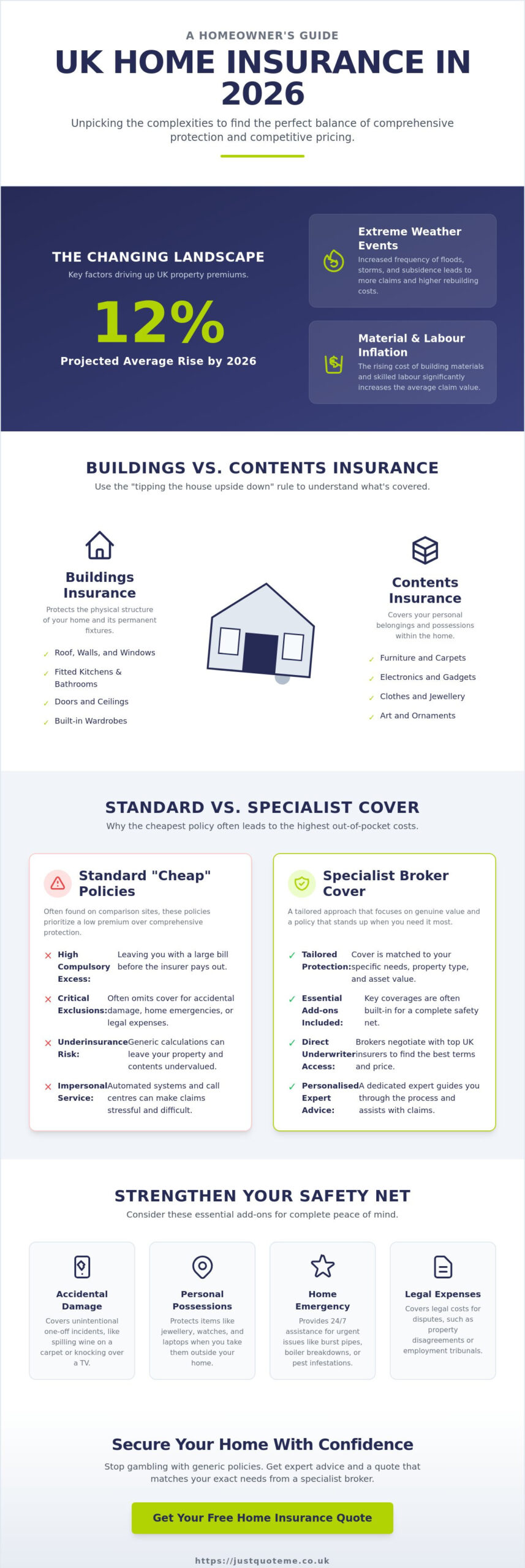
Would you still feel secure in your living room if you knew a single line of fine print could invalidate your entire claim? With UK property premiums projected to rise by an average of 12% throughout 2026 due to extreme weather trends and material inflation, finding the right home insurance has never felt more like a minefield. You’ve likely noticed that your renewal quote is higher than last year, yet the actual level of cover remains a mystery hidden behind industry jargon and complex terms.
We agree that securing your home shouldn’t feel like a gamble against a faceless corporation. This guide promises to help you unpick these complexities to find the perfect balance of comprehensive protection and competitive pricing. We’ll show you how to accurately value your belongings to avoid the trap of underinsurance, identify which add-ons are truly essential, and explain why a specialist broker offers a personal touch that an automated algorithm simply can’t provide. By the end, you’ll have the confidence to choose a policy that stands up when you need it most.
Get Your Free Business Insurance Quote now.
Request a Call back for free Expert advice.
Key Takeaways
- Understand how the 2026 landscape of inflation and climate change has reshaped UK premiums and why comprehensive protection is more critical than ever.
- Master the “tipping the house upside down” rule to accurately categorise your assets and ensure both your structure and belongings are fully insured.
- Discover why standard home insurance policies often fall short for high-value or non-standard properties and how bespoke underwriting provides a necessary safety net.
- Identify the true value of policy add-ons, such as accidental damage and personal possessions cover, to protect your tech and jewellery outside the home.
- Learn why a specialist broker offers a distinct advantage over comparison sites by providing direct access to top UK underwriters and tailored advice.
Understanding Home Insurance in 2026: Why Comprehensive Cover Matters
Home insurance acts as a critical financial safety net designed to protect your property and personal possessions from unexpected disasters. By 2026, the UK insurance landscape has shifted significantly. Data from industry analysts indicates that average premiums rose by approximately 11% between 2024 and 2025. This spike is largely driven by the increasing frequency of extreme weather events and the inflated cost of building materials. Gaining a foundational Understanding Home Insurance is the first step in ensuring you don’t end up underinsured when a crisis hits.
Many homeowners fall into the trap of selecting the lowest premium available on automated comparison sites. These “cheap” policies often carry high compulsory excesses and exclude essential coverages like accidental damage or home emergency assistance. When a claim arises, these budget options frequently result in thousands of pounds in out-of-pocket expenses. An independent broker helps you avoid these pitfalls. We filter through the noise of the crowded UK market to find genuine value rather than just a low price tag.
The Core Purpose of Your Policy
A standard policy protects you against specific “perils” that could otherwise cause total financial ruin. These typically include fire, flood, theft, and subsidence. Beyond the bricks and mortar, your policy should include legal liability cover. This protects you if a visitor is injured on your property and brings a compensation claim against you. Home insurance is a contract of indemnity that secures both the physical structure of your house and the continuity of your daily lifestyle.
- Buildings Cover: Protects the structure, including walls, roof, and permanent fixtures.
- Contents Cover: Protects your furniture, electronics, and personal items.
- Public Liability: Covers legal costs if someone is injured on your premises.
Is Home Insurance a Legal Requirement?
UK law doesn’t strictly mandate home insurance in the same way it requires motor insurance. However, if you have a mortgage, your lender will almost certainly require buildings insurance as a non-negotiable condition of the loan. They need to know their investment is protected. Choosing to be “self-insured” is a massive risk. By early 2026, the average rebuild cost for a standard three-bedroom home in many UK regions has climbed past £280,000, a figure most households cannot cover out of pocket.
Renters often assume they don’t need protection because the landlord handles the building. This is a common mistake. While residential letting insurance covers the landlord’s interests, it won’t replace your laptop, furniture, or clothes if there is a fire or burglary. Every resident needs a tailored plan to safeguard their specific assets.
Buildings vs. Contents Insurance: A Detailed Comparison
Understanding the difference between buildings and contents cover is the first step toward securing the right home insurance. A simple way to distinguish between them is the “tipping the house upside down” rule. Imagine you could lift your property and shake it. Anything that falls out, such as your sofa, television, or curtains, falls under contents insurance. Anything that stays attached, like the roof, walls, and fitted kitchen cabinets, requires buildings insurance. This distinction is vital because it determines how you calculate your total cover and ensures no assets are left vulnerable.
Many UK homeowners choose a combined policy for convenience and cost-effectiveness. The primary benefit is the single excess. If a major event like a flood damages both your flooring and your furniture, you only pay one excess fee rather than two. It also ensures seamless claim handling, as you only deal with one insurer. When you Compare Home Insurance Quotes, look for these bundled options to simplify your administration. Confusion often arises with “fixtures.” Generally, if an item is plumbed in or bolted down, it’s part of the building. This includes laminate flooring and bathroom suites.
Buildings Insurance Essentials
This cover protects the physical structure of your home. It includes the roof, walls, windows, and permanent fixtures. Standard policies also extend to outbuildings like sheds and garages, as well as boundary walls, fences, and gates. You are also covered for underground pipes and cables that provide services to the property. If your property is used for both living and business, you might need Commercial Property Insurance to ensure the entire structure is legally protected. Most mortgage lenders require buildings cover as a condition of the loan to protect their investment.
Contents Insurance Deep-Dive
Contents insurance covers your personal belongings. This includes furniture, electronics, clothing, and high-value items like jewellery. Most modern policies offer “new-for-old” cover, meaning the insurer replaces a damaged item with a brand-new equivalent. In contrast, “indemnity” policies deduct value for wear and tear, which can leave you short if you need to replace an expensive item. According to the Association of British Insurers, UK households are frequently underinsured by up to 20%. You must calculate your “sum insured” accurately by walking through every room and estimating the replacement cost of every item. This prevents the underinsurance trap where a claim is only partially paid out. If you feel overwhelmed by the calculations, seeking professional home insurance advice can provide the clarity you need.
Get Your Free Business Insurance Quote now.
Request a Call back for free Expert advice.
Standard Policies vs. Specialist Cover: Which Level Do You Need?
Choosing between a standard policy and specialist cover depends entirely on your property’s specific risk profile. Most off-the-shelf home insurance products are built for mass-market, modern brick houses. They use rigid algorithms to set coverage limits. If your home’s rebuild cost exceeds £1.5 million, or if the structure includes non-standard materials like timber frames or flint, these automated systems often underestimate the true cost of a claim. You need bespoke underwriting to ensure you aren’t left with a massive financial shortfall after a disaster.
Specialist Property Risks
Thatched properties require a different approach to risk management. Fire is the primary concern, but the cost of specialist materials and traditional craftsmanship is what often surprises owners. We apply the same depth of knowledge here as we do with thatched pub insurance, where understanding the nuances of reed and straw is essential. Listed buildings add another layer of complexity. Owners have a legal obligation under UK law to restore the property using original techniques and materials. A standard policy won’t always cover the premium prices charged by heritage-approved contractors.
Bespoke Solutions for Modern Living
Modern lifestyle changes have blurred the lines between domestic and professional spaces. By 2026, the “home office” is often a sophisticated business hub. While your home insurance might cover a basic laptop, it likely won’t protect £15,000 worth of specialized professional equipment or stock kept on-site. If you provide professional services from your residence, you should also look into professional indemnity insurance to protect your business reputation and finances.
- Short-term lets: Using platforms like Airbnb for more than 90 days a year can invalidate standard policies.
- High-value contents: Standard limits for “single items” often cap at £2,500, which is insufficient for high-end tech or jewellery.
- Unoccupied properties: If your home stays empty for over 30 consecutive days, most standard cover ceases.
We take a pragmatic approach to these challenges. We don’t believe in one-size-fits-all solutions. Instead, we focus on tailored protection that reflects how you actually live and work in 2026. This saves you time and ensures your most valuable asset is actually protected when it matters most. Our goal is to provide clarity so you can make an informed decision without the stress of deciphering industry jargon.
Get Your Free Business Insurance Quote now.
Request a Call back for free Expert advice.
Navigating the Hidden Extras: Add-ons and Common Exclusions
Standard home insurance policies provide a solid foundation, but they often leave gaps that only become apparent during a crisis. Accidental damage is one of the most popular add-ons, covering those “oops” moments like a foot through the loft ceiling or a red wine spill on a cream carpet. While it increases your premium, the cost is often negligible compared to the £2,000 price tag of replacing high-end flooring or electronics. If your household includes children or pets, this extra layer of protection is usually a sensible investment.
Personal possessions cover is equally vital for modern life. It extends your protection to items you take outside the house, such as smartphones, laptops, and jewellery. Most standard home insurance policies only cover these items while they are physically inside the building. In 2026, with the average person carrying over £1,200 worth of tech daily, this add-on ensures you aren’t left out of pocket if you’re targeted by theft or lose an item while commuting.
- Home Emergency Cover: This provides 24/7 access to qualified tradespeople for urgent issues like boiler failures or burst pipes. It typically covers call-out charges and basic repairs up to a set limit, often £500 or £1,000.
- Legal Expenses: This offers a steady hand if you face a boundary dispute, identity theft, or an employment tribunal. It covers the cost of professional legal representation which would otherwise be unaffordable for most individuals.
The “Small Print” You Cannot Ignore
You must understand what your policy won’t cover to avoid a rejected claim. Standard exclusions always include wear and tear, gradual deterioration, and damage caused by a lack of maintenance. If your roof leaks because you ignored slipped tiles for three years, your insurer will likely refuse the payout. Most policies also trigger the “Unoccupied Home” rule if you leave the property empty for more than 30 consecutive days. If you’re planning an extended holiday, you must notify your broker to arrange specialist cover.
Security requirements are another common stumbling block. Your policy documents will specify the types of locks and alarms required to validate your cover. If you claimed to have five-lever mortice deadlocks but a burglar enters through a simpler mechanism, the insurer may reduce or void your claim entirely. Always double-check that your physical security matches the descriptions in your policy schedule.
Avoiding Underinsurance
The “Average Clause” is a technicality that catches many homeowners off guard. If you insure your contents for £40,000 but a loss adjuster determines the true value is £50,000, you are 20% underinsured. Consequently, the insurer can reduce any payout by 20%, even for small claims. In 2026, rebuilding costs have surged due to a 12% increase in raw material prices and specialized labour shortages. The sum insured must reflect the cost to rebuild from scratch, not the market value. This ensures that even if a total loss occurs, you have the funds to reconstruct your home to its original standard.
If you’re unsure whether your current level of cover is sufficient, it’s best to speak with a specialist who can review your requirements.
Request a Call back for free Expert advice
Get Your Free Business Insurance Quote now
Securing the Best Home Insurance Quote: The Broker Advantage
Price comparison websites often fail the specialist homeowner because they rely on rigid, automated algorithms. These systems are designed for “standard” risks and frequently struggle with properties that have unique features, such as thatched roofs, timber frames, or extensive flat roofing. If your home falls outside these narrow parameters, an algorithm might generate an inflated premium or, worse, provide a policy that contains restrictive exclusions. JustQuoteMe offers a human-centric alternative, using 30 years of industry experience to find the right home insurance without the guesswork.
Our team maintains direct access to top UK underwriters, including specialist markets that don’t appear on standard search engines. This allows us to negotiate bespoke terms based on your actual circumstances rather than a computer-generated profile. We also act as your advocate during the claims process. If the unthinkable happens, you won’t be left dealing with a faceless call centre; we manage the communication with the insurer to ensure your claim is handled fairly and efficiently.
How to Prepare for Your Quote
To get an accurate home insurance quote, start by calculating your rebuild cost using the Building Cost Information Service (BCIS) tools. Don’t confuse this with the market value of your property. You should also list security features like BS3621 mortice deadlocks or approved alarm systems, as these can lower premiums. Specify high-value items such as jewellery or art valued over £2,500 to ensure they are fully covered. Landlords seeking a similar level of personal service for their portfolios can explore Residential Letting Insurance to protect their investments.
The Power of Expert Advice
A broker identifies critical gaps in cover that an algorithm would miss, such as “trace and access” limits or matching sets clauses. We help you tailor your voluntary excess to balance your monthly premium with what you can realistically afford to pay in the event of a claim. This professional oversight ensures you aren’t paying for unnecessary add-ons while remaining protected against major liabilities. For those who run a business from home, understanding Public Liability Insurance is also vital to ensure your professional activities don’t leave you vulnerable.
Get Your Free Business Insurance Quote now.
Request a Call back for free Expert advice
Take Control of Your Property Protection
Navigating the 2026 property market requires more than just a basic policy. You’ve now seen how distinguishing between buildings and contents cover serves as the foundation for total protection. Identifying hidden exclusions early ensures your future claims won’t face unnecessary hurdles. Finding the right home insurance shouldn’t feel like a chore or a gamble with faceless automated algorithms. It’s about securing peace of mind through clarity and expert oversight.
JustQuoteMe brings over 30 years of insurance industry experience to your search. As an FCA-authorised independent broker, we provide direct access to the most reputable UK insurer networks. We focus on straightforward, no-nonsense advice that cuts through technical jargon. You deserve a policy tailored to your specific lifestyle, not a generic solution that leaves you vulnerable. Our team is here to handle the heavy lifting so you can focus on enjoying your home.
Get Your Free Business Insurance Quote now.
Request a Call back for free Expert advice.
Protecting your assets is a vital step in securing your financial future, and we’re ready to help you get it right.
Frequently Asked Questions
Is home insurance mandatory for homeowners in the UK?
Home insurance isn’t a legal requirement in the UK, but it’s almost always a mandatory condition of your mortgage contract. Lenders require buildings insurance to protect their financial interest in the property until the loan is repaid. If you own your home outright, the choice is yours, though going without cover leaves you liable for the full cost of any structural damage or loss.
What is the difference between buildings and contents insurance?
Buildings insurance protects the physical structure of your home and its permanent fixtures, such as the roof, walls, and fitted kitchens. Contents insurance covers your personal belongings that aren’t part of the building’s structure, like furniture, clothes, and electronics. A simple way to distinguish them is to imagine turning your house upside down; anything that falls out is generally covered by contents insurance.
How much home insurance cover do I actually need?
You should base your buildings cover on the rebuild cost provided by the Royal Institution of Chartered Surveyors (RICS) rather than the property’s market price. For contents, you need enough cover to replace every item in your home with a brand-new equivalent. Many UK households underestimate their contents value by over £20,000, so it’s vital to conduct a room-by-room inventory to ensure your home insurance remains adequate.
Does home insurance cover my laptop and phone while I am out of the house?
Your standard policy won’t automatically cover gadgets outside the home unless you’ve added specific personal possessions cover to your plan. This optional add-on typically protects items like laptops, mobile phones, and jewellery against theft or accidental damage anywhere in the UK. Most insurers set a single item limit, often around £1,500, so you must specify high-value items individually to ensure they’re fully protected.
What happens if I work from home—does it affect my insurance?
Working from a home office for clerical tasks usually won’t change your premium, but you must inform your provider to ensure your home insurance remains valid. If you have clients visiting the premises or you store business stock worth more than £2,500, you might need a specialist policy. Failing to disclose business activities can lead to rejected claims, even for incidents unrelated to your work.
Why has my home insurance premium increased in 2026?
Premiums in 2026 reflect a 10% rise in subsidence claims following recent dry summers and the ongoing 12% Insurance Premium Tax. Supply chain issues have also pushed the cost of building materials up by 15% since 2024, meaning insurers must pay more for repairs. We help you navigate these market shifts by comparing specialist providers to find the most competitive rates available.
What is an “excess” and how does it affect my policy?
The excess is your agreed contribution to a claim, consisting of both a compulsory amount set by the insurer and a voluntary amount chosen by you. If you set a higher voluntary excess of £250 or £500, your annual premium will usually decrease because you’re taking on more of the risk. You just need to be certain you can afford to pay the total combined excess if you ever need to make a claim.
Can I get insurance for a thatched or listed building through a standard broker?
Thatched and listed buildings require specialist policies because standard insurers often lack the data to price these unique risks accurately. These properties carry higher fire risks and require expensive, traditional materials for repairs, which standard policies don’t cover. As specialist brokers, we understand the nuances of Grade II listed status and can source bespoke cover that recognises the true value of your heritage home.
Get Your Free Business Insurance Quote now.
Request a Call back for free Expert advice.
