

What if a single overlooked fire safety update in 2026 could lead to an insurance provider rejecting a £100,000 public liability claim? It’s a sobering thought for any property owner. Many hosts still assume their standard home policy covers paying guests, yet industry data suggests that a significant portion of UK short-term lets operate without the correct specialist cover. Understanding the specific holiday let insurance uk requirements is no longer just about best practice. It’s about legal survival in an increasingly regulated market.
The UK government is tightening rules around property usage to protect local housing stocks. In April 2024, the government introduced new planning classes: C3 for permanent residences and C5 for short-term lets. You may need formal planning permission to move between these classes depending on your local council’s “Article 4” directions. Regional rules vary significantly; for instance, the London 90-day rule prevents you from letting a property for more than 90 nights a year without specific permission. For owners in the capital, professional management from Holimpia Limited can be an effective way to navigate these local restrictions and ensure full compliance.
You’ve likely felt the growing weight of new government regulations and the frustration of comparing complex policy fine print. We agree that securing your investment shouldn’t feel like a full-time job. This guide provides a comprehensive roadmap to the legal, financial, and insurance standards you must meet to stay compliant through 2026. We will walk you through the mandatory safety checks and the exact levels of cover required to keep your business protected and your guests safe.
Key Takeaways
- Understand why standard home insurance is typically void for commercial use and how to secure the specialist protection required for short-term guests.
- Get up to speed with the latest fire safety orders and mandatory annual gas safety requirements to keep your holiday let legally compliant.
- Identify the critical insurance components, such as public liability and buildings cover, that protect your financial assets from unforeseen accidents.
- Learn how to navigate complex holiday let insurance uk requirements, including the necessity of mortgage lender consent and local authority planning rules.
- Discover the benefits of choosing a bespoke policy tailored to unique properties, ensuring comprehensive coverage that standard comparison sites often miss.
What is Holiday Let Insurance and Why is it Required?
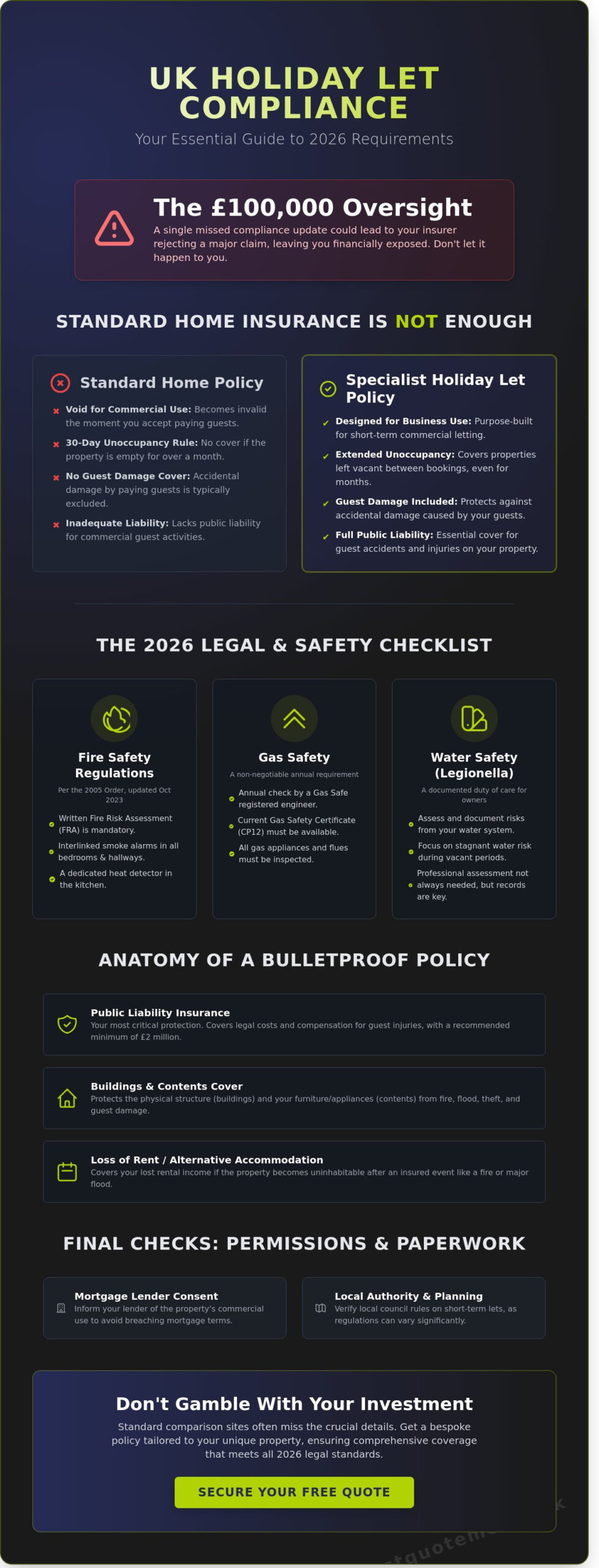
Holiday let insurance is a specialist product designed for properties rented out to short-term, paying guests. While you might assume your standard home insurance provides enough cover, the reality is different. Most standard policies become void the moment you begin commercial letting. This is because the risks associated with a holiday home differ significantly from a primary residence. Understanding holiday let insurance uk requirements is vital to ensure your investment stays protected against unique commercial threats.
A major sticking point in standard policies is the 30-day unoccupancy rule. Most domestic providers won’t cover a property if it’s left empty for more than 30 consecutive days. In the seasonal UK tourism market, properties often sit vacant during winter months or between bookings. Specialist cover removes this restriction, providing peace of mind year-round. There’s also the issue of accidental damage. Standard policies cover you and your family; however, they often exclude damage caused by paying guests. If a guest spills red wine on an expensive rug or damages a boiler, you need a policy that specifically accounts for third-party guests.
The Risk Profile of a Short-Term Rental
Short-term rentals face much higher footfall than private homes. A property might host 30 different groups in a single year, leading to rapid wear and tear that a standard home doesn’t experience. Unsupervised guests don’t always treat a property with the same care as an owner, increasing the likelihood of significant accidental damage. Legally, your liability shifts from “domestic” to “commercial” once you accept payment. This transition means you must adhere to stricter safety standards. For instance, the Landlord and Tenant Act 1985 outlines basic repair obligations that apply to many letting scenarios in England and Wales, highlighting the legal weight of your role as a landlord.
Standard Home Insurance vs Holiday Let Cover
You must disclose any “change of use” to your insurer immediately. If you start letting your property on platforms like Airbnb without telling your current provider, you’re practicing “silent” non-disclosure. This is a dangerous gamble. In the event of a fire or flood, the insurer can legally refuse to pay the claim and cancel the policy entirely. While some owners look at residential letting insurance for long-term tenants, holiday lets require a different approach due to the high turnover of guests. Ensuring your holiday let insurance uk requirements are met by a specialist broker ensures you have the correct public liability and buildings cover for a genuine commercial venture.
The 2026 Compliance Checklist: Legal Requirements for UK Holiday Lets
Staying compliant with UK law is the only way to ensure your property remains insurable. If a claim arises and you cannot produce the required safety certificates, your provider may refuse to pay out. Understanding holiday let insurance uk requirements starts with recognizing that your property is viewed as a commercial business, not a standard residential home. This distinction brings rigorous safety standards that must be met before you welcome your first guest.
Legionella risk assessments have become a standard requirement for holiday let owners. Under the Health and Safety at Work Act 1974, you have a legal duty to identify and assess sources of risk in your water system. While you don’t always need a professional to carry this out, you must document a simple assessment to show you’ve considered the risks of stagnant water in pipes or showerheads, especially during vacant periods between bookings.
Fire Safety and the “Small Paying Guest Accommodation” Guide
The Regulatory Reform (Fire Safety) Order 2005 saw significant updates on 1st October 2023. It’s no longer enough to have a verbal plan; every holiday let must have a written Fire Risk Assessment (FRA) regardless of the size of the property. This document must be updated regularly and reflect any changes to the building layout or occupancy limits. For detailed guidance on these obligations, refer to the UK Government Holiday Let Regulations to ensure your property meets the current statutory standards.
Your fire safety setup must include interlinked smoke alarms in all circulation spaces and bedrooms, along with a heat detector in the kitchen. This ensures that if a fire starts in one room, every alarm in the house sounds simultaneously. By 2026, owners are legally obligated to ensure all doors leading to escape routes are fire-rated to a minimum of 30 minutes (FD30S) to provide adequate protection for guests. Failure to install these fire-rated doors can lead to prosecution and will almost certainly void your insurance policy.
To ensure your property is fully protected and meets these technical standards, Quartz Empire Fire & Security Ltd offers professional installation and ongoing maintenance for fire alarm and security systems, helping you maintain the necessary safety records for your insurer.
Gas and Electrical Certification
Gas safety is non-negotiable. You must obtain an annual Landlord Gas Safety Record, often called a CP12 certificate. This check must be performed by a Gas Safe registered engineer who inspects all gas appliances, flues, and pipework. Insurers demand copies of these certificates before settling claims involving fire or carbon monoxide poisoning, so keep your digital records organized.
Electrical safety is split into two distinct areas. First, you need an Electrical Installation Condition Report (EICR) every five years to check the fixed wiring of the property. Second, you should conduct Portable Appliance Testing (PAT) annually for guest items like kettles, toasters, and hair dryers. While PAT testing isn’t a strict legal requirement for all small lets, most holiday let insurance uk requirements specify it as a condition of coverage to mitigate the risk of electrical fires. If you’re looking for a policy that understands these nuances, you can Just Quote Me to see how our specialist cover fits your specific compliance needs.
Essential Insurance Coverages: What Your Policy Must Include
Securing a property for short-term guests involves more than just a standard landlord policy. To satisfy the specific holiday let insurance uk requirements, your coverage needs to be tailored to the unique risks of the tourism industry. A robust policy acts as a safety net for both your physical asset and your financial stability. Without the right layers of protection, a single accident could jeopardise your entire investment.
- Public Liability: This protects you if a guest or visitor is injured on your property. Claims for serious accidents can be substantial, often reaching six or seven figures.
- Buildings and Contents: This covers the structure and everything inside, from the sofa to the kitchen appliances, against fire, flood, and storm damage.
- Loss of Rental Income: If a major incident like a burst pipe makes the property unbookable, this replaces the lost revenue so you can still meet your mortgage payments.
- Legal Expenses: This provides access to legal professionals for disputes over contracts, guest evictions, or tax enquiries.
Public Liability: How Much is Enough?
While £2 million is often the entry-level limit for many insurers, many owners now opt for £5 million to ensure total peace of mind. If a guest suffers a life-changing injury, such as a fall down stairs resulting in permanent disability, compensation costs and legal fees can quickly escalate beyond the lower limit. You’ll find that some booking agencies and local authorities insist on the higher £5 million figure as a prerequisite for listing. For a detailed breakdown of how these protections work, you can read more about public liability insurance here.
Accidental Damage and Malicious Damage
It’s vital to distinguish between a genuine accident and intentional harm. Accidental damage covers incidents like a guest spilling red wine on an expensive rug or smashing a glass hob. Malicious damage covers intentional vandalism or damage caused by a party that got out of hand. You should also verify that your policy includes “theft by guest.” Most standard policies only pay out if there’s evidence of forced entry, but in a holiday rental, the guest has been handed the keys. This is a common gap in generic policies that can leave owners out of pocket. Remember that insurance isn’t a maintenance contract. Gradual wear and tear, such as a worn carpet in a high-traffic hallway or a sagging mattress, won’t be covered by any insurer as these are considered standard costs of doing business.
By ensuring these core elements are included, you meet the fundamental holiday let insurance uk requirements and protect your cash flow. We focus on providing straightforward advice so you don’t end up with expensive gaps in your coverage.
Financial and Planning Requirements for Holiday Lettings
Operating a short-term rental involves more than just listing on a booking site. You must satisfy specific financial and legal obligations to stay compliant. Chief among these is your mortgage agreement. Most standard residential mortgages prohibit short-term letting. If you ignore this, you risk a breach of contract, which can lead to the lender calling in the full loan immediately. Transitioning to a specialist holiday let mortgage is essential for any property intended for guest use.
The Health and Safety Executive (HSE) also maintains strict oversight. Under RIDDOR (Reporting of Injuries, Diseases and Dangerous Occurrences Regulations), you’re legally required to report specific accidents involving guests if they’re taken to hospital directly from your premises. Failing to keep these records doesn’t just invite fines; it can also invalidate your insurance policy during a claim.
Securing Lender Approval
Lenders require proof that your asset is protected before they approve a mortgage application. They’ll look for specific holiday let insurance uk requirements to ensure the policy covers public liability and potential loss of rent. If your property is part of a mixed-use building, such as a flat above a retail unit, you might need commercial property insurance to satisfy your lender’s criteria. We help you align your coverage with these financial mandates so your investment remains secure.
Local Authority and Licensing
The UK government is tightening rules around property usage to protect local housing stocks. In April 2024, the government introduced new planning classes: C3 for permanent residences and C5 for short-term lets. You may need formal planning permission to move between these classes depending on your local council’s “Article 4” directions. Regional rules vary significantly; for instance, the London 90-day rule prevents you from letting a property for more than 90 nights a year without specific permission.
Taxation is another hurdle. To qualify for business rates instead of council tax, your property must be available to let for at least 140 days and actually let for at least 70 days per year. New regulations effective from April 2026 will further tighten the tax benefits for furnished holiday lets (FHLs). Holding the correct license is now a fundamental part of holiday let insurance uk requirements. Many underwriters won’t provide cover if you don’t comply with the national registration scheme or local licensing laws.
How to Choose a Bespoke Holiday Let Policy with Just Quote Me
Meeting holiday let insurance uk requirements isn’t always as simple as clicking a button on a comparison site. While automated platforms work for standard homes, they often fail to account for the complexities of short-term rentals. Just Quote Me provides a human-centric alternative. With 30 years of specialist UK expertise, we understand that a coastal cottage in Cornwall has different needs than a city-centre apartment in Birmingham. We don’t rely on basic algorithms that might leave you underinsured when you need protection the most.
- Independent Advice: We aren’t tied to one provider, which means we search the market to find the right fit for your specific risk.
- Expert Knowledge: We’ve spent three decades refining our approach to UK property risks and liability.
- Time-Saving: Our team does the heavy lifting, so you don’t have to spend hours deciphering complex policy wording.
Specialist Property Considerations
Unique properties require specific attention to detail. If you’re insuring a thatched property, insurers often insist on strict fire safety conditions. These might include specific chimney sweeping schedules or mandatory electrical certifications every five years. Our deep experience with thatched pub insurance gives us the heritage expertise needed to protect these high-value, high-risk buildings correctly.
There’s also a significant difference between a whole-house rental and a guest house setup. If you’re providing breakfast or have staff on-site, your public and employers’ liability needs change instantly. We help you distinguish between standard holiday lets and hotels and guest house insurance to ensure your policy covers every guest interaction and staff requirement. It’s about ensuring your holiday let insurance uk requirements are met without paying for cover you don’t actually need.
The Personal Touch in Insurance
Algorithms can’t spot the nuances of a listed building or a property located in a flood-prone coastal area. A human broker understands these risks and can negotiate better terms with underwriters on your behalf. This personal touch is becoming even more vital as the UK moves toward the 2026 regulatory changes. With the government planning tighter controls on short-term lets and mandatory registration schemes, having a broker who stays ahead of the law is a massive advantage.
We believe in a no-nonsense approach to insurance. You won’t be stuck in a loop of automated menus or chatbots. Instead, you’ll speak to a specialist who knows the UK market inside out. We make sure your policy is tailored to your specific property risk, whether it’s a modern barn conversion or a historic townhouse. Don’t leave your investment to chance with a generic policy that might fail during a claim. Just Quote Me for your holiday let insurance today and get the professional, straightforward protection your property deserves.
Secure Your Property for the 2026 Regulatory Shift
Navigating the 2026 compliance landscape requires a proactive approach to safety standards and financial planning. As the UK short-term rental market evolves, meeting holiday let insurance uk requirements is about more than just ticking a box; it’s about protecting your investment from risks like public liability claims or sudden loss of rental income. You’ve seen that standard home insurance won’t cover commercial guests, making a specialist policy essential for your legal and financial security.
At Just Quote Me, we simplify this process by doing the heavy lifting for you. With over 30 years of UK insurance brokerage experience, our FCA-authorised experts provide the steady hand you need in a complex market. We offer access to a wide panel of leading UK underwriters to ensure your policy is tailored specifically to your property’s needs. We’re here to help you move from inquiry to full protection quickly and without the jargon. Don’t leave your compliance to chance when you can secure professional, straightforward cover today.
Get a Bespoke Holiday Let Insurance Quote
We look forward to helping you protect your holiday let business for years to come.
Frequently Asked Questions
Is holiday let insurance a legal requirement in the UK?
No, holiday let insurance isn’t a legal requirement in the UK, but your mortgage lender will almost certainly insist on it. Most UK buy-to-let or holiday-specific mortgages include a clause requiring specialist cover to protect their investment. Standard home insurance won’t satisfy these holiday let insurance uk requirements. Without it, you risk breaching your mortgage contract and being personally liable for any claims.
Can I use Airbnb if I only have standard home insurance?
You shouldn’t rely on standard home insurance for Airbnb hosting because most policies explicitly exclude business activities. If you host guests without specialist cover, your insurer can void your entire policy. While Airbnb provides “AirCover,” it’s often seen as a secondary safety net rather than a comprehensive solution. A bespoke policy ensures you’re protected for theft, accidental damage, and liability that standard domestic plans ignore.
What happens if a guest is injured at my property and I don’t have insurance?
You’ll be personally responsible for legal fees and compensation costs if a guest is injured and you lack cover. According to the Health and Safety Executive (HSE), property owners must ensure a safe environment. Personal injury claims for slips or falls can quickly reach £50,000 or more. Without public liability insurance, your personal assets, including your home or savings, could be at risk to settle these legal debts.
Do I need a separate policy for a garden room or annexe used as a holiday let?
You must inform your insurer about any garden room or annexe used for guests to ensure it’s included in your coverage. Most standard policies treat outbuildings as storage rather than living spaces. If the annexe is a self-contained unit with its own kitchen and entrance, it requires specific commercial protection. We’ll help you structure a single policy that covers both the main residence and the additional holiday unit.
How does the “Loss of Rent” cover work for holiday lets?
Loss of rent cover compensates you for the income lost if your property becomes uninhabitable due to a claimable event like a flood or fire. This protection typically covers the period while repairs are carried out. It’s based on your previous booking history or projected earnings. For many owners, this is vital for maintaining mortgage payments during a period when the property can’t be occupied by guests.
Does holiday let insurance cover my property when it is empty during the winter?
Specialist policies cover periods when the property is empty, provided you follow specific unoccupancy conditions. These often include maintaining a minimum temperature of 12°C or draining the water system during the winter months from November to March. Standard home insurance often limits cover after 30 days of vacancy. Our holiday let insurance uk requirements guide ensures you understand these clauses to keep your protection active year-round.
What safety certificates must I provide to my insurance company?
You’ll need to provide an annual Gas Safety Certificate and an Electrical Installation Condition Report (EICR) every five years. The Fire Safety Order 2005 also requires a written Fire Risk Assessment for all short-term lets in England and Wales. Insurers require these documents to prove you’re meeting UK safety regulations. Failing to keep these certificates up to date can lead to a claim being rejected if an incident occurs.
Is public liability insurance included in holiday let policies by default?
Public liability insurance is a standard feature of most holiday let policies, usually providing cover between £2 million and £5 million. It protects you against claims from third parties for injury or property damage occurring at your premises. This is a core part of the specialist cover we provide. It offers peace of mind that you won’t face financial ruin if a guest has an accident during their stay.
