

If a burst pipe or electrical fire makes your property uninhabitable tomorrow, do you know exactly which policy keeps your mortgage payments on track while the builders are on site? Many UK landlords mistakenly believe that any missed payment is covered by a single policy, but the wrong choice can leave you facing a monthly shortfall of £1,000 or more. It’s a high-stakes gamble, especially as the 2025 Renters’ Rights Act continues to reshape the legal landscape for property owners.
We understand that your rental income isn’t just profit; it’s the foundation of your financial security. This guide explores the critical role of loss of rent insurance for landlords uk, specifically highlighting the differences between damage-related claims and tenant default. You’ll discover how to handle the complexities of 2026 regulations to ensure your cash flow remains protected against every eventuality. We’ll break down the specific coverage triggers and provide a straightforward roadmap to choosing the right protection for your portfolio.
Key Takeaways
- Understand the vital distinction between loss of rent and rent guarantee insurance to ensure your income is protected against both property damage and tenant arrears.
- Navigate the impact of the Renters Rights Act 2025 and learn why comprehensive loss of rent insurance for landlords uk is essential in the new legislative landscape.
- Discover how to accurately calculate your Gross Rental Income and select the appropriate indemnity period to prevent financial shortfalls during lengthy repairs.
- Identify the specific “insured perils” that trigger a claim and how insurers define a property as “uninhabitable” in the current UK market.
- Learn the advantages of using a specialist broker to secure bespoke landlord cover that offers tailored protection for individual properties or entire portfolios.
Understanding Loss of Rent Insurance in the 2026 UK Market
Landlords entering 2026 face a complex economic environment. While property remains a solid asset, the risk of income interruption has never been higher. Loss of rent insurance for landlords uk serves as a financial safety net when a property becomes uninhabitable due to an insured event, such as a fire, flood, or significant storm damage. It isn’t just about protecting profit. For many, it’s about survival. When the rent stops coming in, your mortgage lender still expects their payment on the first of the month.
The 2026 market is defined by volatility. Repair costs for UK properties rose by 4.2% in the last year alone, and lead times for specialist contractors remain extended. If a kitchen fire renders your flat unliveable, you might face six months of repairs. Without specific cover, you’re forced to cover the mortgage from your personal savings. Just Quote Me focuses on bridging this gap with clear, no-nonsense advice that keeps your portfolio’s cash flow intact during a crisis.
Loss of Rent vs. Rent Guarantee: The Vital Difference
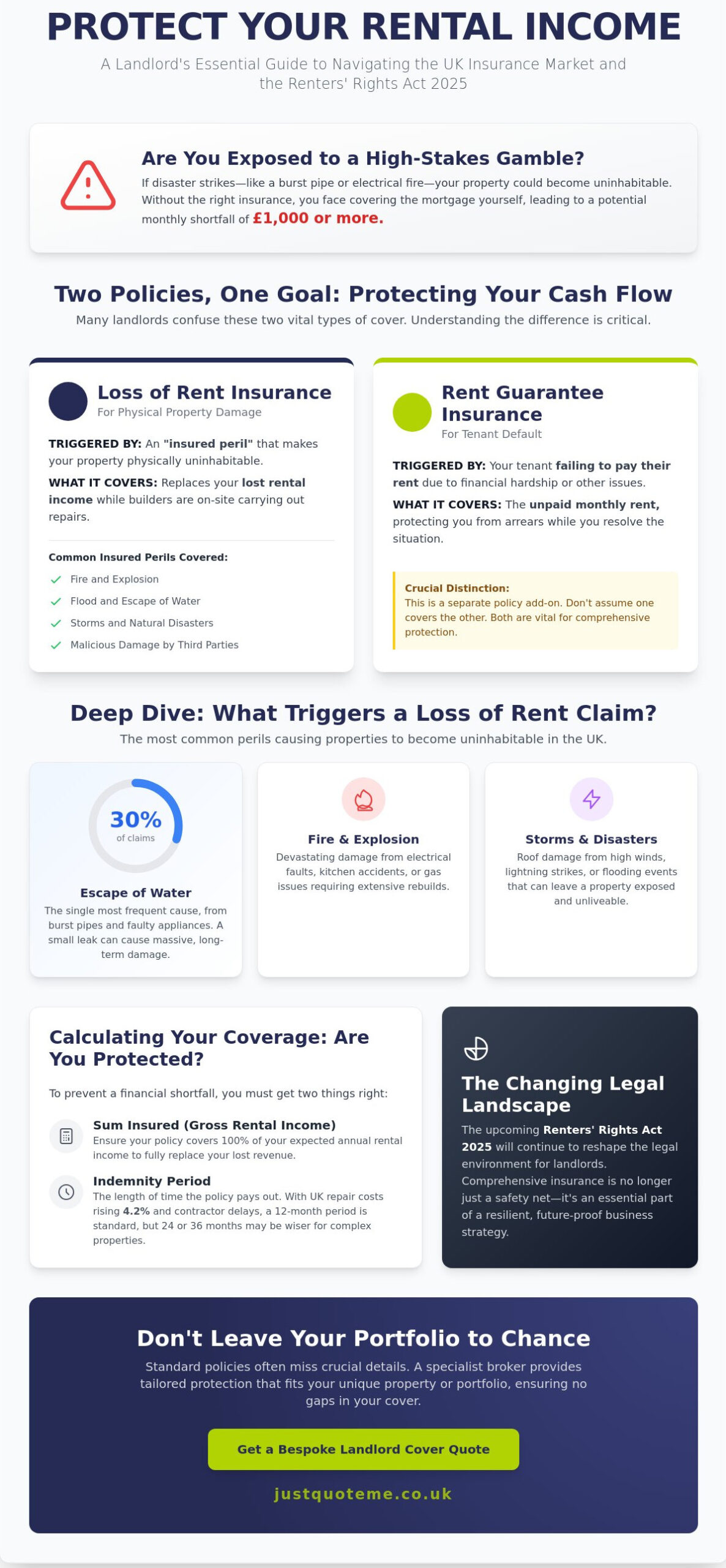
It’s easy to mix these terms up, but the distinction is critical for your balance sheet. Loss of rent is triggered by physical damage to the structure. If a January storm rips tiles from the roof and causes internal flooding, your policy pays the lost income while the building is repaired. In contrast, Rent Guarantee Insurance covers you if a tenant defaults on their payments due to financial hardship. Most comprehensive residential letting insurance plans offer these as separate add-ons. You shouldn’t assume one covers the other.
Who Needs This Protection Most?
High-geared buy-to-let investors are at the top of the list. With mortgage rates remaining significantly higher than the 2010-2020 average, there’s very little “fat” in the monthly budget to absorb a total loss of income. Commercial property owners also face unique risks, especially if they have long-term lease structures that could be voided by a property becoming unusable for an extended period. A damaged warehouse or shop doesn’t just stop rent; it can disrupt an entire supply chain.
We see a high concentration of risk among portfolio owners in Staffordshire and the West Midlands. Managing multiple units across these regions means a higher statistical chance of an incident. Whether you’re letting out a single terrace in Stoke-on-Trent or a commercial unit in Birmingham, loss of rent insurance for landlords uk ensures that a single pipe burst doesn’t bring down your entire business model. Our team understands these local nuances and helps you find the right fit quickly. We believe in providing a human touch that automated algorithms simply can’t match.
What Exactly Does a Loss of Rent Policy Cover?
Loss of rent insurance for landlords uk isn’t a standalone product; it’s a vital extension that works alongside your buildings insurance. It acts as a financial bridge when a property shifts from being a source of income to a liability. While your commercial property insurance pays for the physical repairs to the bricks and mortar, loss of rent cover replaces the money that should’ve landed in your bank account while those repairs take place.
The Standard Insured Perils
For a claim to be valid, the loss of income must result from a specific “insured peril.” These are defined events that cause physical damage to the property. Insurers don’t cover general rental arrears or tenants who simply stop paying; they cover the fallout from physical disasters. Common perils include:
- Fire and Explosion: Significant damage from fires or gas explosions that require long-term renovation.
- Flood and Escape of Water: These are the most frequent UK claims. According to 2024 industry data, escape of water from burst pipes accounts for nearly 30% of all domestic property claims in Britain.
- Natural Disasters: Coverage for lightning strikes and earthquake damage.
- Third-Party Malice: Impact damage from vehicles or malicious damage caused by vandals (though damage by the tenants themselves often requires a specific policy add-on).
Having Loss of Rent Cover is frequently a mandatory requirement for UK buy-to-let mortgage providers. They want to ensure your loan repayments remain consistent even if the building is empty for six months due to a flood.
The “Uninhabitable” Threshold
In 2026, loss adjusters use strict criteria to determine if a tenant must vacate. A property doesn’t need to be reduced to rubble to trigger a claim, but it must fail basic safety and living standards. If a kitchen is damaged but the rest of the flat is functional, the insurer might only pay for a partial loss of rent. However, if the damage is structural or affects essential utilities, it’s a total loss scenario.
In a standard UK policy context, a property is deemed uninhabitable if it lacks essential services like running water, sanitation, or heating, or if structural damage presents a verified risk to the occupants’ safety.
Many policies also include coverage for alternative accommodation. In this scenario, your tenant continues to pay you rent, but your insurer pays for them to stay in a hotel or a comparable rental property. This keeps the tenancy agreement active and prevents you from losing a good tenant during the repair process. If you aren’t sure if your current level of protection is sufficient, you can compare residential letting insurance options to find a better fit for your portfolio.
Rent Guarantee & The Renters Rights Act 2025 Impact
The Renters’ Rights Act 2025 represents the most significant shift in the UK private rented sector for decades. By abolishing Section 21 “no-fault” evictions, the government has fundamentally changed how landlords must manage their properties. You can no longer end a tenancy without a specific legal reason. This change makes loss of rent insurance for landlords uk more than just a safety net; it’s now a core part of a risk management strategy. If a tenant stops paying, the legal route to regaining possession is often slower and more complex under the new Section 8 grounds.
Landlords face longer wait times for court dates and stricter evidence requirements. Understanding the distinction between loss of rent and rent guarantee insurance is vital for staying protected. While standard loss of rent covers income lost due to property damage like fire or flood, rent guarantee specifically addresses tenant default. With the 2025 legislation making it harder to remove non-paying tenants quickly, having a policy that covers your mortgage payments during a legal dispute is essential for maintaining your cash flow.
Protecting Income Against Tenant Default
Rent guarantee policies step in the moment a tenant falls into arrears. These policies typically pay the monthly rent for a set period, often up to 12 months, while you work through the eviction process. It’s a logical addition to your residential letting insurance, providing a comprehensive shield against both physical property damage and financial default. Most insurers require a high standard of tenant referencing to validate your cover. This usually involves a credit check, employment verification, and a reference from a previous landlord. If you skip these steps, you might find your claim rejected when you need it most.
Legal Expenses and Eviction Support
The cost of regaining possession can escalate quickly. Solicitor fees, court costs, and bailiff charges often run into thousands of pounds. A robust insurance policy covers these legal expenses, ensuring you don’t have to drain your savings to enforce your rights. By 2026, many insurance providers will update their terms to include mandatory mediation costs. This aligns with new court requirements designed to settle disputes before they reach a full hearing.
- Solicitor Fees: Coverage for specialist legal representation to navigate complex Section 8 proceedings.
- 24/7 Legal Helpline: Immediate access to expert advice to prevent small disagreements from becoming full-scale legal battles.
- Mediation Support: Funding for independent mediation, which is set to become a standard requirement for 2026 possession cases.
Securing loss of rent insurance for landlords uk ensures that your business remains viable even when the legal landscape shifts. It provides the professional support needed to handle difficult tenants without the emotional and financial strain of going it alone. Just Quote Me can help you find a policy that meets these new legislative standards, giving you a steady hand in a changing market.
Calculating Your Coverage: Indemnity Periods and Sums
Calculating the right level of loss of rent insurance for landlords uk starts with an accurate assessment of your Gross Rental Income. This figure represents the total amount of rent you expect to receive before any expenses, such as mortgage payments or management fees, are deducted. If your monthly rent is £1,200, your annual sum insured needs to be at least £14,400. Many landlords make the mistake of only insuring the profit, but you’ll still have fixed costs to cover if the building becomes uninhabitable.
Under-insurance is a frequent trap that leads to reduced payouts. If you tell your insurer your rental income is £15,000 but it’s actually £20,000, you’re 25% under-insured. In the event of a claim, the insurer might apply the “Condition of Average,” meaning they’ll only pay 75% of your lost rent. You’ve got to be precise with these figures to ensure your financial security isn’t compromised when you need it most.
Selecting the Right Indemnity Period
The indemnity period is the maximum length of time your insurer will pay out for lost rent. While a 12-month period might seem sufficient, it rarely covers major incidents like a total loss fire or severe flood. According to 2023 industry data, rebuilding a property in the UK often takes between 18 and 24 months. You must factor in debris removal, architect plans, and the UK planning permission process, which typically takes 8 to 13 weeks for standard applications but can stretch much longer for complex sites. Your indemnity period should always exceed the worst-case repair time to ensure you aren’t left paying the mortgage out of pocket while the property is still a shell.
Avoiding Claim Rejection
Insurers expect you to be proactive with property care. They won’t pay out if the loss of rent is caused by gradual deterioration or a clear lack of basic upkeep. You’ll need to provide clear documentation to support a claim, such as current Assured Shorthold Tenancy (AST) agreements and up-to-date rent ledgers. Without these, proving the exact loss becomes a difficult and lengthy process.
Safety standards also play a massive role in claim approval. Ensuring your gas and electrical safety certificates are current doesn’t just keep you legal; it protects your policy. This is where public liability insurance overlaps with property management. If a tenant is injured due to poor maintenance, you face both a liability claim and a potential rejection of your rent loss claim. Keeping your property in good repair is your best defense against a denied payout.
Ready to secure your rental income with expert advice? Contact Just Quote Me today for a straightforward, professional insurance solution.
Securing Bespoke Landlord Cover with Just Quote Me
Securing the right loss of rent insurance for landlords uk requires more than a simple comparison site search. Property portfolios often involve unique risks that standard policies overlook. As an independent broker with over 30 years of industry experience, Just Quote Me bridges the gap between complex property needs and competitive market rates. We tap into a broad network of top UK insurers, ensuring you don’t pay for unnecessary extras while maintaining robust protection for your rental income. Our independence is your advantage; we work for you, not the insurance companies.
The Personal Touch in a Digital World
Automated algorithms frequently struggle with complex property risks, such as mixed-use buildings or portfolios with varying tenancy types. These digital tools often default to higher premiums or refuse cover entirely when a situation doesn’t fit a pre-set box. We take a different approach. Based in Staffordshire and serving the West Midlands, our team applies local expertise to every application. Our commitment to the “Just Quote Me” philosophy means we strip away the jargon and provide a straightforward, human-centric service. We handle the heavy lifting, negotiating directly with underwriters to find the most efficient solution for your specific circumstances.
Next Steps for Your Property Protection
To secure your 2026 income and beyond, you’ll need to prepare specific documentation. Start by gathering your current rental figures, property rebuild values, and tenancy agreements. If you employ staff for maintenance or administration, it’s vital to consult on additional protections. You should consider employers liability insurance to meet your legal obligations and protect your workforce. Having these details ready allows us to build a more accurate profile of your business.
When you’re ready to proceed, our process is designed to be fast and logical. You won’t be stuck in a phone queue or forced to fill out endless, repetitive forms. Instead, we focus on the essentials:
- Provide your property portfolio details and total annual rental income.
- Discuss any specific concerns, such as long-term void periods or malicious damage.
- Receive a tailored quote that consolidates your loss of rent insurance for landlords uk into one manageable policy.
Don’t leave your financial stability to chance. Request your bespoke quote today and experience the clarity of a professional, no-nonsense insurance partnership. We’re here to ensure your investment remains profitable, regardless of what the future holds.
Protecting Your Rental Income in 2026 and Beyond
Navigating the UK rental market in 2026 requires more than just finding the right tenants. With the full implementation of the Renters’ Rights Act 2025, landlords face a regulatory landscape that demands robust financial protection. Securing comprehensive loss of rent insurance for landlords uk ensures that your property investment remains viable even when unexpected damage makes your building uninhabitable. It’s about more than just a policy. It’s about choosing the correct indemnity period to cover the time it actually takes to rebuild or repair. At Just Quote Me, we bring over 30 years of industry experience to the table. As an FCA-authorised independent broker, we provide access to top-tier UK insurance panels to find coverage that fits your specific portfolio. Don’t leave your rental income to chance when the market shifts. Get Your Bespoke Landlord Insurance Quote from Just Quote Me. We’re here to help you secure your future with a straightforward, no-nonsense approach to protection.
Frequently Asked Questions
Is loss of rent insurance a legal requirement for UK landlords?
Loss of rent insurance isn’t a legal requirement under UK law. However, most buy-to-let mortgage lenders make this cover a mandatory condition of your loan agreement. They require this protection to ensure you can still meet your mortgage repayments if a fire or flood makes the property uninhabitable for your tenants. Without it, you’re personally responsible for those monthly costs even if your income stream disappears overnight.
What is the difference between loss of rent and rent guarantee insurance?
Loss of rent insurance covers your income specifically when a property is damaged by an insured event, such as a fire or a burst pipe. Rent guarantee insurance is different because it protects you if a tenant stays in the property but stops paying their rent. It’s important to choose loss of rent insurance for landlords uk if you want to protect against physical damage, as rent guarantee won’t pay out for structural issues that force a tenant to move out.
How long does an indemnity period need to be for a residential property?
Your indemnity period should ideally be at least 24 months to account for potential planning delays and modern construction timelines. While many basic policies offer 12 months, data from the Association of British Insurers indicates that major structural repairs often take longer than a year to complete. A 36-month period is even safer for older properties or complex buildings, providing a vital buffer while you wait for the property to be fully restored and re-let.
Can I claim loss of rent if my property is only partially damaged?
You can claim for partial damage if the incident makes the property legally uninhabitable or prevents the tenant from using essential areas. If a kitchen fire makes the home unusable, your policy triggers even if the rest of the house is fine. The insurer pays the proportion of rent lost while those specific repairs are carried out. You’ll need to prove the damage was caused by a peril listed in your policy, such as impact or water escape.
Does loss of rent insurance cover periods when the property is naturally vacant?
Standard policies don’t cover natural rental voids or gaps between different tenancies. This insurance is designed to replace income lost due to physical damage from unexpected events like storm damage or vandalism. If your property is empty because a lease ended and you haven’t found a new tenant yet, you’ll need to cover those costs yourself. It’s a business risk that insurers view as separate from physical property damage claims.
Will my insurance cover legal fees for evicting a non-paying tenant?
Loss of rent cover doesn’t typically include legal fees for evictions unless you’ve specifically added Legal Expenses protection to your policy. These are separate products designed to handle the costs of regaining possession of your property through the court system. We recommend checking your policy schedule for these extras, as legal costs for a standard eviction in the UK can often exceed £1,500 depending on the complexity of the case.
How has the Renters Rights Act 2025 affected rent protection claims?
The Renters Rights Act 2025 has abolished Section 21 “no-fault” evictions, which means landlords must now provide specific grounds for possession. This change has increased the average time it takes to regain a property, making loss of rent insurance for landlords uk more important than ever. With court processes potentially taking longer under the new rules, having a robust policy helps bridge the financial gap while you navigate the updated legal framework and mandatory ombudsman requirements.
Can I add loss of rent cover to an existing landlord insurance policy?
You can usually add this cover to your existing policy by requesting a mid-term adjustment from your insurance provider. Most brokers allow you to tailor your protection at any point during the year, though it’s often simplest to bundle it during your annual renewal. We can help you integrate this into a bespoke package that includes buildings and liability cover, ensuring there are no gaps in your protection that could leave you out of pocket.
